Portuguese


MIT researchers developed self-aligning blocks that simpler robots can assemble. Prototypes include an experimental house, and a study estimates up to an 82% reduction in the carbon footprint of materials.
A team at the Massachusetts Institute of Technology (MIT) in the United States has built structures from small hollow pieces that fit together much like building blocks. The key is who does the work: low-cost robots that can miss their target position by about a centimeter can place the blocks without compromising the alignment of the overall structure.
The research, led by engineer Miana Smith, has progressed from tabletop prototypes to room-scale structural demonstrations, including a small experimental house. An article published by MIT on November 18, 2026, details how the shape of the blocks could reduce reliance on precision industrial machinery for construction.
Hollow pieces correct positioning errors before they accumulate
The components, called voxels, form a three-dimensional lattice with connections that mechanically lock into place. Rather than requiring a machine to position each piece at exact coordinates, the block’s geometry helps guide it into the correct position as the pieces fit together.
-
Caio Martins Stadium Stands Set for Demolition on Nov. 24 as R$381.8 Million Project Plans Reservoir of More Than 102 Million Liters Beneath Field in Niterói

-
Gateway CEO Tom Prendergast says a second tunnel boring machine with a 28-foot cutterhead has started on the $16 billion Hudson Tunnel, so both new rail tubes under New Jersey’s Palisades are now being dug at once.

-
After more than 20 years out of service, a 54-meter elevator inside a Paraná sinkhole reaches 92% completion on R$15 million restoration and prepares to welcome visitors in Ponta Grossa

-
Iguatemi and Catuaí announce R$1 billion Four Seasons complex in São Paulo, with 26 stories, a 104-room hotel and a 1,200-square-meter penthouse near Avenida Faria Lima


The principle is similar to Lego bricks: assembly can be done without millimeter-level precision because the object itself provides physical guides that prevent successive deviations. In the MIT prototypes, the connections were designed to let the structure grow without losing its load-bearing capacity.
The robots in the study have a tolerance of about 10 millimeters, far greater than the precision of around 100 micrometers found in specialized industrial equipment. That difference makes less sophisticated machines viable for tasks that once required much more expensive sensors and actuators.
Robots costing hundreds of dollars take on tasks usually done by industrial machines
The small assembly robots used by the team are known as MILAbots, an acronym for modular robots that move across lattice structures. With grippers at their ends, they can attach themselves to the voxels, travel over the assembled surface and place new components in sequence.
A robot can position a block and press it into place to complete the connection. Similar machines can cost a few hundred dollars each, while ultra-high-precision industrial systems can cost tens of thousands of dollars.
The approach also changes the pace of the work. A single small robot may be slower, but multiple machines working in different areas can divide up the assembly task. A digital interface turns the structure’s design into positioning instructions for each machine.
Watch MILAbot robots assemble voxels in the MIT demonstration:
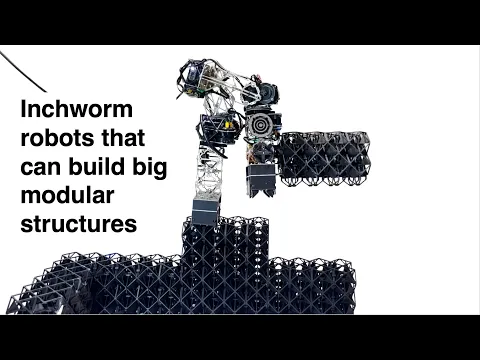

Experimental house shows blocks can form human-scale structures
The work was not limited to demonstration cubes. The team built structures capable of supporting room-scale loads, including a small experimental house made from wooden elements, with further outdoor testing planned as the research progresses.
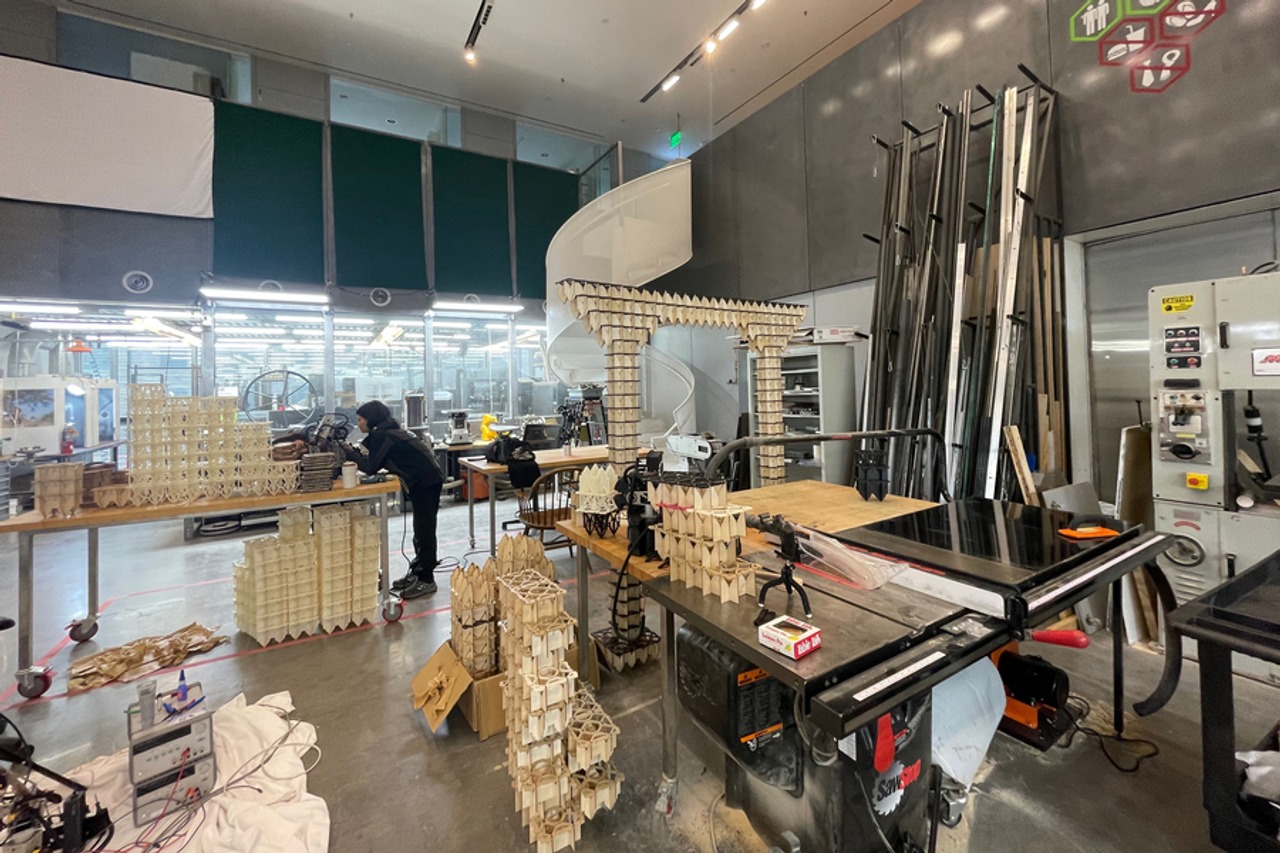
The experiments help test how the connections perform as the lattice grows from a few pieces into larger assemblies. The main challenge is maintaining stiffness, strength and alignment as the number of modules and connection points increases.
The demonstration is still an experimental system. A home ready for occupancy would require assessments of thermal insulation, fire resistance, durability, electrical and plumbing systems, and performance under lateral loads such as wind. The group identified these as among the next steps.
Study found up to 82% less embodied carbon in some scenarios
In April 2026, an MIT technical study examined the feasibility of robotic assembly using voxels and compared material options. The authors assessed plastic, plywood and steel, considering the carbon associated with manufacturing the components and estimating the assembly of a simple, single-story building.
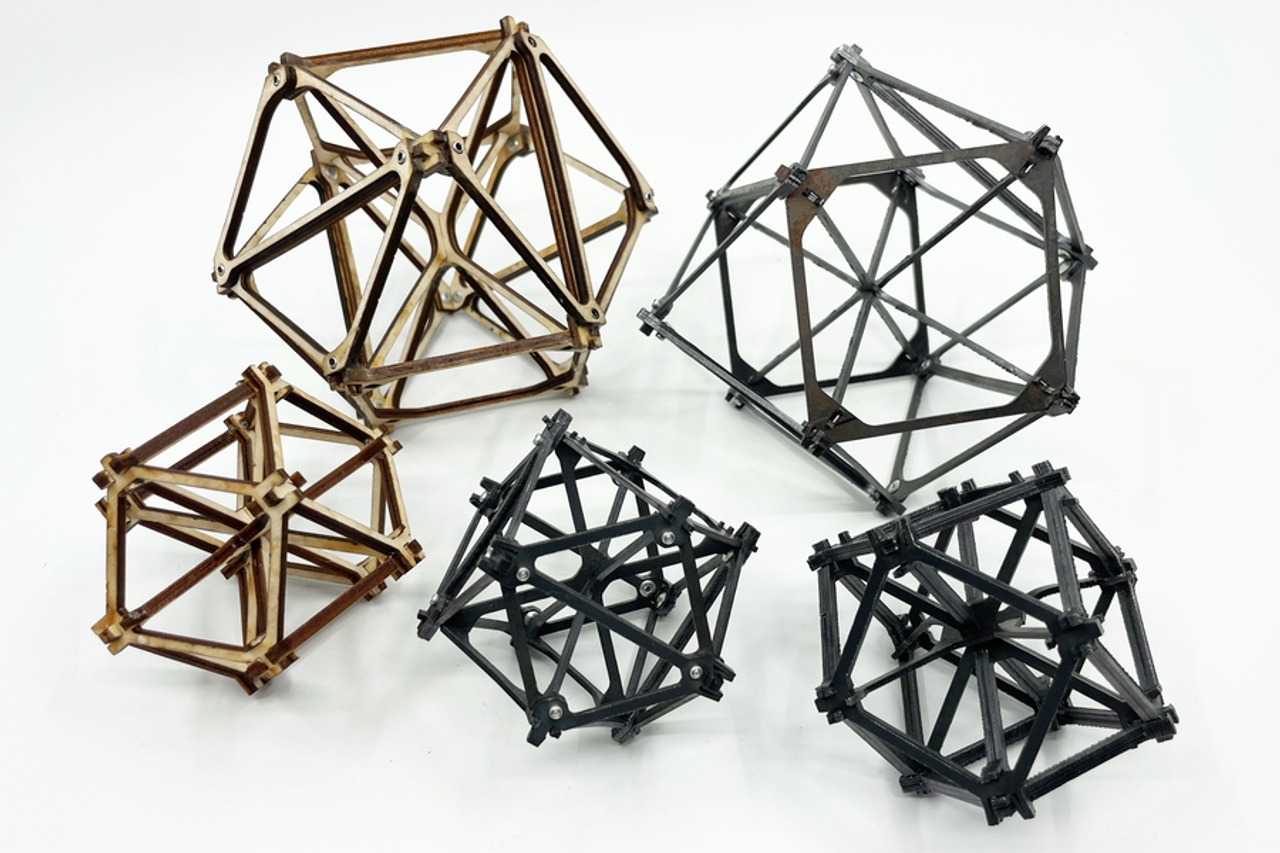
In simulations, some wood and steel configurations had an embodied-carbon footprint up to 82% lower than conventional methods used for comparison, including 3D-printed concrete and precast concrete. The advantage depends on the material and methodology used; the reduction is not guaranteed for every construction project or home.
The results were particularly favorable for plywood. The plastic voxels evaluated were less environmentally competitive in some scenarios, while the steel and wood models offered greater potential to reduce emissions.
The group also estimated 99 hours of on-site assembly for configurations with teams of 20 robots, compared with an average of about 155 hours for the techniques analyzed. These figures are results of modeling and feasibility studies, not timelines demonstrated in a commercial residential construction project.
Larger blocks reduced a series of fragile connections
The first modules required as many as 24 connectors per unit, increasing the number of points prone to looseness and assembly difficulties. Smith began working with larger composite pieces and internal joints assembled before the robot arrived, reducing the number of connections that had to be made on-site.
The geometry evolved into a lattice with more rigid internal connections and joints that contribute to the structure’s strength. The researchers tested versions made of plywood, bio-based plastics, aluminum and steel, while retaining the modular assembly approach.
The ability to disassemble, rearrange and reuse components is one of the system’s ambitions: a structure could gain new modules or be reconfigured without requiring the entire assembly to be rebuilt.
Partnership with Bhutan is set to test the technology outside the lab
MIT is working with Bhutan’s Druk Holding and Investments on research tied to the Gelephu Mindfulness City urban development project. The plan is to expand testing at human scale, using digital fabrication equipment and locally available materials.
The next phase calls for outdoor demonstrations and stability studies. The team also plans to refine the digital instructions, integrate cladding and building systems, and coordinate the movements of different robots.
For the construction industry, the immediate value lies in demonstrating an alternative: components that absorb imperfections could allow simpler equipment to assemble complex structures. Economic viability and safety in buildings for everyday use will depend on further testing.
Could small robots assemble part of a house using reusable components? Readers can share their thoughts in the comments and share the article with others following technological change in the construction industry.