






 Portuguese
  Spanish


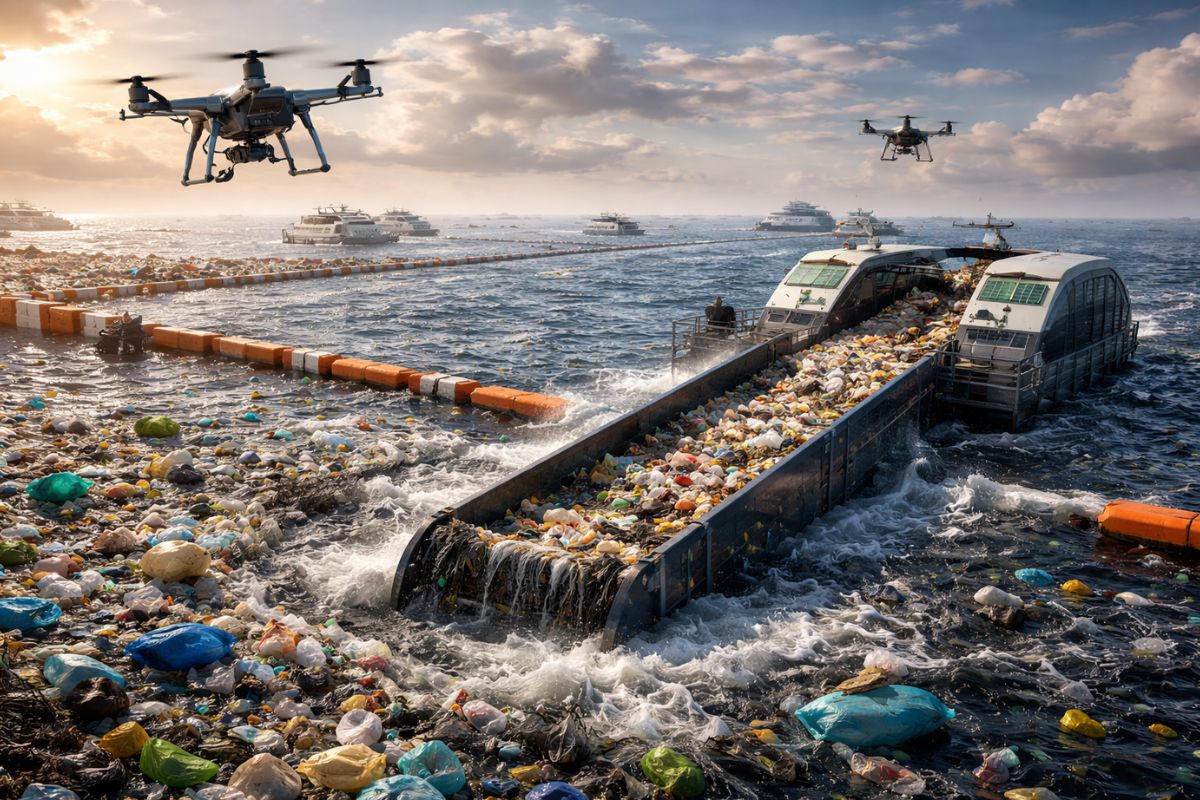


Between The USA And Hawaii, Trash Floats In An Area The Size Of Alaska And Twice The Size Of Texas, But The Photograph Hides Scattered Fragments, Microplastics And Impacts On More Than 800 Species; The Bet Combines Ocean Capture, River Interception And Humidity-Tolerant Hydrochemical Recycling.
The trash accumulating in the Pacific has become a symbol of a problem that seems simple to imagine and difficult to solve: a “carpet” of waste that, in practice, is a vast field of dispersed fragments, with large pieces, tiny particles, and microplastics that are already circulating in the food chain.
At the same time, the technological response begins to split into complementary fronts: ocean collection systems, interceptors in rivers to block the flow before reaching the ocean, and promises of recycling capable of handling dirty, mixed and wet plastic, precisely the type of waste that almost no one can utilize.
The Scale Of The Problem And Why The “Pacific Garbage” Tricks The Eye

When we talk about the “Pacific garbage,” the mental image is often of a continuous mass of bottles and bags. However, the reality described is different: the trillions of pieces are so scattered that, in many spots, it’s impossible to “see” the blot with the naked eye without actively looking for it.
-
Mother discovers she may have won £12 million in the lottery but faces an agonizing wait after the shopkeeper threw the ticket in the trash.

-
A couple bought a house in Sheffield and, when removing the carpet from the hallway, found a trapdoor leading to a secret 23 m² basement with a 2-meter ceiling height, a discovery that eliminated the need for an expensive extension and, according to them, added £70,000 to the property’s value.

-
A nurse bought for 20,000 a 1955 house abandoned by a hoarder in Texas, and months later, rain revealed a buried pool in the backyard valued at $160,000, which he restored himself for about $10,000, a fraction of the cost of building a new one.
-
The United Kingdom is transforming dog feces left on trails into gas to light a streetlamp through an unlikely and surprising project that shows how even one of the most rejected wastes in cities can generate energy.


The scale, nonetheless, is gigantic. The estimate presented is around 80 thousand tons floating between the USA and Hawaii, with something around 1.8 trillion pieces. On a planetary scale, this also helps to understand the cumulative effect: it was estimated to be about 200 pieces for every living human on Earth, just in this part of the Pacific.
This scenario is not limited to a single point on the map. There is an accumulation area in each of the five major oceanic regions, in addition to an even greater volume of tiny particles: tens of trillions of microplastics have been mentioned in the oceans, with impacts that already reach more than 800 species.
Why Collecting Trash In The Ocean Is So Difficult, Even With Large Barriers

The idea of using barriers to concentrate and extract waste from the ocean stems from a straightforward reasoning: if trash accumulates in certain areas, it’s possible to “sweep” what is floating. One cited example is a collection system with thousands of feet in length and dozens of feet in depth, designed to concentrate and remove plastics.
However, the collection rate exposes the size of the challenge. The NGO The Ocean Cleanup has a capacity of around 10 kg of trash per hour, which, in an open ocean with low waste density per area, makes sense: the problem is not just quantity, it’s dispersion. If fragments are scattered, collection becomes a long-duration operation, costly and logistically heavy.

Even when there is an optimistic goal of accelerating cleanup with multiple units, an inevitable mismatch arises: while planning to remove some of what has already accumulated, millions of new tons continue to enter the seas every year. In this equation, no matter how good ocean collecting is, it cannot close the gap alone.
This leads to a practical conclusion: removal at sea may be relevant, but tends to be insufficient if the influx continues. And then the focus shifts from “post-accumulation” to prevention at the source.
The Strategic Turn To Rivers: Interceptors And Capture Before The Ocean

The shift in focus comes from a diagnosis presented with numbers: if it is possible to intercept trash in highly polluting rivers, it can significantly reduce the amount reaching the ocean. The estimate is that blocking the flow in the thousand most polluting rivers could prevent up to 80% of the trash from reaching the sea.
In this front, interceptors come into play: floating barriers, nets, and autonomous systems that allow water to pass while retaining solids.
It was reported that there are already 21 interceptors operating in 10 rivers, with a record of about 21 thousand tons blocked before reaching the ocean. It’s a concrete gain, but also a reflection of the scale of ambition.
The scale jump is the sensitive point. If today the operation is in dozens, to reach a thousand rivers, the expansion would have to be of a much greater order of magnitude.

And, as in any physical system, merely increasing the number of units does not solve everything: demands for maintenance, logistics for removal, storage, and, mainly, the destination of the collected material arise.
This is where digital technology tends to enter as operational “glue.” AI and drones, cited as part of this new stage, can serve to identify hotspots, map critical points, monitor barriers, and prioritize sections where waste concentrates.

The gain is not in “miracles,” but in making better decisions about where to put effort, reducing waste of operation.
The Dilemma Of “What To Do With Collected Trash” And Why Recycling Is So Limited

Capturing trash is only half the journey. The question that stalls projects in the real world is simple: what to do with tons of mixed, degraded, and contaminated plastic? Burning, landfilling, or recycling are possible routes, but each carries an environmental, economic, and social cost.
Mechanical recycling, noted as the most widely used today, works well when the plastic is clean, dry, separated, and of high quality.
However, the real world delivers the opposite: moist, dirty, mixed waste, and multi-layered and composite materials that do not separate easily. Furthermore, an important technical effect: each mechanical cycle causes plastic to lose properties, becoming more fragile and less useful for demanding applications.
Chemical recycling exists precisely for what mechanical recycling cannot handle, but also faces limits. Varied mixtures and contamination complicate processes, and there is a risk of a high carbon footprint depending on the method.
In practice, this translates into an economic barrier: a significant portion of collected waste simply does not meet the purity standards required to turn into valuable raw material.
A symbolic example helps to understand the bottleneck: to produce a “recycled” product of good quality, it was reported that high-quality plastic was sought from a specific river, and still, the utilization was less than 1%, necessitating the addition of virgin plastic.
The message is harsh: without technology that accepts dirty waste, collection becomes a piling up of problems.
Hydrochemical Recycling And The Promise Of Utilizing Dirty Plastic That No One Wants

It is at this point that the proposal for hydrochemical recycling appears, presented as a route different from more well-known alternatives.
The described logic is to reduce the severity of the process by using lower temperatures and reactions in an aqueous environment to “cut” polymer chains in a controlled manner, transforming them into smaller chains of hydrocarbons.
In the technical highlights, a temperature operating range of 350 to 420 °C was cited, in contrast to processes operating above 500 °C.
This difference matters for two reasons: energy consumption and control of by-products. The idea of a “molecular scissors” based on water was also emphasized, with humidity tolerance, something that tends to be a bottleneck in other routes.
Another key point is the tolerance to contaminants. The proposal is not to “throw a pile of garbage into the reactor,” because limits exist and some cleaning and pre-selection would still be necessary, especially with degraded waste coming from rivers and oceans.
However, if the technology can genuinely process dirtier and mixed streams, it addresses the bottleneck that prevents recycling from growing beyond a niche.
There are also clear material limits. PVC, due to chlorine, is described as one of the biggest problems for many technologies, and here the claim is of tolerance to only low concentrations without losing efficiency significantly.
There is still the generation of solid waste from what doesn’t enter the reaction, which maintains the need for waste management. It is not a magic solution, but an additional tool with well-defined boundaries.
From Pilot Plant To Reality: Modularity, Scale And The Fit With Interceptors
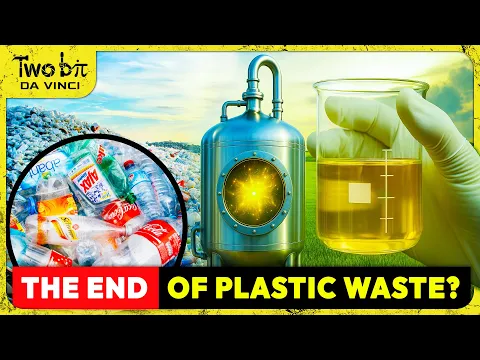

A decisive part of separating promise from impact is the validation stage. It was described that this hydrochemical recycling is in an initial phase typical of technologies seeking commercial viability and that a modular pilot plant of about 10 kg per hour has been planned to operate in London, Ontario, with an expectation to be operational by the third quarter of 2025.
The idea of modularity changes the traditional logic of large plants. Instead of installations designed for tens of thousands of tons per year and high investments, connectable modules can, in theory, bring processing closer to the collection point.
This directly connects to the river scenario: as many of the most polluting rivers are in developing countries, transporting waste far away may not make economic or environmental sense.
In a possible arrangement within what has been described, interceptors capture waste and a nearby modular plant would treat precisely the “bad” fraction that no one wants to buy, reducing landfill shipments and creating a local economic incentive.
Still, success depends on factors that do not disappear: collection chain, minimum sorting, operational stability, destination of the rejects, and demand for final products.
The most interesting consequence, if everything fits, is the systemic effect: when recycling dirty waste becomes possible, plastic gains more value and can create an incentive to capture it before it reaches the ocean.
It’s the combination of “catching it early” with “being able to use it later” that transforms technology into behavior change.
The Pacific trash exposes a modern paradox: engineering can build barriers, robots, and sophisticated processes, but the problem is too large to rely on a single front.
Ocean collection faces dispersion and slowness; interception in rivers reduces the influx but requires scale and logistics; and recycling only becomes a solution when it can accept the real-world plastic, dirty, mixed, and wet.
The introduction of AI and drones, alongside interceptors and new recycling routes, does not eliminate complexity, but can reorganize the effort: measuring better, acting sooner, and creating a viable destination for what is currently treated as inevitable waste. In the end, the question remains not only “Can we clean up?,” but “Can we prevent it from becoming trash again?”.
If you had to choose where to invest first to reduce waste in the sea, would you prioritize interceptors in rivers, ocean cleanup, or technologies that recycle dirty plastic? And, looking at your city, what is the most obvious point where trash escapes to streams and rivers without almost anyone noticing?





Conheça Ingatesus empresa que desenvolveu a madeira polissintetica, não exige classificação de materiais, processo limpo de alta produção. LIXO ZERO.