






 Portuguese
  Spanish


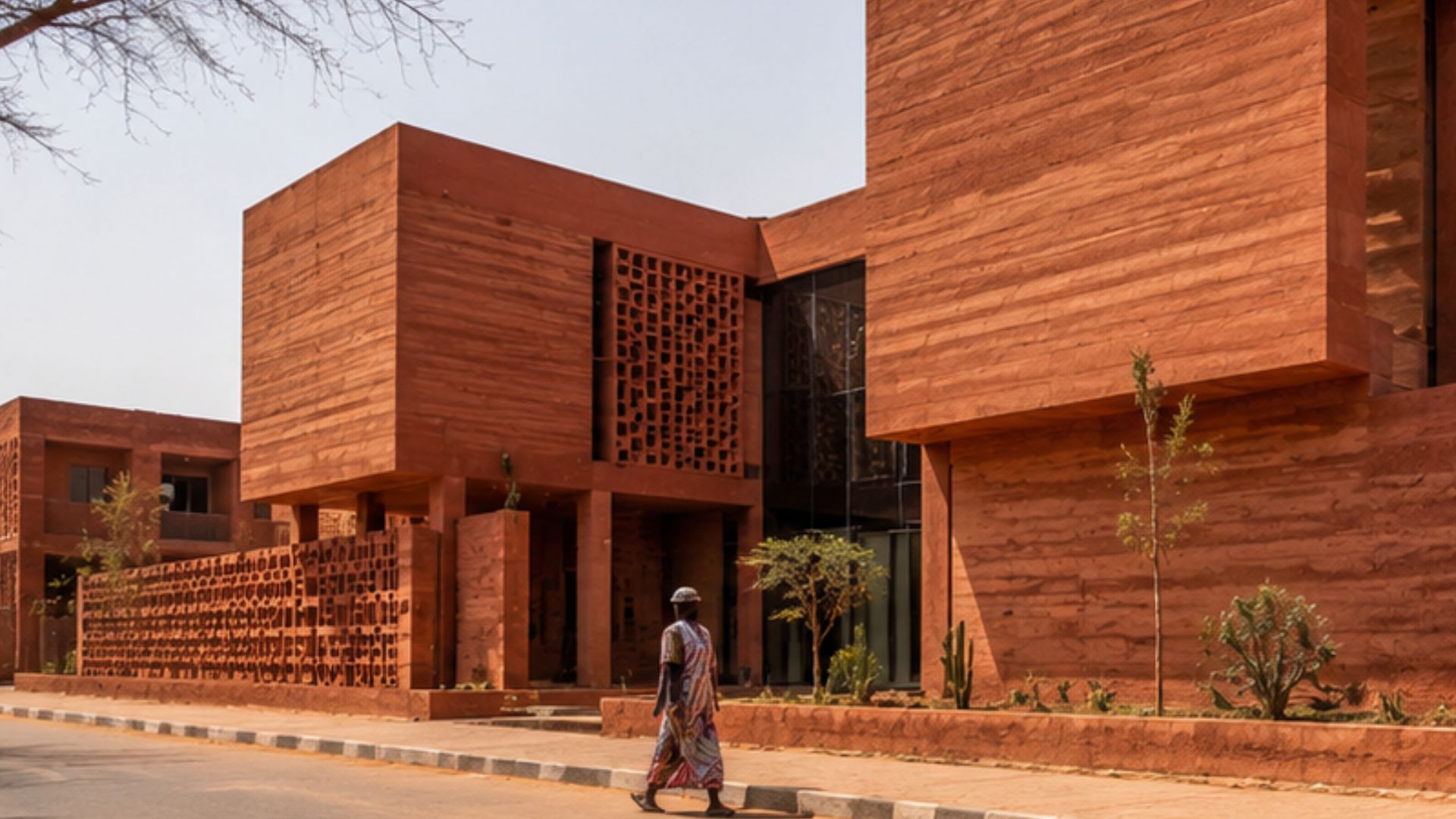


DW Documentary follows Francis Kéré, Worofila, and Elementerre in Senegal, where earth material takes shape in red clay bricks, reduces dependence on gray concrete, and rekindles debate on bioclimatic architecture, urban heat, cost, tradition, scale, and the future of rapidly growing African cities until 2026 on the continent.
The material that for decades was associated with poverty in African construction has returned to the center of the architectural debate in 2026 in the documentary “The Red Matter and the Gray Matter”, by DW History and Culture. The production follows the new Goethe-Institut in Dakar, designed by Diébédo Francis Kéré, the first architect from Sub-Saharan Africa to receive the Pritzker Prize.
The change is happening because cities like Dakar and Accra are growing under intense heat, lack of infrastructure, housing pressure, and the expansion of gray concrete. In response, architects like Nzinga Mboup, Nicolas Rondet, from the firm Worofila, and engineer Amadou Doudou Deme, from Elementerre, are revisiting red clay as a technical, climatic, and cultural solution. What seemed like a setback has become a contest for the future of African cities.
Red clay ceases to be a symbol of poverty and returns as climatic technology

The red clay used in Senegal comes from laterite, a soil abundant in West Africa, marked by the presence of oxides that give it its characteristic color. This material can be extracted locally, mixed with sand and small amounts of cement, pressed into bricks, and used in modern buildings.
-
Concrete-filled PVC homes could be cheaper than traditional masonry, UPF research finds; with ready modular panels, less waste, and faster construction, the Concrete-PVC system aims to cut costs and transform affordable housing in Brazil.

-
Brazilian House Built with 32.8 Tons of Construction Debris Offers Affordable Housing Solution
-
Americans Build Entire Homes in a Day Using Compact Sand Foundations and Pre-Made Wooden Trusses, Reducing Construction Costs

-
China’s Largest Floating LNG Plant, NGUYA, Sets Sail for Congo: 2.4 Million Tons Annually for Italy’s Eni


The shift is in perception. For a long time, building with earth was seen as a sign of lack of resources. Doudou Deme, founder of Elementerre, has been trying to reverse this interpretation for 15 years. His thesis is straightforward: earth is not a poor material; poor is wasting energy on hot buildings that then depend on air conditioning.
Goethe-Institut in Dakar became a showcase of a new African architecture

The new Goethe-Institut in Dakar was designed as a cultural center, meeting space, education, and international cooperation. Francis Kéré chose to use stabilized earth and locally produced bricks to give the building a direct connection with West Africa.
The project gained symbolic weight because a German institution in Senegal decided to build its headquarters with red clay, and not just with gray concrete. The architectural message is strong: local tradition can enter the institutional building without seeming improvised, nostalgic, or a second-class solution.
Francis Kéré transformed traditional knowledge into contemporary language


Francis Kéré was born in Burkina Faso and built his career between Africa, Europe, and the United States. His work became known for recovering local techniques, involving communities, and using simple solutions for ventilation, shade, and thermal mass.
The primary school in Gando, Burkina Faso, is one of the most cited examples of this trajectory. There, earth bricks, natural ventilation, and shaded areas were used to create comfort in classrooms. Kéré does not try to copy traditional architecture; he updates this knowledge to respond to heat, cost, and lack of infrastructure.
Worofila brings bioclimatic architecture to houses and buildings in Dakar
In Dakar, Nzinga Mboup and Nicolas Rondet lead the office Worofila with a focus on bioclimatic architecture. The goal is to design buildings that function better in the local climate, using cross ventilation, internal courtyards, shade, regional materials, and less reliance on mechanical systems.
A five-story building in the Ngor neighborhood, built with clay bricks, showcases this proposal on an urban scale. The facade creates shade and the internal courtyards bring air and light to the environments. The building proves that red clay does not need to be restricted to rural houses or small constructions.
Elementerre tries to take clay bricks out of the niche
At Elementerre, the company of Doudou Deme, compressed earth bricks are produced in Gandigal, in the interior of the metropolitan region of Dakar. With manual presses, production can reach 1,000 bricks per day; with hydraulic presses, the capacity increases and allows for a reduction in the proportion of cement used in stabilization.
This detail is important because the earth brick itself can contain some measure of cement. By reducing this amount, the company tries to make the material even more consistent with the climate proposal. The ambition is to replace part of the gray concrete without creating a new dependency hidden within the red brick.
Gray concrete remains dominant because it became a social and economic symbol
The documentary also shows why gray concrete dominates so many African cities. Researcher Armelle Choplin, based in Geneva, analyzes how cement and concrete transitioned from colonial and Western symbols to everyday products, linked to the idea of permanence, security, and social ascent.
In many West African cities, building with cement means asserting ownership, stability, and the right to remain. Houses are built gradually, bag by bag, as income allows. Gray concrete is not just a construction material; it has become a social language of conquest and urban survival.
The climate cost of cement pressures rapidly growing cities
The problem is that there is no concrete without cement, and cement production is associated with a significant portion of global greenhouse gas emissions. Moreover, sand extraction for construction threatens coastlines and ecosystems, especially when it occurs illegally or predatorily.
This scenario weighs on rapidly growing cities. Dakar, Accra, and the urban corridor between Lagos and Abidjan face demographic expansion, housing deficits, and increasing heat. If African urbanization only replicates the gray concrete model, the climate cost could be immense.
Lesley Lokko placed Africa at the center of the Venice Biennale
The Ghanaian-Scottish architect and writer Lesley Lokko founded the African Futures Institute in Accra in 2021 and curated the Venice Architecture Biennale in 2023. She brought almost 90 architects and artists to the exhibition, with a strong presence from Africa and the African diaspora.
The choice helped change the international showcase. Instead of treating Africa as the periphery of architecture, Lokko placed the continent as a laboratory of the future. The discussion shifted from being merely aesthetic to involving climate, urbanization, colonialism, education, scale, and constructive sovereignty.
Earth material also appears in hospitals and commercial buildings
The revival of earth materials is not limited to cultural centers. Architect David Adjaye, based in Accra after an international career, works with hybrid solutions in clay and concrete, including regional hospitals in Ghana and commercial projects.
These experiences indicate a more challenging stage: moving from the experimental house to public, commercial, and institutional programs. The challenge is no longer to prove that red clay works; it is to show that it can achieve scale, budget, licensing, and political trust.
Mariam Issoufou advocates for earth as logic, not folklore
Architect Mariam Issoufou from Niger also appears in the debate with a pragmatic stance. For her, the value of earth is not just in cultural identity, but in thermal mass, internal comfort, energy savings, and the health of environments.
Projects in Dandaji and Niamey show how the material can take on contemporary forms, with markets, mosques, housing, and offices. Tradition serves as a foundation, but the main argument is technical: if the climate is hot, the building needs to work with the heat, not against it.
Typha expands the repertoire of local materials
In Senegal, another element enters the discussion: Typha, an invasive reed plant from the Senegal River delta. Used in insulation, roofs, and clay panels, it can help create cooler indoor environments while utilizing an abundant local biomass.
Doudou Deme and other builders see this use as a way to expand the repertoire of sustainable construction. Typha filters water, stores carbon, and can become a component of walls and roofs. The logic is to turn an environmental problem into a construction resource.
Hybrid construction shows that clay does not eliminate concrete
The new Goethe-Institut in Dakar does not completely abandon concrete. The project uses a hybrid solution because there are structural loads and technical requirements that still demand reinforced concrete in certain areas.
This caveat makes the discussion more serious. The proposal is not to romantically replace all modern materials with earth. The realistic path is to combine red clay, concrete, wood, shade, ventilation, and engineering to reduce impact without compromising safety.
Lost knowledge returns as a response to air conditioning
Jean Charles Tall, a Senegalese architect and professor, points out that part of the traditional climatic knowledge was lost when air conditioning became the urban standard in the 1980s. From then on, many buildings began to rely on machines to correct problems that architecture could have avoided from the design stage.
This critique is central. Bioclimatic architecture does not reject technology, but questions total dependence on it. A building that needs to spend energy all day to support its own climate may have failed even before being connected to the power grid.
Dakar shows how the city can learn from its courtyards and trees
Nzinga Mboup and architect Carole Diop investigate urban forms prior to French colonization in Dakar, especially community spaces organized around courtyards, trees, mosques, and meeting areas.
These elements help to think about more livable cities. Courtyards bring air and shade. Trees create memory and permanence. Common spaces sustain community life. Innovation, in this case, does not come from erasing the past, but from recognizing solutions the city already knew.
The future of architecture can be born from scarcity
At the end of construction, the Goethe-Institut in Dakar emerges as a symbol of a new cycle. The project took years, involved cooperation between Senegal and Germany, faced technical challenges, and showed that earth material can occupy an international cultural program.
The strongest idea left by Francis Kéré is that pressure can generate innovation. When resources become expensive, heat increases, and cities grow rapidly, local solutions gain urgency. Africa does not appear only as a place that needs answers; it appears as a place capable of producing them.
The material once seen as something for the poor has returned to the center of African architecture because it addresses concrete problems: urban heat, cost, emissions, infrastructure scarcity, and loss of local knowledge. The red clay does not replace gray concrete alone, but challenges its hegemony and paves the way for hybrid solutions.
Francis Kéré, Worofila, Elementerre, Lesley Lokko, David Adjaye, and Mariam Issoufou show that tradition can be technical, contemporary, and scalable. The question now is whether African and also Brazilian cities will have the courage to treat local materials as innovation. Would you live or work in a modern building made with earth, red clay, and less gray concrete? Share your opinion.






A heart warming development. A gradual shift of mindset will advance it with time. I know this shift will initially be resisted by many rich people, but one way to encourage its growth is a good level of adoption by African governments in government-funded builds.
My only concern about this is ecological damage to our environments. …how to fill up the numerous excavations that will spring up here and there as the adoption of this tech expands…
I believe it will not be a new “problem”, as it would only be a transition from San to laterite, with the added benefit of cooler interiors and savings in heating cost and reduced cement usage/cost
The concept isn’t bad , the question is will dis last for long lk concrete?