






 Portuguese
  Spanish


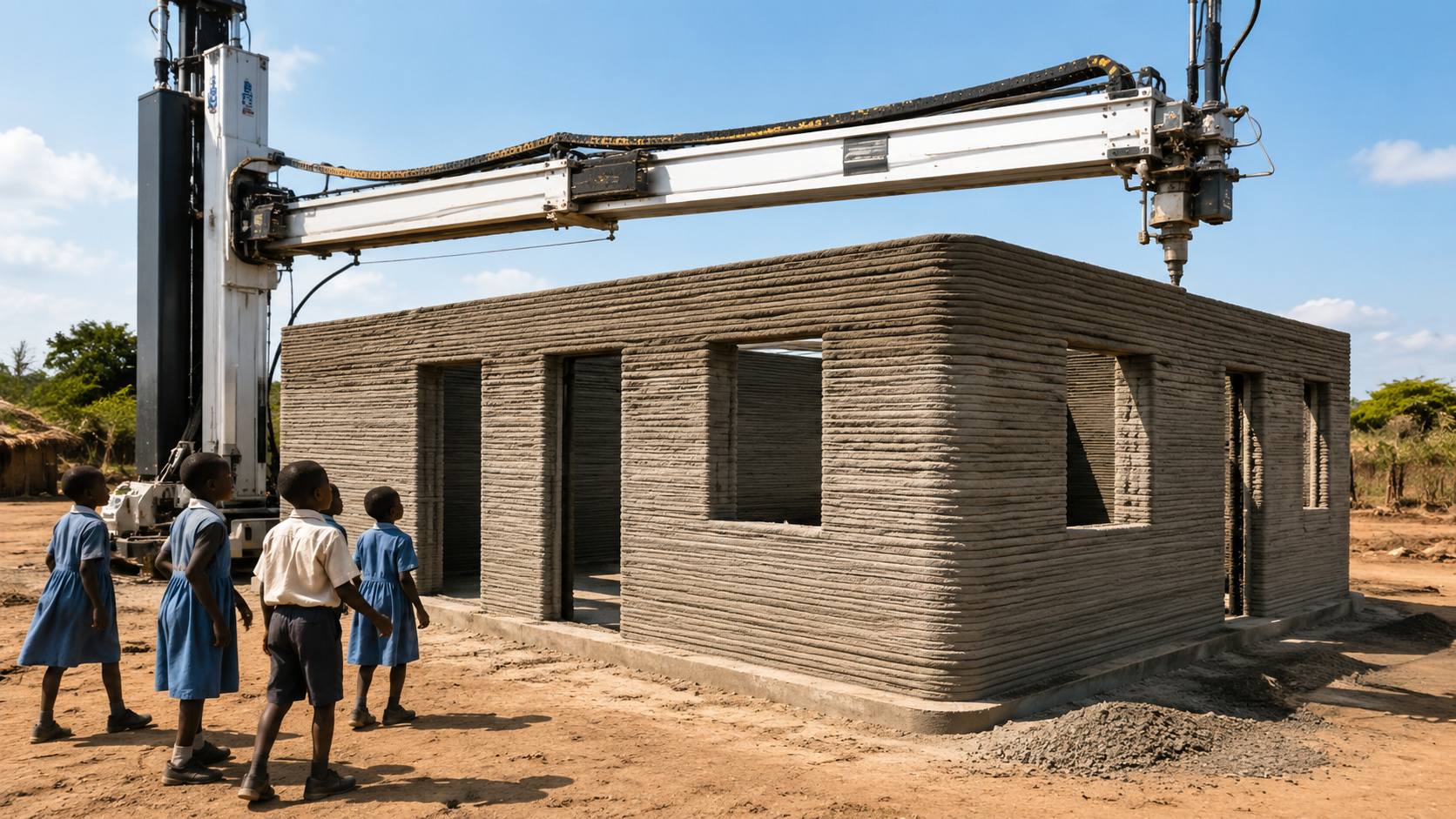


3D Printed School in Malawi Shows How Rapid Construction with Automated Concrete Can Help Communities in Need of Classrooms, Reduce Delays in Simple Projects, and Transform Technology into a Real Solution for Public Education
A 3D printed school in Malawi had its walls built in just 18 hours, a much shorter time than required by traditional construction methods. The project drew attention because it brought 3D printing to a concrete need: creating a classroom where infrastructure is lacking.
The information was released by Holcim, a construction materials company. The school was built in the Salima district of Malawi by 14Trees, a business partnership linked to Holcim and the CDC Group.
The impact goes beyond speed. The project shows how 3D printing in construction can help communities with less access to quick projects, less availability of specialized labor, and greater difficulty in expanding schools.
-
English Skills Boost Career Opportunities in the Oil and Gas Industry

-
Brazil Secures Second Place at WorldSkills 2024 in Lyon, with 64 Young Professionals and 8 Medals, Including Gold from a Rio de Janeiro Hairdresser

-
3,000 Military Personnel from 10 Countries, Including US and Chinese Marines, Train Together in Brazil’s Savanna: Operation Formosa Becomes Largest Naval Ground Exercise Before First Cancellation Since 1988
-
UAE Sends 110 Date Palm Trees to Brazil, Signs $4 Million Deal to Boost Date Production in Bahia’s Hinterland, with Presidential Palace Receiving 10 Saplings


Walls Made in 18 Hours Put 3D Printing at the Center of Public Education
The most striking fact of the project is simple: the school’s walls were printed in 18 hours. In a typical construction, this phase could take several days.

The technology uses a machine that deposits layers of material until the walls are formed. Instead of building everything block by block, the process follows a programmed design and creates the structure in an automated manner.
This difference changes the pace of the project. When a room can be realized faster, the community waits less for a study space, and the construction ceases to be just a time issue and becomes an engineering matter as well.
Malawi Gained a 3D Printed School in a Region with a Real Need for Classrooms
The school was constructed in the Salima district and transferred to the local community of Kalonga. Children began studying in the new space in June, turning the project into real use, not just a technological demonstration.
The case gained traction because it does not involve a luxury construction or a futuristic house. The application was in a school, within a community that needed more space for education.

The 3D printed school shows a practical possibility for regions where building can be expensive, slow, and limited by logistics. Technology alone does not solve all education problems, but it can accelerate an important part of the infrastructure.
How automated concrete construction works simply
The 3D printing in civil construction uses a machine to form walls layer by layer. The material is placed in sequence until the planned structure is created.
This does not mean that the entire school appears ready in a few hours. The printing of the walls is a central stage, but the construction also needs other parts, such as roofing, finishing, and organizing the space to accommodate students.
Even so, the time gain is significant. In the case of Malawi, the walls were ready in 18 hours, which made the project easy to understand and strong to explain the potential of the technology.
Holcim presented the project as a response to the lack of school infrastructure
Holcim, a construction materials company, presented the school as an application of 3D printing aimed at housing and accessible infrastructure in Africa. 14Trees developed the technology used in the project.
The central point is the use of engineering to address a social need. The lack of classrooms does not depend solely on the desire to build, as it also involves time, material, labor, and access to construction sites.
With walls erected in less than a day, the experience in Malawi opens an important discussion. If the technology can be replicated safely and with planning, simple schools may gain a faster construction alternative.

The 3D printed school shows a solution for simple public works
The project draws attention because it combines three elements of great appeal: education, rapid construction, and technology applied to a real problem. The combination makes the case easy to understand and hard to ignore.
In regions with limited infrastructure, delays in building classrooms can directly affect the routine of children and teachers. Therefore, a solution that reduces steps and accelerates delivery gains social relevance.
3D printing can also reduce waste, as the material is applied in a controlled manner. This point reinforces the interest in the technology for simple public works, especially where every resource needs to be well utilized.
Why this school became a symbol of a new phase in construction
The school in Malawi shifted 3D printing from a technological curiosity to an application with social impact. What once seemed restricted to experimental projects has now emerged as a tool to expand basic infrastructure.

The use in a school makes the example stronger because the consequence is direct. More classrooms mean more space to learn, more organization for the community, and a quicker response to an old demand.
The technology still needs to prove its scalability, cost, and adaptation in different regions. Even so, the case shows that building faster can change the way governments, companies, and communities think about essential works.
The 3D printed school in Malawi was marked by a powerful number: 18 hours to erect the walls. The result showed that engineering can help transform the lack of classrooms into a challenge of planning, speed, and execution.
More than just a different construction, the project showed a technology being used where there was a real need. The rapid construction made sense because it ended with children studying inside the new space.
If a school can have its walls ready in 18 hours, what still prevents this technology from reaching more communities that have been waiting for years for a decent classroom?







3D construction technology cuts out waste indeed but most importantly corruption in countries like Malawi where we have a corruption pandemic.
Where can one get the machine and at what cost.The machine is good for helping vanarables in city slums and the needy for shelter at refugees camp
I have got two pieces of land in Northern Part of Malawi measuring 11 and 17 Hecters each respectively in the rural area , how can I be helped to develop them with School buildings and 🏘️ like the Salima scool?
This is a good initiative you have. As a specialist in the technology, I can guarantee both speedy construction, almost zero waste, stronger and safer walls with 3D Concrete Printing (3DCP). The technology reduces the concrete volume and maximise the strength at the same time. Get in touch with me for more information about the same. Reach out to me directly on LinkedIn @mwangimacharia for more information.