Portuguese
  Spanish


In 1991, after a cowardly attack on Brazilian soldiers on the border with Colombia, the Army executed an exemplary retaliation known as Operation Traíra.
The immense Brazilian border in the Amazon has always been a challenge for control. Neighboring some of the world’s largest drug producers and serving as a route for international trafficking, the area is a constant stage for conflicts. In 1991, an attack by the Revolutionary Armed Forces of Colombia (FARC) on a Brazilian military outpost demanded a swift and vigorous response: Operation Traíra.
Border, Illegal Mining, and Pressure on the FARC
Brazil has an extensive and difficult-to-monitor border, especially in the Amazon region. This area is strategic for criminal organizations, serving as a corridor for drug trafficking from neighboring countries and also as a stage for activities such as illegal mining. The illegally extracted gold moves a lot of money and power.
In the Rio Traíra region, on the border with Colombia, the Brazilian Army maintained bases to occupy the territory and curtail crimes. A specific action, Operation Jatuarana, aimed to end the illegal mining occurring in areas abandoned by a mining company. This operation was successful, disturbing groups that profited from the activity, including the FARC.
-
Mother discovers she may have won £12 million in the lottery but faces an agonizing wait after the shopkeeper threw the ticket in the trash.

-
A couple bought a house in Sheffield and, when removing the carpet from the hallway, found a trapdoor leading to a secret 23 m² basement with a 2-meter ceiling height, a discovery that eliminated the need for an expensive extension and, according to them, added £70,000 to the property’s value.

-
A nurse bought for 20,000 a 1955 house abandoned by a hoarder in Texas, and months later, rain revealed a buried pool in the backyard valued at $160,000, which he restored himself for about $10,000, a fraction of the cost of building a new one.
-
The United Kingdom is transforming dog feces left on trails into gas to light a streetlamp through an unlikely and surprising project that shows how even one of the most rejected wastes in cities can generate energy.



The FARC, a Colombian guerrilla group with communist orientation that emerged in the 1960s, evolved into organized crime, engaging in kidnappings and drug trafficking. At the time, pressed financially by actions from the Colombian government, they saw illegal gold mining on the border as a vital source of resources. The Brazilian Army became a direct obstacle to these interests.
The Surprise Attack on the Brazilian Detachment at Rio Traíra

Under the command of the group “Comando Simón Bolívar”, around 40 FARC guerrillas attacked the Brazilian military camp at Traíra. The base was simple, made with local materials, and did not offer much protection. At the time of the attack, on a Tuesday around noon, the approximately 17 Brazilian soldiers were engaged in routine activities, such as cooking and gathering firewood, and were caught by surprise.
The attack was brutal. Three Brazilian soldiers were killed, including a soldier known as Sansão, and others were injured. The guerrillas stole all the weapons, ammunition, communication equipment (radios), binoculars, vests, and even uniforms and official documents. The theft of the radios was critical, as it left the survivors completely isolated in the jungle.
The Immediate Reaction: Mobilization for Operation Traíra
The surviving soldiers remained cut off until the arrival of a replacement platoon the following Friday. Only then did news of the attack reach command in Manaus, and quickly to Brasília. Then-president Fernando Collor, informed by the Armed Forces, contacted Colombian President César Gaviria. Gaviria, busy combating Pablo Escobar, authorized Brazil’s entry and action in Colombian territory to hunt down those responsible.
The Brazilian response was immediate. Still on Friday afternoon, an order was given for officers and sergeants of special units in Rio de Janeiro to remain in barracks or return immediately. Within a few hours, they were all gathered, unaware of the exact reason. They were transported to Brasília and from there boarded aircraft under complete secrecy. The Military Operations Command (COTER) took over coordination. The mission, initially called Operation Jatuarana II, became known as Operation Traíra.
The Hunt in the Jungle
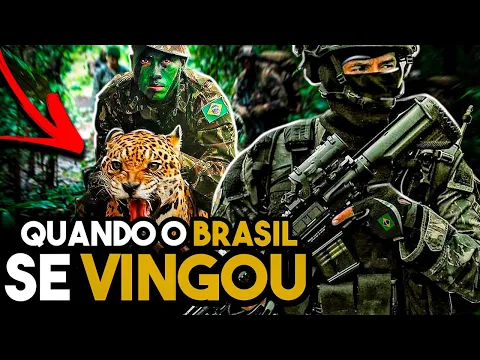

Inside the plane, the troop commander received an envelope with orders, to be opened only during the flight. The mission was clear: retaliate against the FARC attack. The task force was composed of elite troops with various specialties: parachuting, infiltration, reconnaissance, counter-terrorism, and jungle warfare, including specialists from the Amazon itself. They had support from Tucano aircraft and helicopters. The Amazon Military Command and the Solimões Frontier Command (the home of some of the dead) also participated, adding a personal element of revenge to the mission.
After infiltrating Colombian jungle, the Brazilian military intercepted a suspicious vessel. Interrogating the captured guerrillas, they discovered the location of the FARC camp responsible for the attack: five hours upstream and two more hours walking through the jungle. On the 8th (the exact counting of days after the start of mobilization may vary by source, but it was quick), Brazilian forces executed a precise attack, destroying the guerrilla camp.
Later, on another incursion on the 20th, they located a second camp with about 150 guerrillas, but also with women and children (families of the combatants) and prisoners. Given the presence of civilians, the Brazilian military leadership decided to cancel the direct attack.
Operation Traíra was considered a success. Although it did not eradicate the presence of the FARC or crime on the border—a complex task given the vastness and lack of civilization in the area—it sent a clear message: attacking the Brazilian Army would have severe consequences. The operation reinforced the reputation of Brazilian military specialized in jungle warfare and demonstrated Brazil’s rapid response capability in defense of its sovereignty.