






 Portuguese
  Spanish


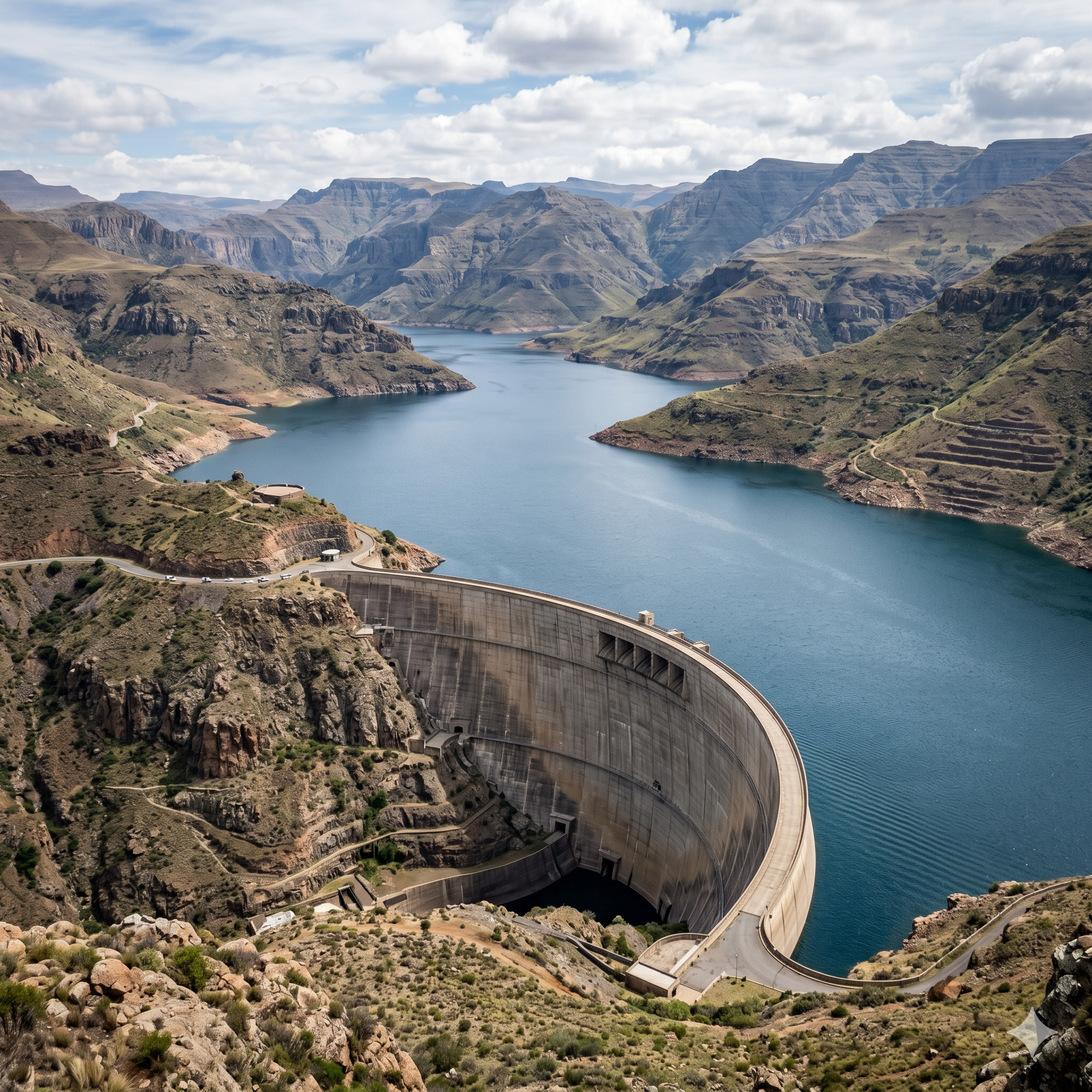


Lesotho exports water to South Africa with dams, tunnels, and works at 2,000 m altitude in one of the world’s largest water projects.
In 2026, the Lesotho Highlands Water Project (LHWP) returned to the spotlight with the inauguration of the Senqu Bridge on April 22 and the advancement of Phase II, which includes the Polihali dam and a transfer tunnel of about 38 kilometers to Katse. According to the Associated Press, in a report on April 23, and the Lesotho Highlands Development Authority, the project uses Lesotho’s mountainous geography to transfer water by gravity to South Africa’s water system, supplying Gauteng, the province where Johannesburg is located.
The scale reveals a rare dependency: the AP reported that, in Gauteng, there is a 60% chance that the water consumed comes from Lesotho, while the new phase is expected to increase water exports from 780 million to over 1.27 billion cubic meters per year. LHDA data updated on March 4, 2026, indicated the Polihali dam was 44% complete and the transfer tunnel 51% complete, solidifying Lesotho as a kind of water reservoir for the continent’s largest industrial economy.
The logic is straightforward yet unusual: a mountainous country exports water on a national scale to sustain the continent’s largest economy.
-
72-Year-Old Man Spends Six Years Building a Rotating House for His Wife, Completing a Full Turn in 22 Seconds

-
Chinese Residential Building Surrounded by Circular Overpass After Residents Reject Compensation

-
After 79 Months and $145 Million Investment, Nepal Set to Open First 2.7 km Road Tunnel to Ease Traffic in Kathmandu Valley

-
In China, 23 Families Spent Over 4 Years Carving a 1.2 km Road Through a Cliff to Overcome Isolation and Transform a Remote Village


System combines giant dams, tunnels tens of kilometers long, and structures in remote areas
The LHWP consists of a series of works including large dams, reservoirs, and tunnels excavated through mountainous formations. In the first phase, structures like the Katse dam had already demonstrated the project’s viability, with reservoirs in elevated areas allowing for natural water flow.


The second phase significantly expands this capacity with the construction of the Polihali dam and a new tunnel of approximately 38 kilometers, designed to interconnect the reservoirs and increase the volume of water transferred.
Additionally, complementary works such as bridges and access roads were necessary to enable construction in hard-to-reach regions, including a bridge approximately 825 meters long and 90 meters high, built to cross deep valleys.
The complexity of the engineering reflects the challenge of operating in one of the most difficult terrains on the African continent.
Volume exported from the Lesotho Highlands Water Project could exceed 1.27 billion cubic meters per year
With the expansion of the second phase, the system’s total capacity is expected to reach over 1.27 billion cubic meters of water per year, a significant increase compared to the initial phase, which already transferred about 780 million m³ annually.
This volume is sufficient to supply millions of people, as well as sustain industrial and commercial activities in one of Africa’s most populous and economically active regions.
The project transforms water into a strategic national resource, with a direct impact on the South African economy.
Altitude difference allows for gravity transport without constant pumping
One of the most efficient aspects of the project is the use of geography itself to transport water. As Lesotho is in an elevated mountainous region, water can be directed to South Africa using the natural drop in terrain.
This system reduces the need for continuous pumping, lowering operational costs and energy consumption over time.
The engineering leverages altitude as a natural advantage, making the system more sustainable from an energy perspective.
Johannesburg directly depends on the system for urban and industrial supply
The city of Johannesburg and the entire Gauteng region concentrate a significant portion of South Africa’s population and economic activity. Water supply in this area is a constant challenge due to high demand.
The LHWP has become a fundamental piece in ensuring this supply, especially during periods of drought or increased consumption.

Without the system, the pressure on local water resources would be much greater, increasing the risk of scarcity. The dependence on external infrastructure shows the degree of integration between the two countries.
Lesotho transforms water into revenue and a national strategic asset
For Lesotho, the project represents one of the main sources of external revenue. The exported water generates royalties paid by South Africa, contributing to the country’s economy.
This model transforms a natural resource into an economic asset, allowing the country to leverage its geography to generate income.
However, this dependence also raises questions about sustainability and long-term resource management. Water ceases to be merely a natural resource and becomes an exportable product.
Construction in remote regions requires complex logistics and high investment
The execution of the LHWP works involves significant logistical challenges. Many of the areas where dams and tunnels are built are in remote regions with limited access.
This requires the transport of materials, equipment, and labor under difficult conditions, in addition to detailed planning to avoid delays and ensure the safety of operations.
The total costs of the project are high, reflecting the scale and complexity of the infrastructure. Construction in an extreme environment increases the level of difficulty and the necessary investment.
Environmental and social impacts accompany large infrastructure projects
Like any megaproject, the LHWP also generates environmental and social impacts. The construction of dams can alter ecosystems, modify watercourses, and affect local communities.
In some cases, populations were displaced to allow for the construction of the structures, which requires compensation and resettlement programs.
These aspects are part of the debate on the costs and benefits of large engineering projects. The balance between development and environmental impact remains a constant challenge.
Project becomes a global reference in water management between countries
The LHWP is often cited as an example of international cooperation in water resource management. The partnership between Lesotho and South Africa demonstrates how countries can strategically share resources.
This type of model can be replicated in other regions where there is an imbalance in water distribution. The experience shows that infrastructure can be used as a tool for regional integration.
The project’s growth reinforces a global trend: water is increasingly becoming a strategic resource, comparable to energy and minerals.
As demand grows and availability varies between regions, water transfer systems gain importance. This can influence relations between countries and infrastructure investment decisions. Water is now playing a central role in contemporary geopolitics.
A small country supplying an economic powerhouse raises questions about the future of water
The case of Lesotho and South Africa shows how geography can redefine a country’s role in the regional scenario. A small, mountainous territory becomes essential for the functioning of a large economy.
At the same time, the model raises questions about dependence, sustainability, and long-term management. What is at stake is not just supply, but the control of an increasingly valuable resource.
With billions of cubic meters of water crossing borders every year and an entire economic capital depending on this flow, do you believe that projects like this could become common in a world increasingly pressured by natural resources?





The program is good until Lesotho want to hold SA hostage.
Lesotho has set a great standard for this type of thing.The project has an unfortunate history in the country and has been at the center of numerous military incursions despite it being propagated commonly as a national security risk for South Africa.Needless to say they have maintained cordial and pragmatic relations which isnt new for the mountain kingdom, expanding the project upon agreement with SA until today and reflecting a constructive posture towards the precedent set.Even from a benefit perspective it is wildly exploitative and has only recently come under review ,including its lack of account for the value of the water since royalties are actually based on the gravity delivery amenity ,not water volumes,hopefully these insecurites can be adressed and the true benefits of the export for both countries can be realised as it remains the greatest example of international geopolitical hydropragmatism and constructivism.
Lesotho should consider closing the water flowing to SA until xenophobia has been dealt with.