






 Portuguese
 Spanish


Brazil has Serra Verde in operation and three rare earth projects in development after dysprosium prices diverged by a factor of 10.7.
Serra Verde recorded its first sales in November 2026 of mixed rare earth carbonate produced in Minaçu, Goiás, while three other Brazilian ventures are seeking to reach commercial production in the coming years. The developments are unfolding in a market dominated by China and marked by sharp price differences: in July, dysprosium oxide cost as much as 10.7 times more in North America than at the Chinese benchmark, according to an S&P Global Energy report released in October. The report also highlights Brazil’s potential to expand international supplies of dysprosium and terbium, which are used in permanent magnets.
Serra Verde is already supplying raw material to an international buyer under a contract of about 15 years
Among the Brazilian ventures tracked by S&P, Pela Ema is the only one already operating commercially at scale with raw material containing heavy rare earths extracted from ionic clays outside China. At its Minaçu facility, Serra Verde produces a mixed carbonate containing dysprosium, terbium and other elements. The product is not yet equivalent to individually refined oxides.
Control of the operation changed hands in September 2026, after its acquisition by U.S.-based USA Rare Earth was completed. Commercial shipments to the contracted buyer began the following month, ahead of the first sales recorded in November. The move is part of a strategy to build supply, processing and magnet manufacturing outside the China-dominated supply chain.
-
Three Cities in Pará Receive R$123.5 Million in Mining Royalties, Nearly One-Third of ANM’s Distribution to Municipalities

-
U.S. company controlling a rare earth mine in Goiás warns that Brazil’s new critical minerals law might obstruct exports and international contracts
-
Brazilian company finds rare earths with concentrations 25 times the crustal average in Bahia, but another discovery detail could shift mineral exploration’s direction

-
Samarco transforms 588,000 metric tons of marble waste into raw material for steelmaking


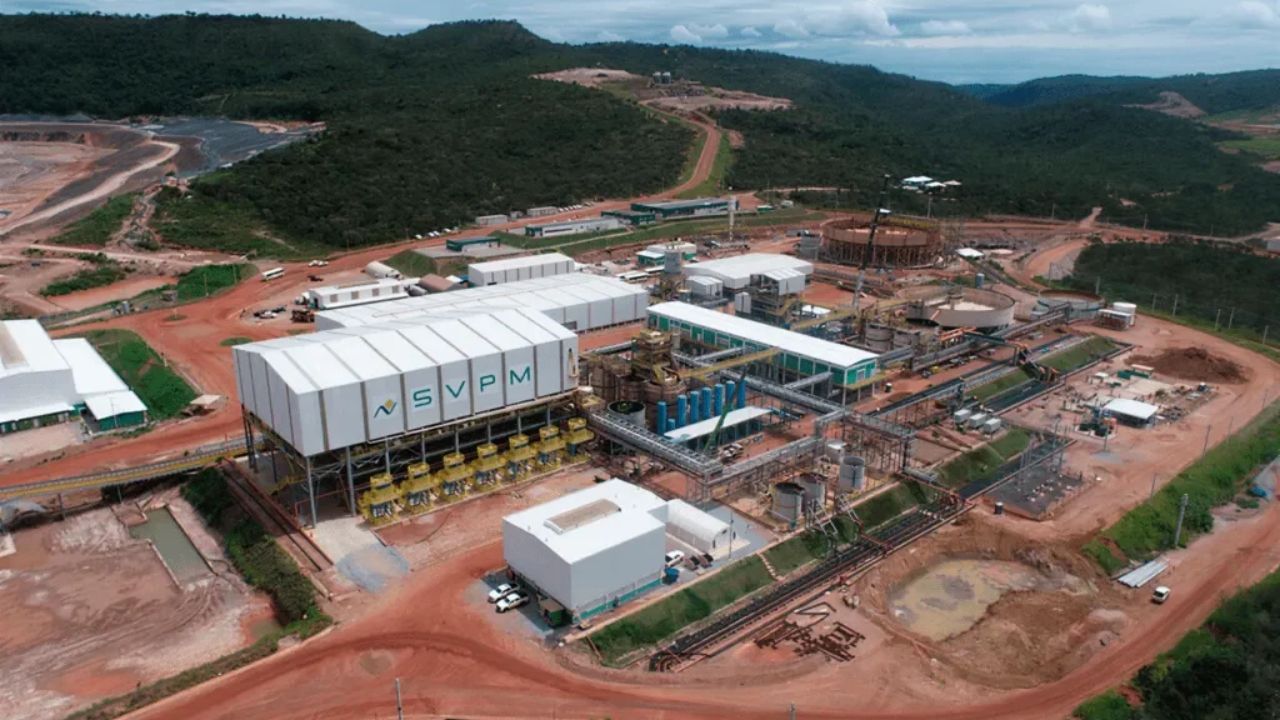
A key commercial pillar is the commitment made to US SIIE, a company backed financially by the U.S. government. The offtake agreement, estimated to run for about 15 years, covers nearly all output from the first phase of Pela Ema, subject to contractual exceptions.
Documents USA Rare Earth filed with the U.S. Securities and Exchange Commission list reference floor prices of US$2,050 per kilogram of terbium oxide equivalent and US$575 per kilogram of dysprosium oxide equivalent.
These contractual benchmarks are not market prices and do not mean Serra Verde is already selling separated oxides. The model also gives the company a share of any increase in international benchmark prices.
Carina, Colossus and Caldeira have different partners and targets for starting rare earth production
Beyond Serra Verde, three Brazilian initiatives are included in the survey, but none has begun commercial production. Their plans combine domestic extraction with industrial processing or international agreements, although execution still depends on project-specific conditions:
- Carina, in Nova Roma (GO): Developed by Aclara Resources, the project completed a feasibility study in April 2026 and is expected to begin production in 2029, following permitting and construction. The company plans to send feedstock from projects in Brazil and Chile to a future separation plant in Louisiana, in the United States, and later move into metals and alloys. In November, it experimentally produced neodymium-praseodymium metal suitable for making magnets, a demonstration result that does not yet represent commercial production across this supply chain.
- Colossus, in Poços de Caldas (MG): Viridis Mining and Minerals completed its definitive feasibility study in August, with an estimated initial investment of US$449 million and a planned start in 2028. It signed a binding agreement with Belgium’s Solvay to supply mixed rare earth carbonate for processing in France, at minimum volumes equivalent to about 70% of estimated output during the contract period, initially through 2034. The projected minimum contract revenue is US$915 million, contingent on deliveries; the companies are still discussing technology support for processing in Brazil.
- Caldeira, in Minas Gerais: Developed by Meteoric Resources, the project has completed a definitive feasibility study, with an estimated initial investment of US$498 million and planned annual production of approximately 122 metric tons of dysprosium and terbium starting in 2028. In October, Lynas Rare Earths announced an agreement worth about US$672 million to acquire Meteoric, a transaction that is still subject to approvals.
The schedules presented are projections, not guarantees that operations will begin, and depend on financing, permits and construction of the planned facilities.
Rare earth price differences reflect China’s industrial concentration and call for careful comparison
The price benchmarks compiled by S&P Global Energy help put into perspective the market conditions these projects are seeking to navigate. In July 2026, terbium oxide was priced at US$4,900 per kilogram in North America and US$1,005 in China, a difference of nearly fivefold. For dysprosium, the benchmarks were US$2,300 and US$215 per kilogram, respectively, a gap of about 10.7 times.
It is important to note that these are not current prices and were not calculated under the same delivery terms. The North American benchmark includes freight and insurance to the destination port, while the Chinese figure is an export price that excludes those international costs. The comparison therefore shows the price contrast but does not, on its own, measure the physical availability of the minerals in each market.
The consultancy’s report links the disparity to industrial concentration and Chinese export restrictions, which intensified beginning in April 2025. China, Myanmar and Laos account for approximately 91% of global mining of these elements, while China has about 98% of global dysprosium and terbium separation and refining capacity.
That dependence matters because both elements are used to improve permanent magnets’ resistance to demagnetization at high temperatures. The components are used in electric vehicle motors, wind turbines, electronics and defense applications.
In this context, Brazilian projects could offer alternatives for diversifying international supply, but the country’s effective participation in this market will depend on consolidating existing operations and carrying out investments that are still planned.


