






 Portuguese
  Spanish


Teacher Mia uses bottle caps, leaves, stones, and branches to teach letters and words in a low-resource school in Indonesia.
In 2025, teacher Mia from a madrasah in North Nias, Indonesia, demonstrated how simple materials can change classroom dynamics. According to the KREASI program, Kolaborasi untuk Edukasi Anak Indonesia, she started using recycled bottle caps with letters to help children form words in English.
The activity was applied in a context with few available pedagogical resources. Mia has been teaching since 2017, teaching mathematics to 5th and 6th-grade classes and English to 1st and 2nd-grade classes, according to KREASI.
Instead of expensive materials, the teacher used common everyday objects. Bottle caps, leaves, stones, and branches became part of the class, allowing students to assemble letters, words, and small projects with their own hands.
-
After losing his father and taking care of his mother, a son creates a nursing home that offers 24-hour care and three caregivers per patient with Alzheimer’s in Thailand.

-
Architect bought a completely abandoned farm in the interior of Rio, rebuilt the soil, fences, headquarters, and milking facilities from scratch, replaced cows with buffaloes adapted to organic management, and reached 200 liters of milk per day, transforming forgotten land into a certified agroecological business.

-
Surviving 100 years in the Brazilian market is almost a miracle: while six out of ten companies close before five years, a rare group of centenary companies has weathered crises and currency changes and continues to stand in Brazil.

-
At 17, he was a construction worker, at 24 he founded his own construction company, and today the company he created has delivered 4,600 units, built 652,000 m², and has almost five decades of history.


Recycled bottle caps became letters to teach fruit names in English
The main dynamic consisted of using bottle caps marked with letters. According to KREASI, Mia asked the students to organize these caps to form fruit names in English.
The proposal made learning more concrete. The child not only copied a word from the board but manipulated each letter, observed the correct sequence, and participated in the construction of writing.
This type of activity is especially helpful in the early years when the child is still developing the association between sound, letter, and word. By physically assembling a word, the student begins to see writing as something that can be formed, disassembled, and reorganized.
Leaves, stones, and branches were used to turn words into practical activities
The class was not limited to bottle caps. According to KREASI, Mia also encouraged students to choose a favorite fruit, draw that fruit, and spell the name using natural materials like leaves, stones, and twigs.
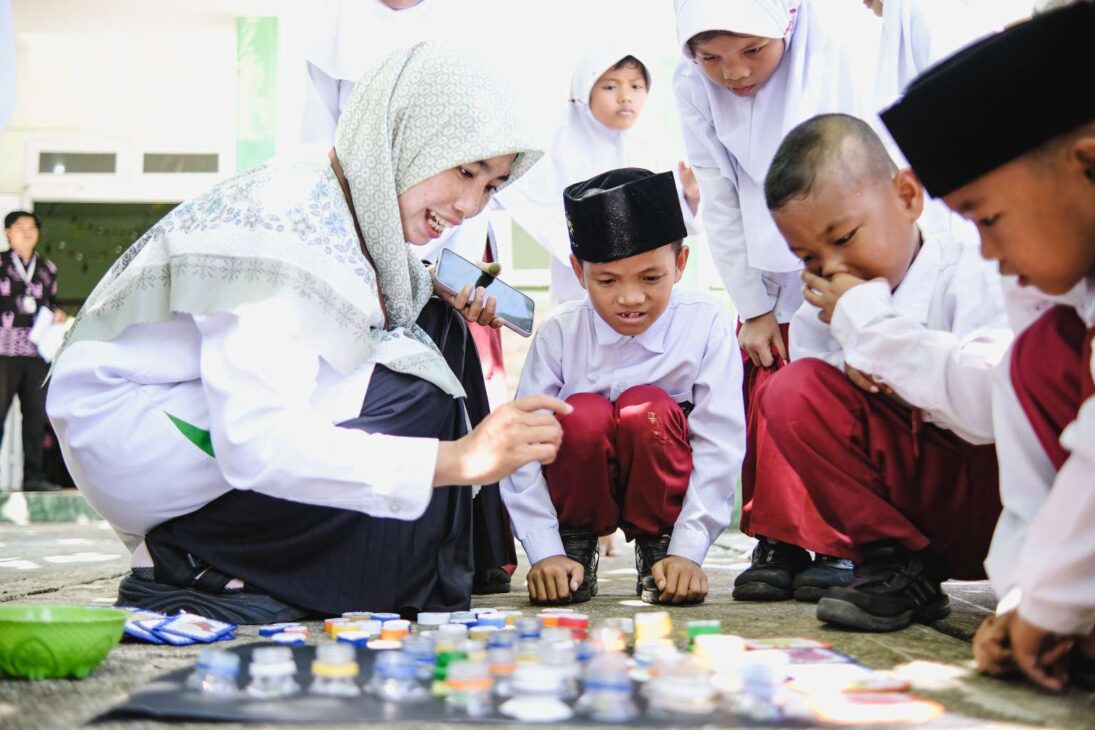
With this, the content moved away from the traditional repetition model and gained a manual stage. The word became linked to the drawing, the object, and the environment around the school.
The activity also created a connection between literacy, creativity, and reuse. What could previously be discarded now has a pedagogical function within the classroom.
Children were more focused during the activity with simple materials
The result appeared in the students’ behavior. According to KREASI, Mia observed that when the children were directly involved in the activities, they were more concentrated on learning.
The teacher reported that normally, the students would get tired quickly or become impatient to leave. However, when learning with materials from the environment, they became so involved that they even forgot it was already break time.
This involvement shows the impact of an active class. When the child touches the material, chooses pieces, assembles words, and participates in the process, learning tends to gain more attention and interest.
Method was born after training on creating learning materials
Mia’s practice gained strength after training. According to KREASI, she is one of the master trainers of the program and began applying new strategies in the classroom after participating in training on the development of learning materials.
KREASI is a program aimed at strengthening education in Indonesia. According to the initiative itself, the program is funded by the Global Partnership for Education and developed with Indonesian government agencies, through Save the Children and local partners.
Mia’s work shows how teacher training can generate practical solutions within the school. The proposal did not depend on sophisticated equipment, but on adapting to the class context.
Recycled materials help children learn with movement and participation
The use of bottle caps creates a literacy activity with movement. Each child can pick a letter, change its position, test combinations, and correct the word during the process.
This resource also reduces the distance between the content and the student’s reality. Simple materials found in everyday life become recognized as part of learning.
Another case cited by KREASI reinforces this logic. In Morotai, teacher Umian uses objects like bottle caps, stones, marbles, and straws to help children practice counting. According to the program, students became more active, confident, and engaged in the learning process.
Similar example in Brazil uses bottle caps and egg cartons in literacy
In Brazil, a similar practice was recorded in Canoas, Rio Grande do Sul. According to the Canoas City Hall, teacher Jaqueline de Freitas, from EMEI Alcy Paulo de Oliveira, created a literacy activity with bottle caps and egg cartons for a preschool class.
The task consisted of decoding words on the board and replicating them by organizing letters with the available materials. Then, the children reinforced the sounds of these words.
According to teacher Jaqueline, phonetic and phonological awareness activities help children perceive the connections between written and spoken letters.
Literacy can gain strength with cheap and well-planned resources
Mia’s story shows that low-cost materials can have a high impact when used with pedagogical intent. Bottle caps, leaves, stones, and branches do not only function as support objects but as tools to make learning more concrete.
The child stops being just a listener and starts constructing the word. This process stimulates attention, coordination, visual memory, letter recognition, and the association between sound and writing.
Recycling also adds another layer to the lesson. By using bottle caps and natural elements, the teacher transforms waste and the environment into part of literacy.
Teacher shows that creativity can transform the lack of resources into real learning
Mia also shared her practice with other teachers. According to KREASI, the response was positive because the materials used were simple, like used bottles, stones, sand, branches, and leaves, but they managed to support the learning process.
The case reinforces a central idea for schools with few resources: the quality of the lesson does not depend only on the quantity of available materials, but on how the teacher organizes the learning experience.
By transforming bottle caps into letters and natural elements into writing activities, Mia demonstrated that literacy can arise from accessible, recycled materials present in the school environment itself.


