Portuguese
  Spanish


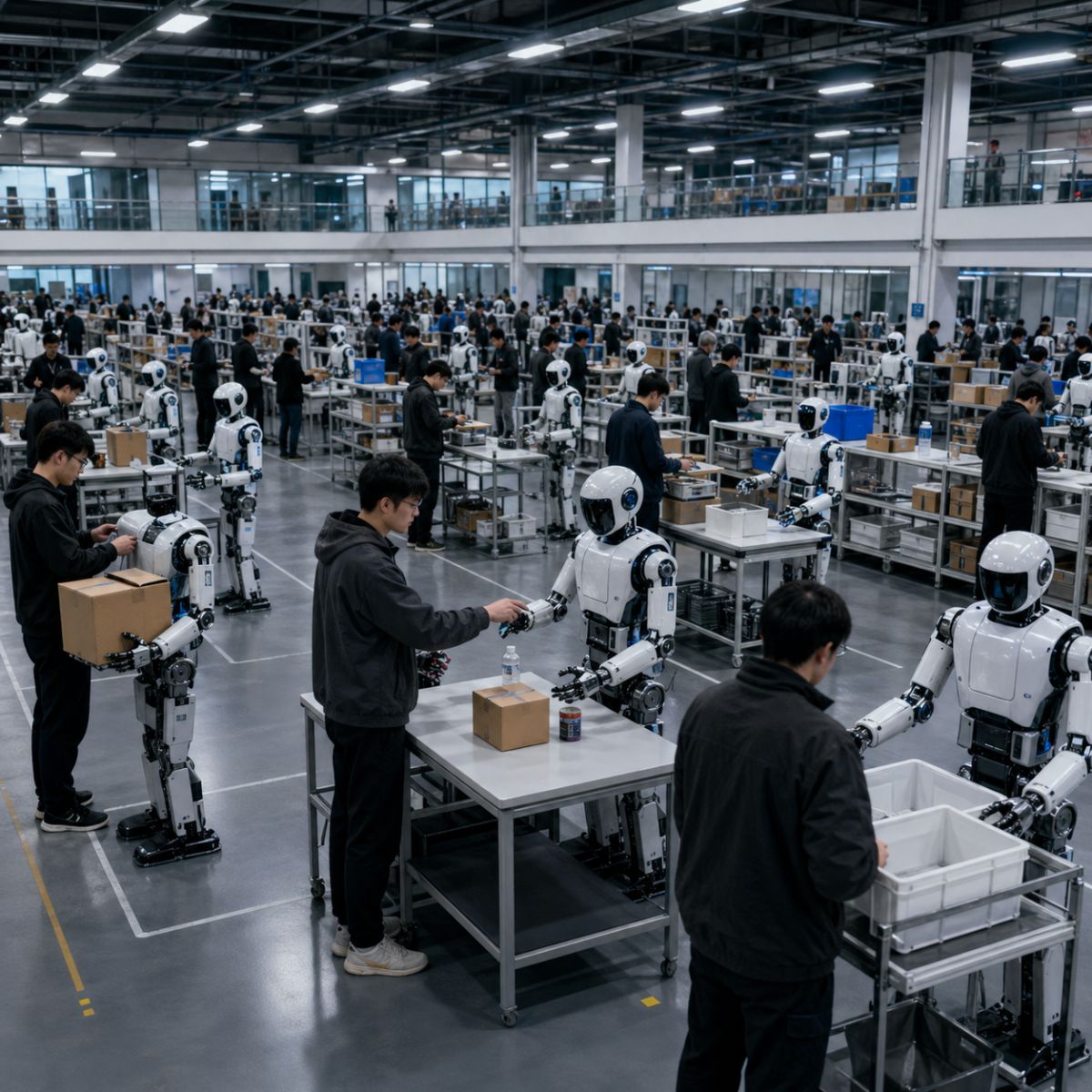


China has opened the country’s largest data training center for humanoid robots in Beijing, with nearly 200 human instructors and 100 1.66-meter-tall robots learning everyday tasks. The campus replicates full-scale factory and residential scenarios and was built by the Shijingshan district government in partnership with Leju Robotics. The robots repeat tasks such as picking up medicine bottles, loading goods, sorting orders, and flipping through files, trained to replace humans in roles ranging from elder care to emergency rescue.
China has just opened a school where the students are not people: they are 100 1.66-meter-tall humanoid robots that learn to do everything humans do in daily life. In a commercial building in Beijing’s Shijingshan district, nearly 200 human instructors wear headphones, hold control levers, and move slowly while the machines next to them replicate each movement with increasing precision. The campus is China’s largest data training center for humanoid robots, built in partnership between the local government and Leju Robotics.
The curriculum is purposeful and monotonously repetitive. The robots repeat everyday tasks such as picking up a medicine bottle from a cabinet, loading goods in a factory, sorting orders on a conveyor belt, and flipping through office files. The training areas reproduce full-scale factory and residential scenes, with every detail faithfully replicating real working conditions. The goal is not to create impressive demonstrations for viral videos: it is to produce machines that truly work in real environments where people work today.
What robots learn and how humans teach

According to information released by the China Daily portal, the training process works through motion capture. Human instructors repeatedly perform each task while robots capture data on the position, force, speed, and angle of movements, creating a database that allows the machines to autonomously reproduce the actions. The more times a task is demonstrated, the more precise the robot becomes in its execution.
-
Japan Deploys Offshore Concrete Factory, Constructs Massive Caissons in 8 Days, Revolutionizing Port Construction with Industrial Efficiency

-
China Builds World’s Largest Power Grid, Generating Enough Energy to Supply 15 Times Brazil’s Needs, Surpassing the US, EU, and India Combined
-
Brazil’s First 3D-Printed House Built in 30 Hours with Two Operators and 20% Lower Costs

-
Parker Solar Probe Discovers High-Speed Dust Grains Near the Sun, Offering New Insights into Solar Corona’s Mysteries



Repetition is the central element of the method. The 200 instructors work in shifts, demonstrating the same tasks hundreds of times a day, feeding the artificial intelligence algorithms that allow the robots to generalize movements and adapt to environmental variations. If a medicine bottle is in a different position than trained, the robot needs to be able to adjust its reach. If a box in the factory is heavier than the previous one, the machine needs to calibrate its force. Each repetition adds layers of competence that bring the robot closer to human performance.
Why China is training robots to care for the elderly
China faces a demographic crisis that makes humanoid robots not just desirable, but necessary. The country has one of the world’s fastest-aging populations, and the shortage of caregivers for the elderly is already a problem that the human labor market cannot solve. Training machines to assist with tasks such as medication administration, health monitoring, and mobility support is a pragmatic response to a demographic equation that lacks a solution with enough people.
The training scenarios include simulations of residences where the robot needs to navigate among furniture, identify objects, handle fragile items, and interact safely with humans. The complexity of caring for an elderly person, which involves everything from opening a medicine bottle to helping someone stand up, requires a level of dexterity and perception that robots do not yet fully master, but which intensive training in Beijing seeks to develop.
The role of factories and logistics in robot training
In addition to caring for the elderly, robots are trained for industrial and logistical work. Loading goods in factories, sorting orders on conveyor belts, and organizing inventories are tasks that demand precision, endurance, and speed that machines can offer without breaks, holidays, or limited shifts. China, which is the world’s largest manufacturing power, sees humanoid robots as the next frontier of industrial automation.
The advantage of the humanoid format over conventional industrial robots is versatility. A robotic arm fixed on an assembly line performs a single task, but a humanoid robot can be reprogrammed for different functions in the same environment, transitioning between loading boxes, inspecting products, and organizing shelves. This flexibility justifies the investment in training that simulates dozens of different activities on a single campus.
The training centers multiplying across China
The Shijingshan campus in Beijing is the largest, but not the only one. Across the country, data collection training centers are bustling with robots learning new skills in scenarios ranging from medical care and elderly rehabilitation to energy exploration and emergency rescue. Each center specializes in a set of tasks, and the collected data feeds shared platforms that accelerate the learning of all robots connected to the system.
The scale of Chinese investment in humanoid robots is unparalleled in any other country. While Western companies like Boston Dynamics and Figure AI develop impressive prototypes, China is building the mass training infrastructure that transforms prototypes into machines ready for the market. The difference is that demonstrating a robot in a video requires one unit; placing robots in thousands of factories and homes requires hundreds of thousands of hours of training that only centers like Beijing’s can provide.
What it means for the world when these robots are ready
The question is not if Chinese humanoid robots will work, but when. Every day of training on the Beijing campus brings these machines closer to the moment when they will be able to replace humans in tasks ranging from assembly lines to nursing homes. For China, the race is against demographic time: the country needs machines to compensate for the reduction in the working-age population.
For the rest of the world, the Chinese scale of humanoid robot training raises questions that go beyond technology. If China places robots in its factories and reduces production costs, the industrial competitiveness of other countries will be directly affected. And if these robots are exported to care for the elderly in nations facing the same aging population, China will not just sell machines: it will sell the solution to a crisis that Japan, Europe, and even Brazil have not yet solved.
Would you accept being cared for by a humanoid robot trained in China, or would you prefer these tasks to continue to be done by people? Tell us in the comments what you think about machines learning to do everything humans do and whether you think this is progress or a threat.