






 Portuguese
  Spanish


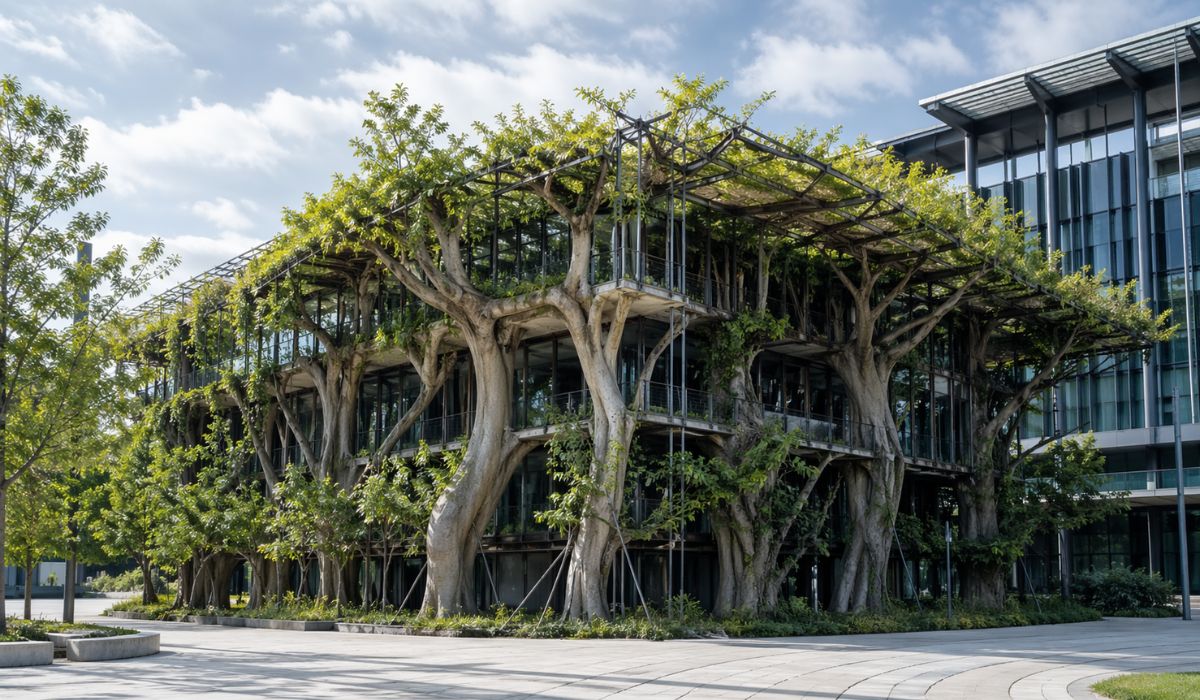


A technique developed in Germany transforms trees into active parts of construction and brings together architecture, botany, and engineering in structures that grow over time, with real applications already tested in prototypes monitored by universities.
The idea of using trees as part of a building’s structure has already been applied in constructed projects in Germany.
Developed by Ferdinand Ludwig, Baubotanik combines living trees and temporary technical elements to form columns, walls, and roofs that transform over time.
Instead of completing the entire construction at once, as is done in conventional building, the method guides the growth of the plants until they begin to serve a structural function.
-
Sweden Removes 200-Ton Concrete Gallery to Restore Pjältån River’s Natural Flow in Europe’s Largest Aquatic Restoration Project

-
Key Infrastructure Projects for Brazil’s Next President: Expanding Railways to Cut Transport Costs, Reduce Truck Traffic, Create Jobs, and Boost Industries Nationwide

-
While China Builds Undersea Rail and Mexico Connects Two Oceans, Brazil Struggles with Grain Transport Due to Lack of Railways
-
Students Build Kansas’ First Hemp-Insulated Social House for a Needy Family: 85% Less Concrete, Solar Roof Returns Energy to Grid, Carbon Negative in Under 20 Years


This was the case with the Baubotanik Tower, built in 2009, and the Platanenkubus in Nagold, inaugurated in 2012.
The proposal does not immediately eliminate steel nor dispense with traditional engineering in the initial phases.
In the beginning, the trees depend on frameworks, supports, and constant management.
Still, the principle of the system is different: the living structure grows, heals, responds to the environment, and can gradually increase its load capacity.
In an interview with Technical University of Munich, Ludwig stated that one of the central points of the method is the relationship between technical design and the fact that the tree continues to grow.
What is Baubotanik and how the technique emerged in Germany
The term Baubotanik was established in 2007 at the Institute of Theory of Architecture and Design at the University of Stuttgart.
Today, the Technical University of Munich defines the field as an engineering approach with living plants, in which living and non-living elements are connected to form a composite structure.
In this process, individual plants unite and begin to function as a larger organism, while technical components integrate into the whole.
The conceptual basis of the method engages with historical references.
Ludwig has cited, in academic presentations, the living bridges cultivated by the Khasi people in northeastern India, and the Tanzlinden in Germany, trees shaped over time to create spaces for collective use.
The difference, according to the research groups involved, is that Baubotanik takes this repertoire into the field of contemporary architecture, with structural calculation, monitoring, and long-term experimentation.
“`html
How living trees bear weight in buildings
At the center of the technique is inosculation, also known as plant anastomosis.
This is the process by which trunks, branches, or roots in continuous contact merge their tissues and form a physiological and mechanical connection.
In test areas at TUM, the university describes the method as based on healing, callus formation, and joint growth.
In recent studies linked to the institution, researchers also point out that these anastomotic networks are an essential part of baubotanical structures.
In practice, construction begins with a temporary technical support.
Then, young trees are positioned at different levels and connected to each other to accelerate volume gain and structure formation.
Describing the Baubotanik Tower and the Plane-Tree-Cube, Ludwig reported that hundreds of trees were connected to each other, with part of the plants rooted in the ground and another part installed in containers supported by a temporary steel structure.
As the years go by, bark and wood merge, and the metal skeleton can be removed when stability reaches the necessary level.
This process does not occur automatically or entirely predictably.
The Stuttgart team itself noted, back in 2010, that it was not possible to accurately anticipate how long the plants would need to independently bear the loads of the building.
In Freiburg, an experimental pavilion started in 2007 with willows had to be redesigned years later, after a loss of stability associated with the death of some plants and the incidence of parasites.
The redesign, initiated in 2017, began to use plane trees as the main base.

Baubotanik Tower, Platanenkubus, and other prototypes in Germany
The first major case was the Baubotanik Tower, completed in 2009 in the area of Neue Kunst am Ried, in Wald-Ruhestetten, near Pfullendorf, in southern Germany.
According to TUM, the experimental tower is almost nine meters tall, has three levels, and about eight square meters of base.
“`The plant part was formed with several hundred white willows, and the system included continuous irrigation for the plants installed in containers on the upper levels.
At that stage, the experimental nature required permanent monitoring, and the load capacity still needed to be verified through tests.
In 2012, the Platanenkubus brought Baubotanik into an urban context.
Installed at the Nagold gardening show, the cube was conceived as a long-term experiment with trees distributed across six levels from the start.
The structure measures 10 meters on each side and forms green walls around an open space for the sky.
In an evaluation published by TUM, the university reported that all the trees had already grown together and recorded a progressive increase in the load capacity of the structure.
Another development of the research appears in the Arbor Kitchen, in Baden-Württemberg.
In this project, a set of 32 plane trees, planted in 2012, began to support a lightweight roof over a communal area with tables and an oven.
TUM reports that the roof, just over 57 square meters, is supported by the existing trees, which transfer the loads to the ground through their own trunks, branches, and roots.
This case shows that the technique is also being tested in public use roofs.


Limits of architecture with living trees and use in urban areas
The interest surrounding Baubotanik is associated with the combination of constructive function and environmental effects.
Ludwig states that, in urban areas, plants can help cool the surroundings and improve the microclimate without requiring separate green areas, as they become part of the building itself.
Therefore, the technique appears in discussions about climate adaptation, shading, and reducing the exposed mineral surface to heat.
At the same time, Baubotanik does not yet present itself as a broad substitute for concrete and steel.
Growth follows the biological rhythm of the species, maintenance is continuous, and there is an evident limit: living organisms can become ill or die.
Furthermore, the project needs to deal with uncertainties that conventional construction tends to reduce.

Research conducted in Freiburg and Stuttgart indicates that architectural design should adapt to the site, and not just the other way around.
This set of factors helps explain why Baubotanik is still treated, in academic circles, as an experimental field of architecture with concrete applications, and not as a standardized market solution.
Nevertheless, the prototypes built in Germany show that trees can play a supporting role in structures designed to grow over the years, provided there is technical oversight, development time, and ongoing control of biological and mechanical conditions.


If you want to get bit by mosquitoes all the time, yes 😁