






 Portuguese
  Spanish


Li-Fi Technology Promises to Revolutionize Wireless Connectivity by Transmitting Data Through Light, with Speeds up to One Hundred Times Faster than Wi-Fi, Greater Security, and Lower Energy Consumption, Potentially Transforming Homes, Businesses, and Transportation.
The Li-Fi, a wireless communication system based on light, emerges as an alternative to Wi-Fi and promises connections up to one hundred times faster, with greater stability and security.
According to experts, the technology could scale over the next decade and change how homes, businesses, and public spaces access the internet.
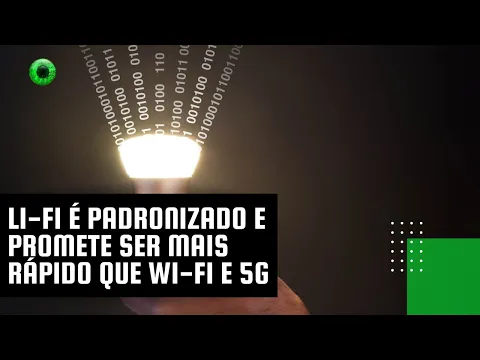
Unlike Wi-Fi, which uses radio waves, Li-Fi transmits data via visible light, ultraviolet, or infrared.
-
Collector adapts forklift electric motor in a Kombi Corujinha pickup, hides 16 batteries under the bed, and makes the Brazilian classic run silently with up to 90 km of range.

-
Goodbye traditional vacuum: Samsung surprises and launches 2-in-1 robot with steam, AI that recognizes floors and stains, self-cleaning station, hot air drying, automatic emptying, water refill, and app control.
-
Brazil is transforming acerola waste discarded by the pulp industry into an ambitious and surprising project that could forever change the way the country utilizes one of the most invisible by-products of the fruit sector.
-
Scientists have created a colossal digital twin to predict tsunamis in real time, a simulation of 55.5 trillion unknowns run on 43,520 GPUs that reduced 50 years of calculation to 0.2 seconds and could change the defense of coastal cities.


The signal is emitted by adapted LED lamps, which vary in intensity at imperceptible cadences to the human eye to encode the information.
This mechanism allows for a high transfer rate and reduces interference, especially in crowded environments.
Although the concept is not new, the recent momentum comes from efficiency gains and practical testing in different sectors.
In scenarios with high user density, Li-Fi stands out for its speed and the control of the light beam, which limits the signal’s propagation to a defined area.
How Light Transmission Happens
In practice, the network operates with light fixtures equipped with transmitters and receivers installed in compatible devices.
The LED modulates the light to send the data packet; on the other side, a sensor converts these variations into digital information.
As the “medium” is the light beam itself, the channel tends to be more predictable than the radio spectrum, which is often subject to noise and frequency contention.
Light communication also benefits from the energy efficiency of LEDs.
The same infrastructure used to illuminate rooms, corridors, and vehicles can, in theory, simultaneously serve as a data channel, reducing steps and utilizing existing installations.
This dual function is cited by developers as a differentiator for large-scale projects.
Speed, Stability, and Security

The most repeated argument by Li-Fi advocates is its superior speed, estimated to be up to 100 times that of traditional Wi-Fi in ideal conditions.
In addition to virtually instant downloads, the model favors buffer-free streaming and low latency, even with many users connected in the same area.
Another point is stability.
Since light does not easily pass through walls, the signal remains confined to the illuminated environment, which reduces external interference and can enhance performance.
This characteristic, consequently, is seen as an advantage for security, because it restricts the range of the data packet and makes unauthorized access from outside more difficult.
What Changes in Infrastructure
Despite the potential, adoption requires adaptations.
To operate on Li-Fi, it will be necessary to install specific light fixtures and incorporate compatible receivers into computers, smartphones, televisions, and industrial sensors.
Manufacturers and integrators will also need to standardize protocols to ensure interoperability between different brands and models.
This update of infrastructure does not happen overnight.
Providers, companies, and public entities often plan investment cycles in networks in advance.
Experts, however, believe that the replacement can occur gradually, starting in environments where the technical advantages are most evident and the benefits justify the initial cost.
Applications in Critical Environments
In healthcare, the technology emerges as an alternative where radio waves are undesirable due to the risk of interference.
Hospitals and clinics could provide connectivity to electronic records, monitors, and team tablets without compromising the operation of sensitive equipment.
In transportation, the proposal is to bring stable connectivity to airplanes, subways, and trains, utilizing the lighting already present in the cabins.
With light as the medium, the system tends to maintain consistent performance even with many passengers connected, in addition to allowing for the delineation of access areas.
In cultural spaces, such as museums and exhibition centers, Li-Fi enables immersive experiences.
The lighting in the rooms can transmit multimedia content to the visitor’s mobile phone, according to the position and the observed collection, without overloading local radio networks.
Limits, Challenges, and Adoption Horizon
Although it promises significant gains, Li-Fi has contour conditions.
The signal depends on line of sight or, at least, sufficient reflection to reach the receiver; obstacles can degrade the connection.
In places with reduced or no lighting, the network requires arrangements that keep the infrared beam active without compromising visual comfort.
Therefore, experts point out that coexistence with Wi-Fi and other wireless technologies will likely continue for years, with each serving specific scenarios.
There is also the challenge of distributing compatible devices.
While Wi-Fi routers are widely spread, Li-Fi modules are still a minority in the consumer market.
Massification depends on agreements with manufacturers, incentives for testing in real environments, and, primarily, on widely accepted communication standards to guide projects and ensure that one device can work with another.
Even so, the sector’s expectation is for progressive advancement.
Researchers and companies estimate that within ten years, Li-Fi could establish itself as a new connectivity standard in relevant niches, paving the way for broader adoption as costs decrease and mature solutions prove themselves in everyday use.
What to Expect for Homes and Offices
In residences, the transition tends to start with specific applications, such as home office rooms, study spaces, or entertainment areas that require high bandwidth.
Offices and industrial plants, on the other hand, may opt for deployments by sector or by floor, prioritizing areas with higher densities of people and performance needs.
Integration with smart lighting systems is expected to become a central focus of these projects.
In a typical scenario, light points would operate as “access cells,” with power control, targeting, and handover between fixtures to maintain a stable session as the user moves around.
Network management, therefore, will need to consider both connectivity parameters and energy efficiency and comfort.
Why the Debate Gained Traction Now
The renewed interest in alternatives to Wi-Fi comes at a time of continuous data traffic increase and competition for spectrum in urban areas.
The ability to use light — a resource present in almost all environments — as a transmission medium creates a parallel channel to relieve traditional networks, maintaining performance for critical applications.
For IT managers and urban planners, the central question becomes where Li-Fi adds the most concerning cost and implementation complexity.
In places with strict security requirements and signal predictability, technical arguments are stronger.
In others, the combination of Wi-Fi, mobile networks, and cables will continue to be the best cost-benefit solution until mass production brings more affordable prices.
As initial experiences take shape, the discussion about connectivity through light leaves the laboratory and reaches pilot projects in sectors such as healthcare, aviation, railway transportation, and exhibition spaces.
As results are released and compatible devices become more common, the decision to adopt Li-Fi will shift from being a bet to a calculable return — in your home and at your work, in which scenario would light make more sense as a data channel?


Isso não é novidade pois é para ter maior domínio e encontrar as pessoas que denegrirem o sistema, acredite nada é feito para melhoria da população, e sim para prejudicar o povo,
Achei muito interessante está nova tecnologia, espero que possam implanta-la com sucesso o mais breve possível.
Deus abençoe os desenvolvedores!!
Mas pelo que entendi para assistir a um filme ou mexer no celular a noite no escuro como fazemos como wi fi não seria possível já que precisa de luz para obter internet
É aqui é que tá, da mesma forma que existe uma lâmpada na sua casa que coleta os raios de energia e acende sua lâmpada, vai existir um aparelho que armazena essa luz ultravioleta e etc durante o dia, e faz a utilização dela a noite!