Portuguese
  Spanish


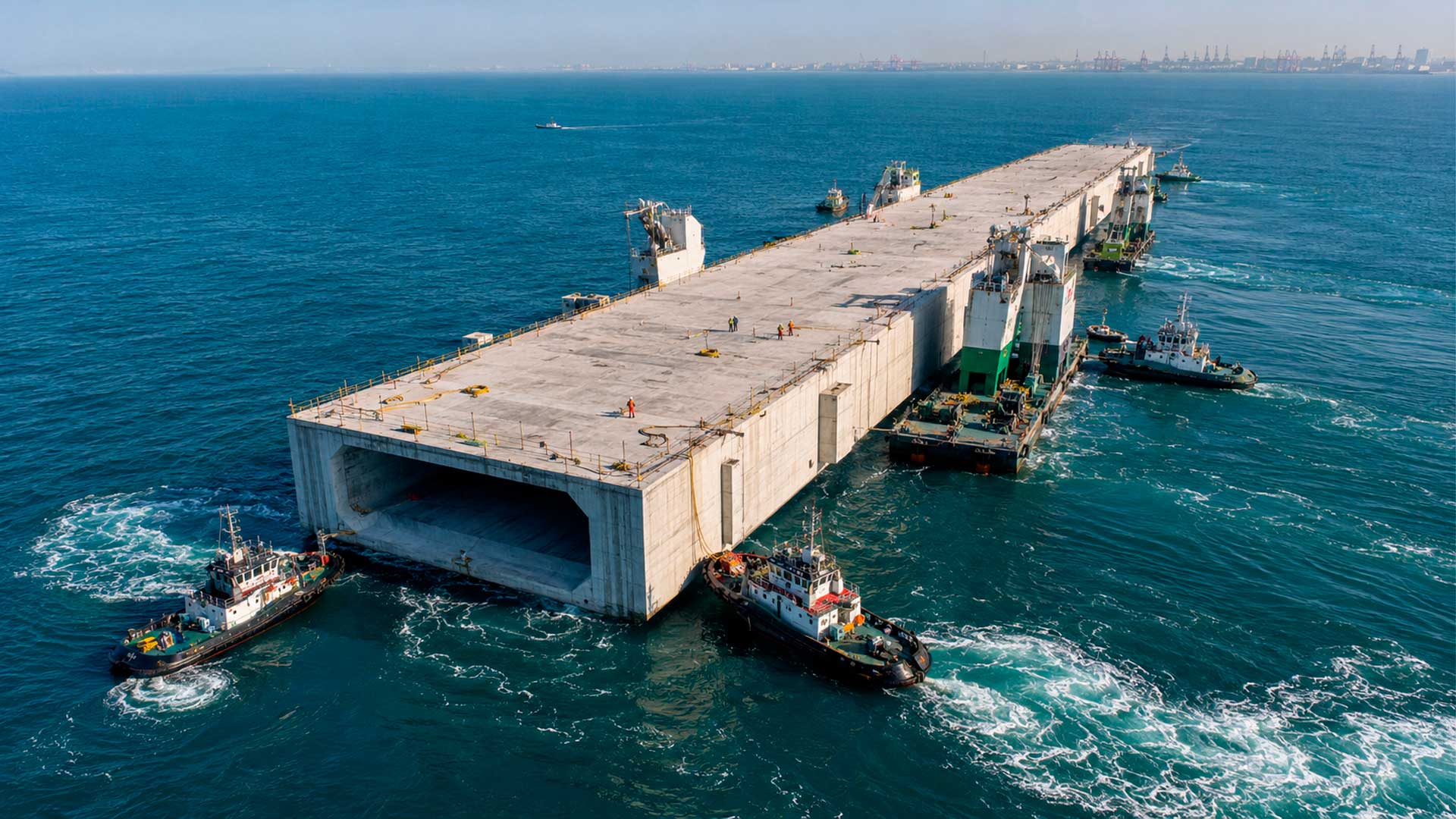

The Busan Geoje link reduced a long journey along the South Korean coast with an unusual solution in civil engineering. Instead of building a bridge over the entire maritime stretch, the project used giant concrete pieces constructed on land, transported by tugboats, and sunk into a prepared trench at the sea bottom.
In 2010, South Korea put into operation one of the most complex roadworks ever done in open sea. The Busan Geoje Fixed Link connected the Busan region to Geoje Island with a set of cable-stayed bridges, rock tunnels, and a submerged section formed by 18 concrete elements.
The most striking point is not just the length of the link. In the immersed tunnel, each piece was about 180 meters long, over 26 meters wide, and weighed tens of thousands of tons.
These blocks were not molded directly at the sea bottom. They were manufactured in a pre-molding area, floated, towed for dozens of kilometers, and installed one by one in a submarine trench, with a horizontal tolerance of approximately 20 millimeters in the final positioning.
-
Chinese Tianwen-2 Mission Targets Near-Earth Asteroid After 1 Billion Kilometer Journey to Collect Ancient Samples, Aiming to Uncover Clues About Water, Organic Compounds, and Solar System Origins Before Heading to a Comet

-
France Constructs 900-Meter Sea Wall in Brest, Expands Port by 14 Hectares for Marine Renewable Energy Hub

-
New Discovery Suggests Prehistoric “Hobbits” May Have Survived on Komodo Dragon Remains

-
Tiny 10-centimeter fish in Brazilian reservoirs may play a surprising role in reducing methane emissions, scientists find.


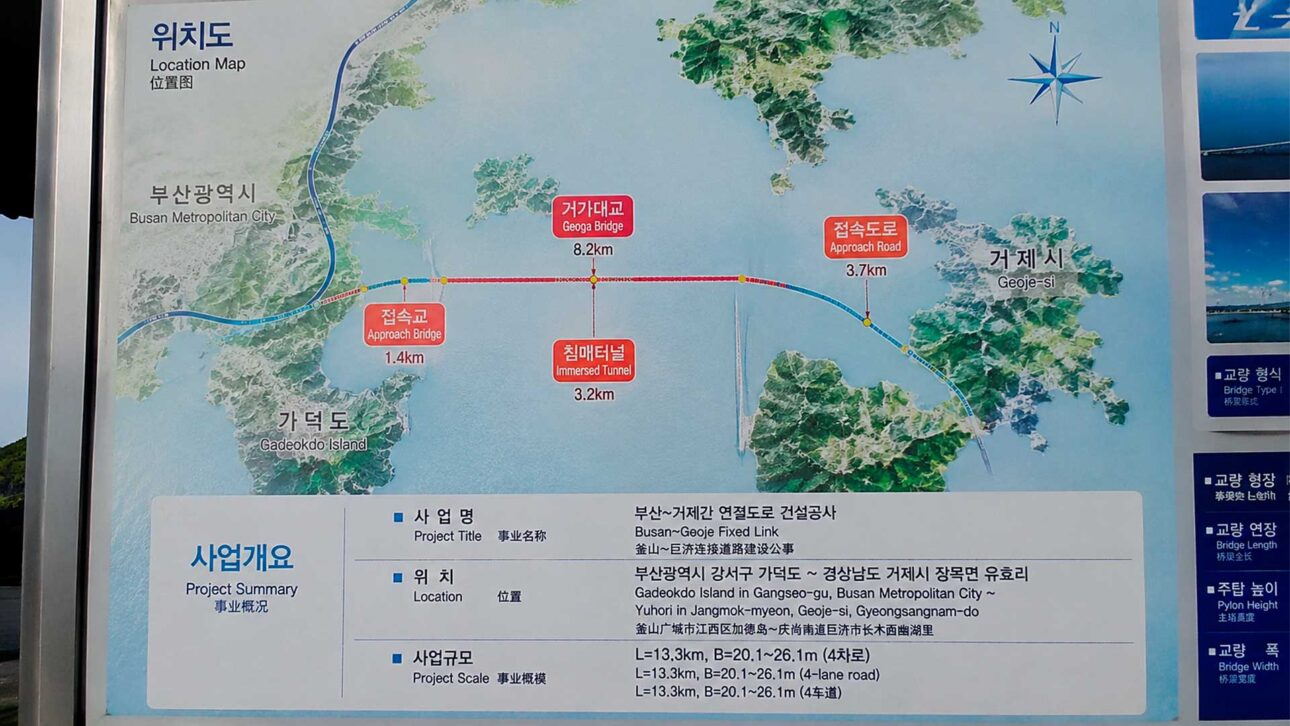
According to the technical sheet of Strukton Immersion Projects, the immersed section of the tunnel is 3,240 meters long, was made for road traffic in a 2×2 lane configuration, and reached a maximum depth of 48.5 meters at element TE13.
The blocks emerged from the land as if they were concrete ships
The construction followed a different logic from a dug tunnel. First, the concrete elements were produced in a temporary pre-molding area. Then, the dock was flooded so that each module could float.


From there, the blocks were moved to a waiting area at sea. They remained there until waves, wind, and currents were within a safe window for the operation.
According to the specialized publication Tunnels & Tunnelling International, the 18 elements weighed up to 48 thousand tons, were molded in the Anjeong dry dock and towed for about 36 km before immersion, in an operation that could take about 40 hours per element.
This process explains why the project gained prominence outside South Korea. The challenge was not just to build a giant piece. It was to control a concrete structure the size of a horizontal building, floating in the sea, and lower it precisely to almost 50 meters deep.
The tunnel was not chosen by chance in the most sensitive section

The connection between Busan and Geoje is not formed only by the submerged tunnel. The complete project is over 8 km and combines two cable-stayed bridges, tunnels on intermediate islands, and the immersed section between Jungjuk and Gadeok.
The choice for the tunnel in the main section had a practical reason. Part of the route crosses an area used by heavy navigation and naval traffic. A bridge at this point could create restrictions for ships and strategic operations.
The technical article published in the magazine Tunnelling and Underground Space Technology describes the Busan Geoje Fixed Link as a connection with two large cable-stayed spans, rock tunnels, and an immersed tunnel of 18 elements, in a region with a difficult seabed, weak clay, rock sections, and seismic sensitivity.
In practice, the project needed to solve three problems at the same time. The seabed was not uniform, the area received long waves coming from the open sea, and the depth increased the pressure on joints, seals, and installation equipment.
Precision depended on wave prediction, GPS, and acoustic sensors
The installation of the modules could not be done on just any day. The sea needed to be within defined limits before transport, during descent, and when connecting to the previous block.
To reduce risk, the operation used catamaran-type floating gantries, wave prediction systems, tensioned cables, distance sensors, GPS, and USBL acoustic technology. The goal was to bring each piece closer to the previous one without abrupt movements at the moment of joining.
As reported by Immontec, a company linked to Strukton’s history, the elements were sensitive to currents and waves, so the immersion system was tested on a reduced scale in a maritime laboratory before field operations.
Another detail not very visible to those just crossing the road is the remote control of the operation. Since the project did not use a conventional access shaft, equipment inside the elements needed to be monitored from a command unit installed on the pontoons.
The road shortened travel and became a showcase of South Korean engineering
When the link was opened in December 2010, it provided a direct route between Busan and Geoje, a region associated with the South Korean shipbuilding industry. The island hosts large shipyards and relied on longer land routes before the project’s completion.
The Korea Times reported at the time that the section between Gadeok and Daejuk was made as an immersed tunnel, while the rest of the route combined cable-stayed bridges and tunnels over intermediate islands. The publication also highlighted that the construction reduced travel time and created a more efficient logistical connection for the country’s southern coast.
The benefit was not just for drivers. The connection also served the region’s industrial chain, especially suppliers, workers, and companies linked to shipbuilding in Geoje and Busan.
From an engineering perspective, the project became a reference because it brought the immersed tunnel technique to a more aggressive environment than rivers and sheltered canals. There, the pieces were installed in open sea, with high depth, long waves, and a requirement for millimetric precision.
What looks like an ordinary road hides a construction assembled piece by piece at the bottom of the sea
Today, those who cross the link between Busan and Geoje pass through infrastructure that seems simple on the surface. But below sea level, there is a sequence of concrete blocks laid on a gravel bed, connected by watertight joints, and covered by protective fill.
The Busan city hall, when reproducing information from the Korea Herald in 2006, already pointed out that the 18 prefabricated elements would weigh between 45,000 and 50,000 tons, would be built in Anjung, floated to the site, and sunk into a pre-dredged trench.
This type of construction shows an engineering choice that is not intuitive to the public. Instead of drilling the entire seabed or placing pillars in the path of ships, the designers created a submerged road with ready-made modules, transported as floating structures and fitted at the bottom of the sea.
The result is one of the strongest images of modern infrastructure. A road tunnel that was born on solid ground, crossed the sea towed by vessels, and ended up functioning at almost 50 meters deep, without appearing to those driving over it.
Do you think constructions of this type should be more used in coastal regions with heavy ship traffic, or do the costs and technical risks still limit this model? Leave your comment and say which detail of the Busan Geoje tunnel construction caught your attention the most.