






 Portuguese
  Spanish


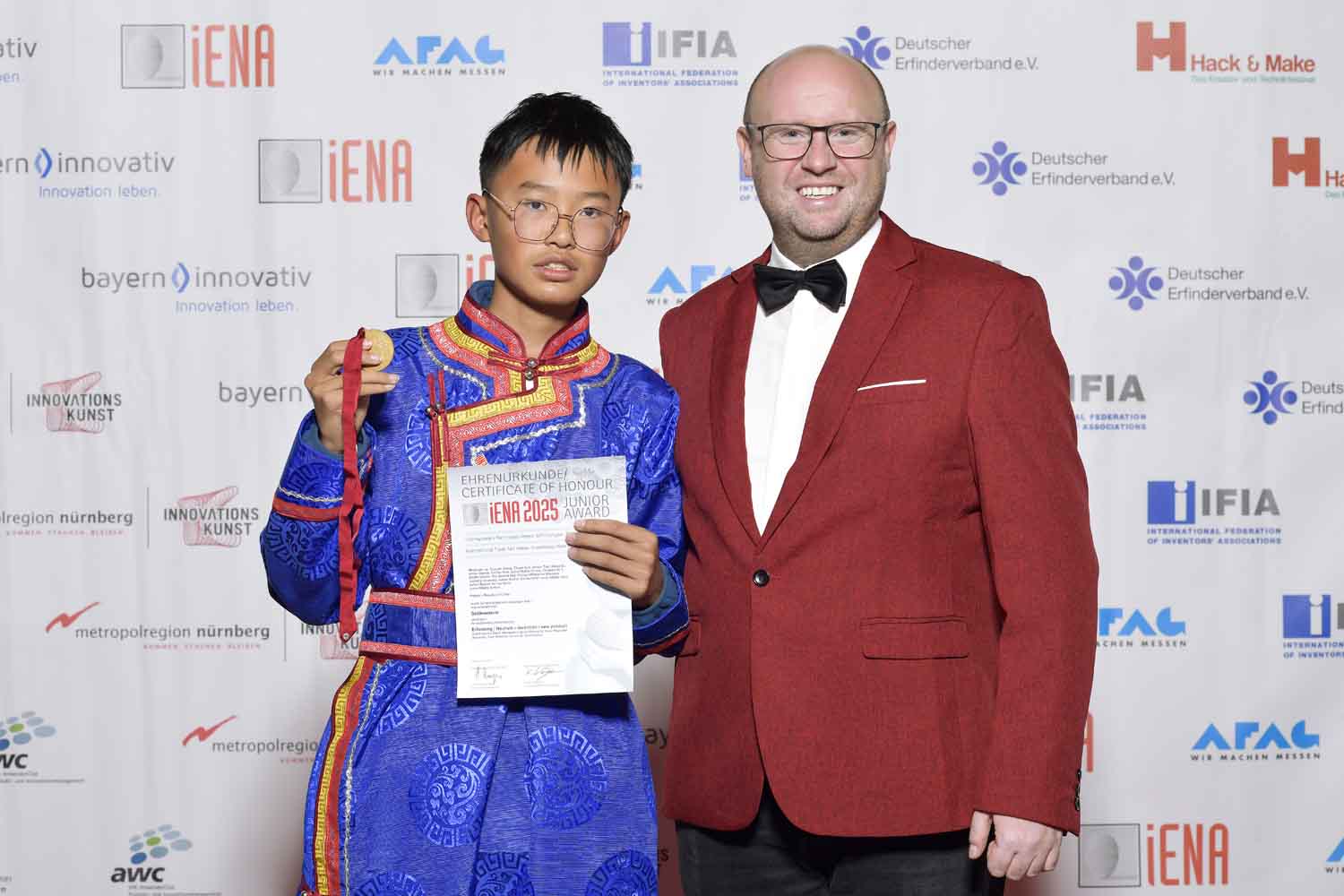

A school project developed in northern China brought a simple irrigation solution to an international fair, amidst the challenge of keeping seedlings alive in dry and degraded areas.
The Chinese student Jia Mingxuan, 14 years old, developed an automatic device to aid the irrigation of seedlings in arid areas of Inner Mongolia, northern China.
The structure uses buried steel tubes to condense air moisture and direct water droplets around the roots.
The project received a gold medal in the youth group at the 77th iENA, an international fair of ideas, inventions, and new products held in Nuremberg, Germany, from November 1 to 3, 2025.
-
Desertification Threatens Brazil’s Caatinga: 85% of Semi-Arid Region Affected, 30 Million at Risk, and Efforts Underway to Restore 10 Million Hectares by 2045

-
Few People Realize Earth Spins at 1,670 km/h Unnoticed: Explained by Gravity and Brain Perception

-
China Turns Solar Panels into “Umbrellas” in the Desert, Protecting Goji Berry Farms and Aiming to Restore 7,000 km² of Degraded Land by 2030
-
China Launches 40,000-Ton Amphibious Carrier with Electromagnetic Catapult for Drones, Enhancing Naval Power in the Pacific.


The invention was presented as an irrigation system aimed at young trees in dry regions.
According to the Chinese state agency Xinhua, Jia built the prototype with steel tubes bought from a hardware store and recycled plastic bottles.
The proposal does not use traditional hydraulic pumps nor depends on electrical connection to operate the condensation process.
According to data released by the International Federation of Inventors’ Associations, the 2025 edition of iENA gathered more than 540 inventions presented by 274 exhibitors from 21 countries and regions.
The event took place in Hall C3 of the Nuremberg Exhibition Center and included projects from different areas, such as engineering, health, environment, and applied technology.
How the underground irrigation system emerged
Jia lives in Chifeng, in the Inner Mongolia Autonomous Region, an area prone to drought, winds, and soil degradation processes.
Aohan County, associated with the project’s development, is described by the Chinese press as a region with an arid and semi-arid climate, with an average annual precipitation of about 380 millimeters.
The idea emerged in March 2025, after a school assignment that asked students to create invention themes.
According to a report published by Xinhua, the teenager related a physics class to the droplets formed by steam in the kitchen at home.
From this observation, he began to design a structure capable of capturing water vapor from the air and directing it to the soil.
The problem chosen by Jia was linked to the survival of seedlings in areas with low water availability.
In dry regions, newly planted trees may die before the roots develop enough to withstand drought periods.
Manual irrigation, in turn, tends to require movement, labor, and regular access to water sources, conditions that do not always exist in remote areas.
Steel tubes use temperature difference in the soil
The system’s operation is based on condensation.
A steel tube is buried in the ground, with an upper structure designed to direct air into the equipment.
When the vapor comes into contact with the cooler underground part, the temperature difference favors the formation of droplets.
Once condensed, the water flows inside the tube and reaches the root surroundings.
Thus, moisture is delivered below the surface, where it is less exposed to immediate evaporation.
The structure was designed to reduce the dependence on conventional irrigation in areas where water transportation represents a practical limitation.
The Chinese newspaper Science and Technology Daily reported that the device takes advantage of the thermal variation observed in Chifeng in the summer, with an average of approximately 27°C during the day and 14°C at night.
This contrast helps explain the choice of vertically buried hollow tubes, as the difference between the surface and underground is a central part of the physical process used in the prototype.
30 km trips marked the prototype tests
The development required successive attempts.
According to Xinhua, Jia studied in a boarding school and needed to travel about 30 km to the family home to monitor the tests.
On some occasions, he would wake up at 4 am to unearth part of the setup, check humidity measurements, and return to classes.
The first versions did not have the expected result.
A report by Xinhua in Chinese stated that the initial prototype did not collect water, and other attempts also failed.
After adjustments to increase the thermal difference inside the tube, the student observed an accumulation of about one centimeter of water at the bottom of the device during a weekend of tests.
The family participated in the construction and verification of the equipment.
According to the report, the grandfather contributed suggestions, the father helped with cutting, drilling, transportation, and excavations, and the mother recorded stages on video.
The information indicates that the project was developed in a school and family environment before reaching the international fair.
Gold medal at iENA increased visibility
The medal was received in early November 2025.
The Chinese newspaper Chutian Metropolis Daily reported that the award was presented on the afternoon of November 3, local time in Germany.
Xinhua later published an image of Jia displaying the medal in Nuremberg on November 4.
In the coverage by the Chinese agency, the project appears alongside other youth inventions of greater technological complexity, such as surgical robots and brain-computer interfaces.
The recognition granted to the irrigation device was attributed to the application of basic physics principles to a concrete environmental problem.
The iENA is presented by entities related to the event as an international fair focused on the exhibition of inventions, prototypes, and technical solutions.
In the 2025 edition, the projects submitted came from different countries and fields of knowledge, which contextualizes the reach of the award obtained by the Chinese student.
Desertification Increases Relevance of Irrigation Technologies
The invention gained attention for being linked to an environmental challenge documented by international organizations.
The United Nations Convention to Combat Desertification states that up to 40% of the planet’s land is degraded, affecting populations, ecosystems, and economic activities.
In the case of Aohan, environmental restoration is related to reforestation and sand control projects in northern China.
The region is associated with the Three-North Shelter Forest Program, a Chinese initiative for planting and protection against desertification.
According to Xinhua, the local forest coverage reached about 40.6%, with approximately 373 thousand hectares, after decades of actions in this area.
Even with these programs, newly planted seedlings remain vulnerable to water scarcity, as reported by the consulted Chinese sources.
Jia’s device aims to act at this initial stage, providing moisture during the rooting period.
However, practical application still depends on broader tests and technical validation outside the context of the school prototype.


