





 Portuguese
  English
  Spanish
  6 min of reading
  0 comments


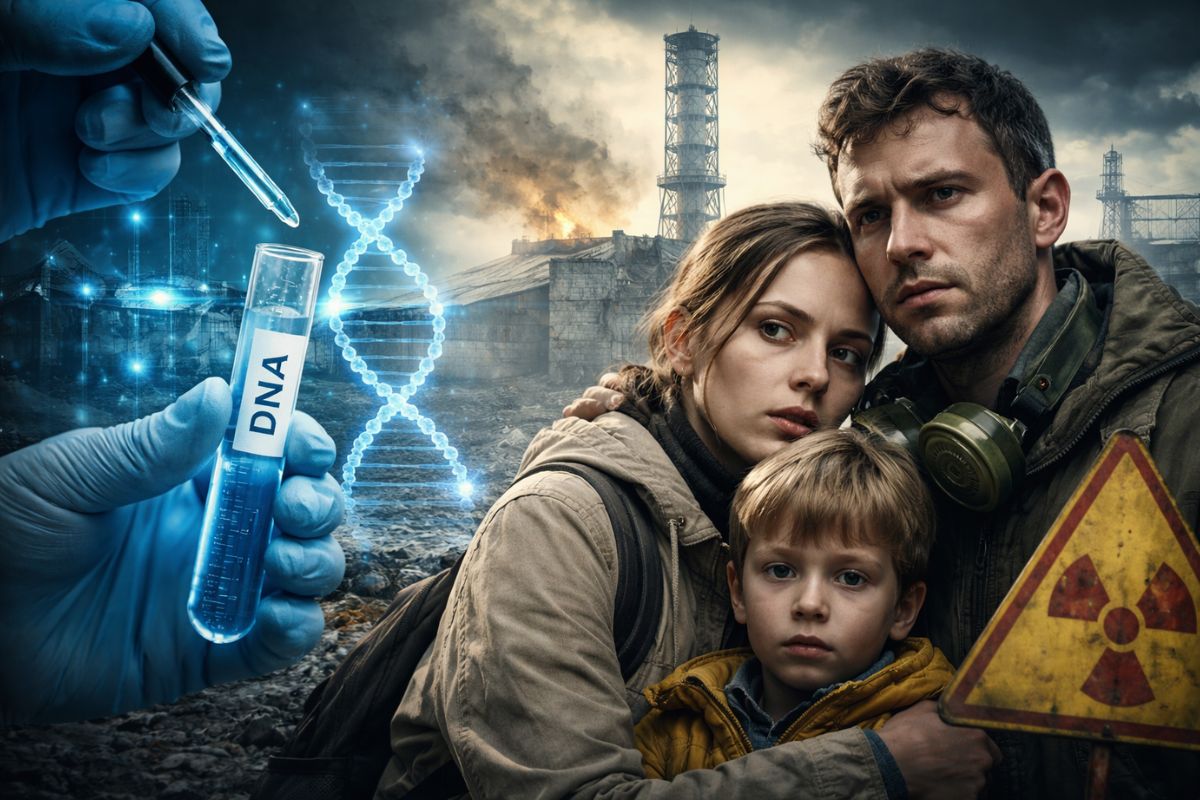
In Chernobyl, the 1986 exposure did not stay only in memory: whole-genome sequencing in descendants of liquidators and residents of Pripyat revealed an increase in cluster mutations, a sign of breaks and failed repairs in parental DNA. Nevertheless, the authors associate low risk of diseases in the future.
Chernobyl returned to the center of scientific debate for a specific reason: for the first time, a study clearly demonstrated that signs of DNA damage in workers exposed to radiation can appear in the next generation. The discovery does not claim a “genetic fate,” but describes measurable marks that cross family lines.
The point that makes this relevant is the nuance: it is not about saying that children will fall ill, but about showing that certain traits of mutation may be inherited even when the associated risk of disease is described as extremely low. Between historical memory, molecular biology, and the limits of old data, Chernobyl continues to raise difficult questions now with more concrete evidence.
What Was Observed and Why This Changes the Discussion

For decades, the hypothesis that radiation from the 1986 accident could leave “hereditary signatures” in the genomes of the children of the exposed was surrounded by uncertainties.
-
China bets on a fire blanket that withstands up to 1,000°C and can smother flames in seconds without water or foam.

-
Blue antelope extinct for 200 years may reappear to become a ‘living legend’ of biology after company uses museum DNA to revive African animal in the coming years
-
Colombia targets the hidden heat underground to generate clean energy, while Ecopetrol bets on an 80 MW geothermal project capable of producing 610 GWh per year and supplying users across an entire department in the south of the country.

-
The James Webb telescope aimed at a giant planet 330 light-years from Earth and measured, for the first time, a surprisingly mild temperature, more similar to ours than to the furnace of other planets of the type.



Part of this stemmed from technical limitations: many previous studies could not distinguish noise, natural variations, and mutations that were truly related to exposure.
The new finding takes an important step by focusing on a particular type of genetic evidence, rather than trying to find “any mutation” in the next generation.
By directing the analysis to patterns that suggest DNA breaks followed by imperfect repair, the research seeks a plausible mechanism of how exposure in Chernobyl could be recorded in the genomes of descendants, even decades later.
Who Were the Participants and How the Study Was Designed
The analysis was based on whole genome sequencing scans with three groups. The group directly linked to Chernobyl included 130 descendants of workers involved in the disaster response and also of people who lived in Pripyat at the time of the accident.
These parents had a history of exposure in the context of the city and the activities of guarding, cleaning, and containing the site.
For comparison, there was an additional group of 110 descendants of German military radar operators, who were considered likely exposed to dispersed radiation.
As an essential reference to separate signal from background, the study used 1,275 descendants of unexposed parents, serving as controls.
What Are cDNMs and How They Signal Damage and Repair in DNA
Rather than only looking for “new” mutations in children, researchers sought the so-called cluster de novo mutations (cDNMs). In practice, this means two or more mutations close to each other, detected in the children, but absent in the parents’ DNA.
The central interpretation is that this “clustering” is not an aesthetic detail of the genome: it suggests that there was a break in the parental DNA strand and that the biological repair occurred inadequately.
This type of pattern is consistent with a process of damage and failed repair, and it is precisely here that the study attempts to connect exposure to ionizing radiation and genetic inheritance, with a more specific target than previous research.
How Ionizing Radiation Can Leave Marks on Genetic Material
The nuclear power plant accident at Chernobyl occurred in 1986, when the explosion of reactor 4 released large amounts of cesium-137, iodine-131, and other radioactive materials.
The contamination affected more than 2,600 km², and thousands of people were forced to evacuate hastily, with Pripyat becoming a lasting symbol of evacuation and social rupture.
At the cellular level, the proposed explanation links ionizing radiation to the generation of reactive oxygen species (unstable and highly reactive molecules).
These molecules can break DNA strands, and, if the damage affects developing sperm cells, they leave a favorable scenario for breaks and repairs with “genetic scars.” When these individuals have children, some of these marks may be transmitted and become part of the genetic code of the descendants.
How Much Did the Mutational Count Increase and What Does This Mean
The reported average numbers show a clear difference between the groups: 2.65 cDNMs per child in the group associated with Chernobyl, 1.48 per child in the group of German radar operators, and 0.88 per child in the control group.
The authors acknowledge that these values may be overestimated due to noise in the data but highlight that even after statistical adjustments, the difference remained significant.
Additionally, there was an indication of possible association between dose estimates and the number of cDNMs in the descendants, which reinforces the consistency of the finding within the study’s logic. Still, this association does not turn cDNMs into a “sentence”: it indicates trend and biological compatibility, not an inevitable individual prediction.
The most sensitive point, and at the same time the most enlightening, is that researchers describe the risk of diseases resulting from these mutations as extremely low.
In other words, the genome may carry subtle marks from Chernobyl’s past without this automatically translating into a significant increase in diseases—a crucial distinction to avoid alarmism and keep the discussion rooted in evidence.
Limitations, Uncertainties, and Caution When Interpreting “Dose” and Risk
There are inevitable limitations when the initial exposure happened decades ago. Exposure estimates had to be reconstructed from historical records and outdated devices, which introduces a margin of error.
The dose was not “measured in real time” with current tools, and this affects the accuracy of any fine correlation between exposure and genetic effect.
Another important point is the voluntary design of participation. People who believed they had been exposed may have had a greater motivation to enroll in the study, which can produce bias.
This possibility does not invalidate the finding, but requires careful reading: the strength of the work lies in the detection of a consistent genetic pattern comparable between groups, not in turning the sample into a perfect portrait of the entire population affected by Chernobyl.
What Remains as Practical Legacy: Safety, Monitoring, and Memory
Even with the disease risk described as very low, the study reinforces a practical message: prolonged exposure to ionizing radiation can leave subtle traces in DNA over generations.
In occupational environments or accident contexts, this places focus on safety precautions, careful monitoring, and exposure traceability, especially for frontline workers.
Chernobyl also becomes, once again, an example of how science and history intertwine. Genetics does not replace the social memory of the disaster but offers another lens to understand consequences that do not appear immediately.
And by mapping inherited signals without associating them with a disease surge, the discussion gains maturity: it is possible to recognize biological effect without inflating fear, maintaining the priority on protection, transparency, and monitoring.
Chernobyl continues to mark generations because the 1986 accident was not just a technical event: it was a human, territorial, and biological rupture.
The study adds an important detail to this story by showing cluster mutations in the children of exposed workers, suggesting damage and imperfect repair in parental DNA while also indicating very low disease risk.
And you, when you think about Chernobyl today, what weighs more: the memory of the disaster, trust in science to measure long-term effects, or how governments and companies should protect those who work under risk? If someone in your family has ever experienced a work accident or environmental exposure, has that changed your view on safety and monitoring?


Be the first to react!