Portuguese
  Spanish


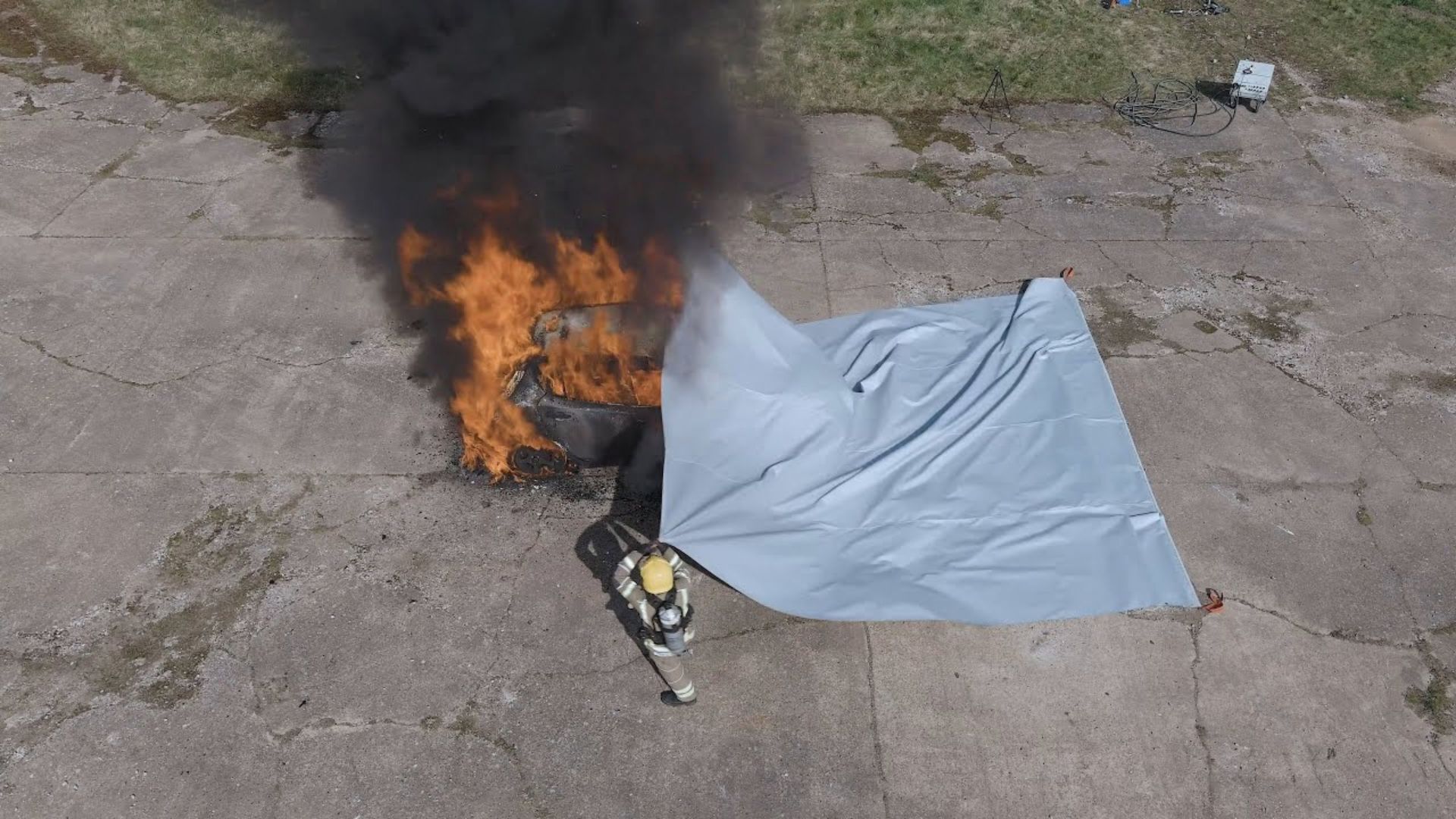


China develops fiberglass fire blankets that withstand up to 1,000°C and promise to contain fires without using water.
China is expanding the production of a new generation of fire blankets made with fiberglass and materials resistant to extreme temperatures. The equipment was developed to quickly smother flames by blocking the fire’s contact with oxygen, eliminating the immediate need for water or chemical foam in certain situations. The most advanced models released by Chinesemanufacturers are mainly aimed at vehicle fires, industrial kitchens, workshops, welding areas, and environments with electrical equipment. Some blankets released by companies like Suntex have continuous thermal resistance of up to 1,000°C and can withstand even higher instant peaks.
The growth of this market comes at a time when fires involving electric vehicles, lithium batteries, and industrial equipment increase the global demand for quick fire containment solutions without relying solely on traditional extinguishers.
Chinese fire blanket uses fiberglass to smother fires without water
The operating principle of the fire blanket is relatively simple. The material is placed over the flames to cut off the supply of oxygen, an essential element to keep combustion active.
-
The Trap of Modern Technology: How Screen Overload and Digital Connections Can Impact Your Mental Health and Well-being

-
Wyoming Couple Grows Tropical Fruits Year-Round in -40°C Using Geothermal Greenhouse, Demonstrating Earth’s Heat Can Produce Oranges and Lemons in Snow Without Traditional Heating

-
Ship Returns from Brazilian Coast with Thirty Newly Discovered Life Forms
-
Nigerian Professor Invents Electricity-Free Refrigerator Using Clay Pots and Wet Sand, Extending Shelf Life of Vegetables to 27 Days; 7,000 Units Distributed in Energy-Deprived Villages




According to Chinese manufacturers, the blankets are produced with fiberglass fabrics, high thermal resistance silica, and flame retardant coatings. In many cases, the material is also treated to withstand direct contact with extreme temperatures without melting quickly.
The structure allows the equipment to be used to contain initial fires in vehicles, electrical equipment, workshops, and kitchens. Unlike water, the system does not spread flammable liquids and can reduce the spread of flames in the early moments of the fire.
Resistance of up to 1,000°C places fire blankets among the most extreme materials in the category
Chinese manufacturers claim that some models can continuously operate at temperatures close to 1,000°C. There are versions aimed at automotive fires that use reinforced silica fabric and flame-retardant coating on both sides.
Suntex, one of the companies marketing the product, states that certain models withstand up to 1,500°C in instant peaks and up to 1,000°C in continuous operation.
These numbers place the equipment above the thermal resistance found in many conventional industrial fabrics. The goal is to allow the blanket to remain over the fire long enough to reduce temperature, smoke, and fire spread.
Fires in electric cars accelerate demand for giant fire blankets
The advancement of electric vehicles has become one of the main drivers of this market. Fires involving lithium-ion batteries are considered more difficult to control because the cells can continue reacting chemically even without external oxygen.
Therefore, manufacturers make it clear that the fire blanket does not necessarily completely extinguish a fire in an electric car battery. The equipment mainly serves to contain the flames, reduce spread, and protect nearby areas until the arrival of specialized teams.

Some Chinese models measure up to 6 × 8 meters or 6 × 9 meters, large enough to cover SUVs, pickups, and larger electric vehicles. The weight can exceed 30 kilograms depending on the material thickness and thermal protection layer.
How the fire blanket can suffocate flames in seconds
Fire depends on three basic elements: fuel, heat, and oxygen. This concept is known as the fire triangle. When the blanket completely covers the burning area, the oxygen flow quickly decreases.
In smaller or initial fires, this can reduce the flames in a few seconds. This is exactly the effect shown in promotional videos released by manufacturers and fire brigades.
China transforms fire blankets into strategic equipment for electric vehicles
The increase in lithium battery fires has led several countries to start testing giant thermal blankets in parking lots, tunnels, ferries, workshops, and logistics centers.
Chinese manufacturers are taking advantage of this global demand to expand exports. Chinese industrial platforms already display dozens of models specifically aimed at fires in electric and hybrid vehicles.

The focus is not just on extinguishing the fire. In many scenarios, the priority is to prevent the flames from reaching nearby cars, urban structures, or industrial areas while firefighters work on cooling the vehicle.
Fire blankets can reduce toxic smoke and flame spread
Another advantage pointed out by manufacturers is the partial reduction of smoke, radiant heat, and particles released by the fire. When the fire is isolated under the blanket, the spread tends to slow down.
This is especially relevant in enclosed spaces, such as underground parking lots, workshops, ferries, and logistics warehouses. In vehicle fires, the radiated heat can quickly reach nearby cars and create a chain effect.
By completely covering the vehicle, the blanket helps create a temporary thermal barrier. Even when it does not completely extinguish the fire, the system can extend the available time for evacuation and emergency response.
Fire blanket does not completely replace extinguishers and professional firefighting
Despite technological advances, experts and manufacturers warn that the fire blanket does not eliminate the need for firefighters, automatic systems, and traditional fire-fighting protocols.
In large-scale fires, especially in lithium batteries, it may still be necessary to use large volumes of water for continuous cooling. Suntex itself states that the blanket primarily acts in containing and isolating flames in electric vehicles.

Even so, the technology shows how materials resistant to extreme temperatures are beginning to change the initial firefighting. What once relied solely on chemical extinguishers now includes giant thermal barriers capable of withstanding heat close to that found in severe industrial environments.