





 Portuguese
  English
  Spanish
  7 min of reading
  3 comments


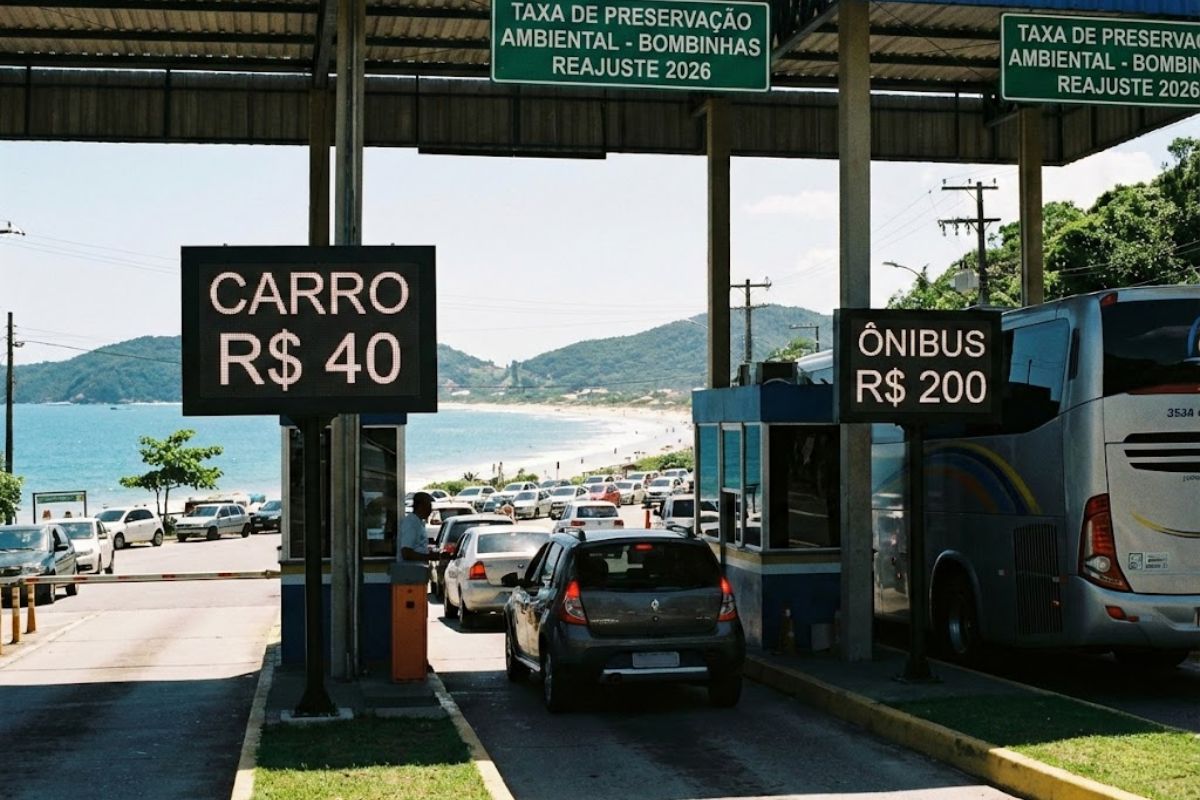


The Environmental Preservation Fee in Bombinhas, located on the northern coast of Santa Catarina, had its values updated and began to be applied this Thursday (1st). The charge is calculated in UFRM, converted into reais, and rounded. It ranges from R$ 5 for motorcycles to R$ 200 for buses as a management tool.
The fee to enter Bombinhas, on the northern coast of Santa Catarina, was adjusted and took effect this Thursday (1st), according to the Bombinhas City Hall. The update applies to vehicles entering the municipality and redefines how much each category pays, according to the table released by the municipal administration.
With the adjustment, passenger cars now pay R$ 40, while the maximum amount can reach R$ 200 for buses. The city hall explains that the charge follows municipal legislation: the fee is set in the Municipal Tax Reference Unit (UFRM) and is then converted into reais according to the type of vehicle, with rounding when the calculation results in cents.
What Is the Environmental Preservation Fee in Bombinhas
The Environmental Preservation Fee (TPA) is a fee established by municipal law and treated by the administration as a public management tool.
-
Does Bolsa Família create dependency? Understand how the social program works and why this question has once again divided opinions in Brazil.

-
Free PIX for Brazilians bothered the US: understand why Trump accuses the Central Bank of giving an unfair advantage to Brazil’s payment system
-
São Paulo creates over 202,000 formal jobs in four months, leads the national balance, and records an average admission salary of R$ 2,693.01
-
While 14.8 million workers await the end of the 6×1 schedule, Flávio Rocha, owner of Riachuelo, claims that retail costs will rise by up to 20%, says companies will pass everything onto prices or resort to mass layoffs, and calls the debate ‘populism’ in an election year.


The proposal, according to the Bombinhas City Hall, is to help balance the intense flow of visitors, especially during the high season, with environmental preservation and the maintenance of the quality of services offered to both the local population and tourists.
In practice, the city hall positions the fee as a way to deal with the pressure that tourism can cause in a municipality with high demand.
This involves higher demands for cleanliness as well as the need for infrastructure and organization of visited areas, such as beaches and trails.
When the Fee Adjustment Took Effect
The city hall informs that the adjusted values of the fee were applied from this Thursday (1st).
This means that, from this date, vehicles entering the municipality are subject to the updated table, according to the category in which they fall.
The central point is that the change is not just a future announcement: it is already in effect, and the municipal guidance is that payment should be made through the available channels, including digital options and self-service points in strategic locations.
How the Fee Is Calculated: UFRM, Conversion, and Rounding
One detail that explains why the fee has specific and closed values in reais is the calculation method defined in municipal legislation.
According to the city hall, the TPA is set in Municipal Tax Reference Unit (UFRM) and then converted into reais based on the type of vehicle.
Additionally, there is an important practical rule: when the conversion generates a value with cents, rounding occurs.
In other words, the city hall indicates that the calculation goes through a conversion stage and, if necessary, a final adjustment to define the actual amount charged.
This methodology is used precisely to standardize the charge and ensure that the fee is applied consistently by category, respecting what is stipulated in municipal legislation.
Complete Table: How Much Each Vehicle Pays in the Fee
With the adjustment in effect since Thursday (1st), the city hall detailed the new values of the fee by category.
The logic is tiered: smaller vehicles pay less, and larger vehicles or those aimed at collective transport pay more.
The reported table is as follows:
Motorcycles, Mopeds, and Motorized Bicycles
- R$ 5.00 fee
This includes motorcycles, mopeds, and motorized bicycles, which fall at the lowest level of the charge. It is the entry range of the table.
Passenger Cars and Small Vehicles
- R$ 40.00 fee
Small vehicles, such as passenger cars, now pay R$ 40.00. This is the amount that tends to directly impact the majority of visitors traveling by private car.
Pickup Trucks and Vans Classified as Utility Vehicles
- R$ 60.00 fee
Pickup trucks and vans, when classified as utility vehicles, pay R$ 60.00. The difference compared to passenger cars reinforces the criteria by category and size.
Tour Vans and Minibuses
- R$ 80.00 fee
Tour vans and minibuses fall in the range of R$ 80.00. This tier tends to affect organized transport and group travel.
Trucks
- R$ 120.00 fee
Trucks are charged R$ 120.00. The table makes it clear that larger vehicles carry a higher charge within the municipal logic.
Buses
- R$ 200.00 fee
At the top of the table, buses are charged R$ 200.00.
This is the cap mentioned by the city hall for the fee to enter, and also the number that draws the most attention for being the highest amount of the published adjustment.
Why the City Hall Charges the Fee and What the Official Justification Is
According to the Bombinhas City Hall, the fee is considered a mechanism to help balance a typical challenge of highly sought-after destinations: high visitor flow during specific periods, especially in the high season.
The municipal administration associates the charge with environmental preservation and also with maintaining the quality of services offered in the municipality.
In other words, the city hall presents the fee as a tool to support routines that need to be reinforced when the city receives significantly more people than its resident population.
Where the Money Collected from the Fee Goes
The city hall states that the funds collected from the fee are designated for actions and fronts that, in theory, are directly impacted by the increase in visitors.
Among the cited destinations are:
- Strengthening Urban Cleaning
- Environmental Education Campaigns
- Implementation of Infrastructure to Support Tourism
- Trail Signage
In addition to these fronts, the administration also claims that funds are invested in:
- Expansion of Selective Collection
- Maintenance of Beaches
- Initiatives Aimed at Preserving the Blue Flag Certification
In practical terms, the city hall describes the collection of the fee as a type of fund directed towards operational and structural activities that support the destination experience and simultaneously attempt to mitigate environmental and urban impacts.
How to Pay the Fee: Digital Options and Payment via Pix
An essential part for those entering the municipality is understanding how to make the payment of the fee.
The city hall informs that there is the possibility to pay in advance, which is often the most convenient option for those who want to avoid unforeseen issues.
The informed options include:
- Official Website of the Bombinhas City Hall
- TPA App, with the option to settle via Pix
The highlight here is the availability of Pix, which tends to simplify payment for a large number of drivers and visitors, especially when the goal is to resolve everything before arriving in the city.
Self-Service Kiosks: Where to Pay the Fee In-Person
In addition to digital payment, the city hall also provides self-service kiosks in strategically considered points.
This expands the alternatives for those who did not pay in advance or prefer to resolve it in person.
The informed locations are:
- Komprão Koch Atacadista, in Sertãozinho
- Shopping Tropical, in the Center
- Supermarket Comper, in Bombas
- Pórtico do Morro do Macaco, in Canto Grande
The list indicates that kiosks have been distributed in areas with significant circulation, which can facilitate the lives of those entering the municipality and needing to regularize the fee quickly.
Where the Fee Is Charged: Access Piers to the Municipality
Another point mentioned by the city hall is that the collection of the fee occurs at the access piers to the municipality located in the neighborhoods Bombas and Zimbros.
In practice, this signals that there is a structure dedicated to control and collection linked to the entrances of the city.
The city hall also cites the Pórtico do Morro do Macaco, in Canto Grande, as a point with a self-service kiosk, reinforcing the idea of multiple payment support locations.
What Changes for Those Visiting Bombinhas by Car, Van, or Bus
With the table in effect, the impact varies according to the mode of transportation:
- Those traveling by private car now have a defined amount of R$ 40 as a fee
- Those entering with a utility vehicle, such as a pickup truck or van, are at R$ 60 as a fee
- Excursions in vans and minibuses can reach R$ 80 as a fee
- Trucks rise to R$ 120 as a fee
- Buses reach the cap of R$ 200 as a fee
This structure makes the charge more visible and predictable by category, which helps visitors plan costs before leaving home.
For you, is this fee in Bombinhas a necessary measure to preserve the city and maintain services, or has it become too high a cost for those just wanting to spend the day and return?





“Considerando a legalidade da Taxa de Preservação Ambiental (TPA) — reafirmada pelo STF em 2024 e mantida por decisões judiciais em 2025 — e o valor atualizado para R$ 40,00 por carro em 2026 em Bombinhas, o custo hipotético de uma viagem do Oiapoque (AP) ao Chuí (RS) baseia-se no número de cidades atravessadas. Para percorrer o trajeto de carro entre os extremos norte e sul do Brasil em 2026, o custo seria aproximadamente: 1. Cálculo por número de municípios A rota rodoviária mais comum entre Oiapoque e Chuí (via BR-153 ou BR-101) possui cerca de 5.572 km. Embora não exista uma lista única oficial de cada cidade atravessada, estimativas de logística para essa travessia indicam a passagem por aproximadamente 120 a 150 municípios dependendo do traçado exato. Estimativa Conservadora (120 municípios): R$ 4.800,00Estimativa Ampla (150 municípios): R$ 6.000,00 2. Contexto da Taxa em 2026 Valor Unitário: O valor de R\(40,00refere-seàtaxavigenteem2026paracarrosdepasseioemBombinhas(ajustadadeR\) 38,00 em 2025).Cidades Reais com Taxas: Atualmente, apenas alguns municípios aplicam taxas similares, como Ubatuba (SP), Ilhabela (SP) e Jijoca de Jericoacoara (CE). O Guarujá (SP) iniciou a implementação de sua própria taxa em 2026.Isenções: Na prática de Bombinhas, a taxa é cobrada por entrada (válida por 24h) e residentes ou veículos de abastecimento costumam ter isenção. No seu cenário de isonomia total (onde todos cobram de todos), o custo seria cumulativo a cada fronteira municipal cruzada. Portanto, em um cenário onde cada prefeitura exercesse o direito de cobrar R\(40,00 para a entrada de visitantes,o custo apenas de”pedágios municipais” entre Oiapoque e Chuí superaria os **R\) 5.000,00**, valor que frequentemente excede o gasto com combustível para o mesmo percurso.” O Brasil é uma piada. Qualquer um faz o que quer e a “justiça” esta aí para bater o martelo. Em Sc, por que somente Bombinhas? Quanto custaria o turismo trafegando de cidade em cidade pagando essa taxa absurda alem de estacionamento e estadia? E fazer turismo no Brasil inteiro pagando taxa de cidade em cidade. Ainda mais sabendo-se que a arrecadação vai direto para a politicagem.
Viola o direito de ir e vir do cidadão! Está previsto na constituição e como sempre desconsiderado! Mais um absurdo de um país sem leis! E a mercê de conveniências políticas desastrosas!
É uma ação bem SELETIVA a meu ver….