






 Portuguese
  Spanish


The Ceará Water Belt, an artificial river approximately 145 kilometers long, has reached 91% physical completion and is scheduled for delivery in June 2026. The artificial river was designed to combat decades of drought in the hinterland, capturing water at the Jati dam, linked to the North Axis of the São Francisco River transposition, and conveying it through channels, pumping systems, and strategic reservoirs to the sources of the Cariús River in Nova Olinda. According to information from the Itatiaia portal, the project is considered the largest state water transfer in Brazil and promises to transform the scarcity scenario that has plagued the Ceará hinterland for decades.
The Northeast of Brazil is about to gain an artificial river of 145 kilometers that did not exist in nature and was entirely designed by engineering to solve a problem that geography did not solve: bringing water to where it never arrived in sufficient volume and drought devastated communities for generations. The Ceará Water Belt, known by the acronym CAC, captures water from the São Francisco River transposition at the Jati dam and conveys it through large-scale artificial channels, pumping systems, and strategic reservoirs to the most arid regions of the state. The artificial river has already reached 91% physical completion, and authorities expect to complete delivery in June 2026, turning the promise of permanent water into reality for municipalities that have been experiencing water collapse for decades.
The project is one of the most ambitious in hydraulic engineering in Latin America. The artificial river runs approximately 145 kilometers from the capture in Jati to discharge at the sources of the Cariús River, in the municipality of Nova Olinda. The route takes advantage of the terrain’s topography so that part of the water flows by gravity, reducing dependence on electric pumping and lowering the operational cost of a system that will need to function continuously for decades.
Where the water of the artificial river comes from

The journey of the artificial river begins at the Jati dam, which is linked to the North Axis of the São Francisco River Integration Project. The São Francisco transposition is the primary source that feeds the Water Belt, and without it, the artificial river would not exist: the water that originates in Minas Gerais travels thousands of kilometers to reach the Northeast and be redirected to the interior of Ceará.
-
Giant Robots Build Entire Neighborhood of 100 3D-Printed Homes in the U.S., Showcasing Technology’s Impact on Construction Industry

-
Helsinki Residents Receive Water That Travels 120 Kilometers Through a Hidden Rock Tunnel from a Lake Before Treatment

-
Brazil’s Sertão Region Nears Completion of Latin America’s Longest Artificial River, Transforming Water Access in Drought-Prone Ceará
-
Pre-mixed stabilized mortar set to revolutionize construction in 2026: extends usability to 36 or 72 hours, boosts productivity, and minimizes waste in building projects.


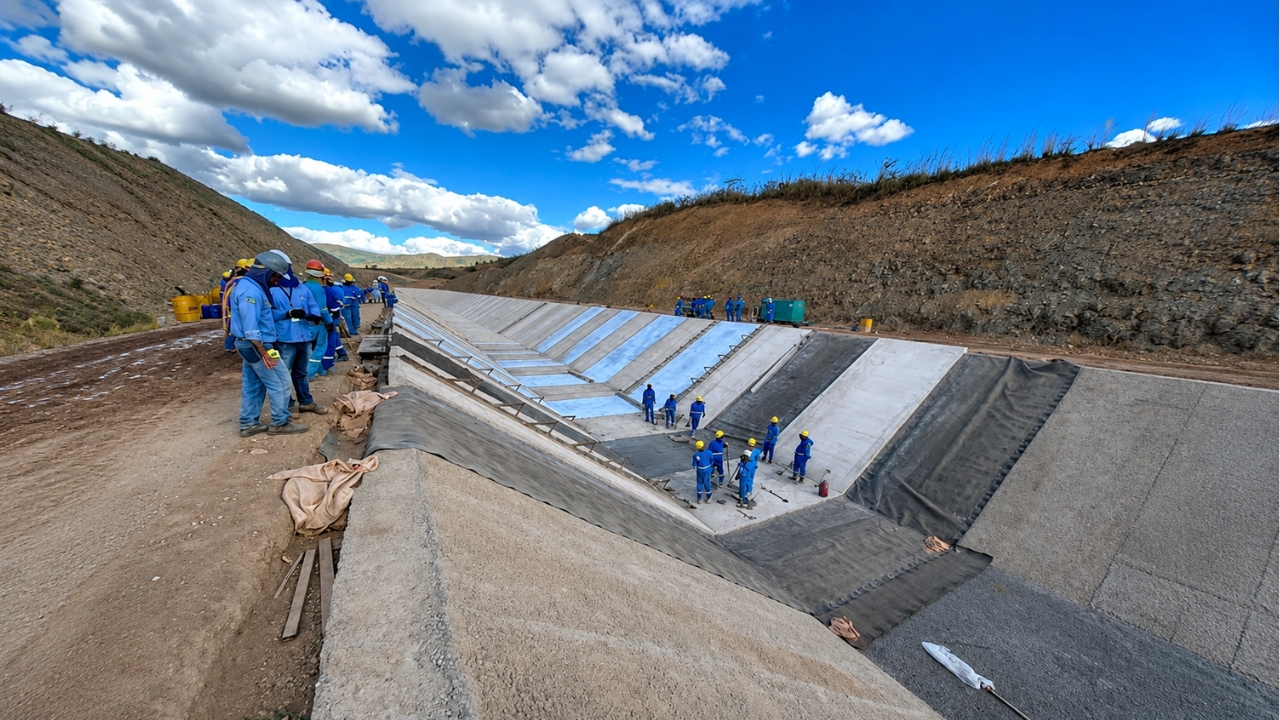

From Jati, the flow crosses various regions of Ceará through open-air channels, pressurized pipelines in specific sections, and intermediate reservoirs that regulate the flow and ensure supply even during periods of lower flow.
The endpoint is the Cariús River in Nova Olinda, from where the water is distributed to supply the surrounding municipalities. The engineering of the artificial river combines gravitational conduction methods with pumping stations at points where the terrain rises.
What the artificial river changes for the Ceará hinterland
The Brazilian Northeast has historically dealt with high temperatures, irregular rains, and prolonged droughts that devastate agricultural production and force entire populations to rely on water trucks. With the artificial river in operation, human supply and agricultural and livestock production now have a permanent source of water that does not depend on local rains or reservoirs that dry up during droughts.
For the municipalities served, the change is structural. The continuous availability of water allows for the irrigation of crops that were previously unviable in the hinterland, the raising of animals with regular access to drinking water, and urban supply without rationing. The artificial river does not solve all of Ceará’s drought problems, but it creates a backbone of distribution that can be expanded with lateral branches in the coming years.
The engineering behind the 145 kilometers
The artificial river project required engineering solutions that go beyond simply digging a channel. The 145 kilometers include large-scale artificial channels sized for specific flows, modern pumping systems in sections where the terrain rises, and complex hydraulic connections that integrate the flow of the artificial river with existing reservoirs in the state.
The construction involved earthmoving on an industrial scale, lining of channels to prevent infiltration and water loss, installation of flow control gates, and electronic monitoring of the entire system. The artificial river is not a natural watercourse: it is an engineering infrastructure that requires maintenance, technical operation, and permanent management to function as designed.
What is needed for the artificial river to be completed
With 91% of physical execution achieved by the end of 2025, the remaining work focuses on the completion of canal sections, pumping tests, and commissioning of control systems. The goal of the Ceará authorities is to deliver the complete artificial river by June 2026, allowing the water from the São Francisco transposition to reach Nova Olinda continuously.
The completion of the Water Belt will mark the end of a project that took years of planning and execution in one of the most challenging environments in Brazil.
For the Ceará hinterland, the artificial river represents the largest water intervention ever carried out by a state government in the country and could become a model for similar projects in other northeastern states facing the same scarcity issues.
Did you know that Ceará is building a 145-kilometer artificial river that uses gravity to bring water to the hinterland? Do you think this project can end the drought in the region or is it just the beginning? Tell us in the comments.









Obviously DPWH wasn’t involved in the construction process. Maybe Marcos should contact them to see if they could help build effective and efficient flood control structures.
Congratulations for the noble project, this brings life hence green environment. Wild life will have a quenching destination….
The project may not end the drought in the region because it does not cover the entire region. A lot is needed; Irrigation is now made easier to the nearing homestead and companies..