






 Portuguese
  Spanish
  5 min of reading
  1 comment


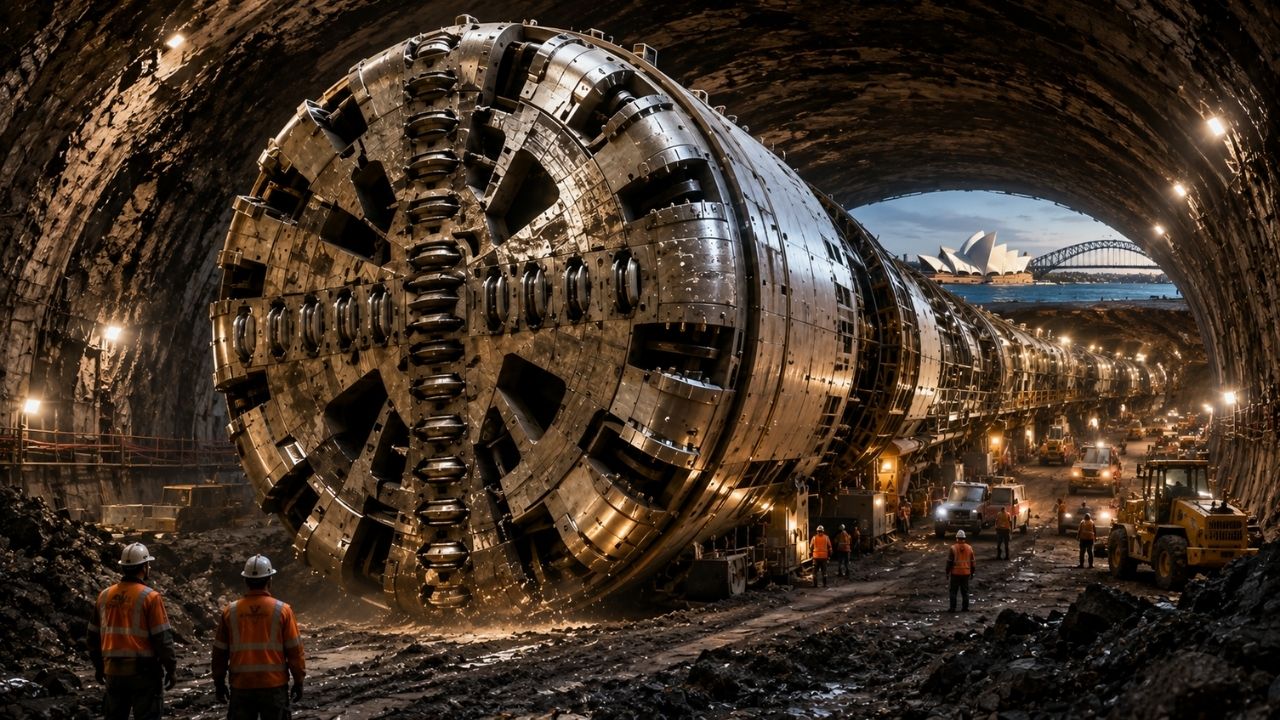


The largest tunnel boring machine ever exported by China has arrived in Australia to excavate the Western Harbour Tunnel under Sydney Harbour: a 15.7-meter diameter machine with an articulated body that bends to navigate underground S-curves with a minimum radius of just 960 meters, delivering six traffic lanes by 2028.
Under Sydney Harbour, one of the largest excavation machines ever built by China is making its way through one of the planet’s most challenging underground environments. The tunnel boring machine, named Patyegarang, in honor of an Aboriginal woman known for facilitating communication between Indigenous peoples and Australia’s first European settlers, has a 15.7-meter excavation diameter and is the largest machine of its kind ever exported by China to any country in the world. It was built by the China Railway Engineering Equipment Group (CREG) and currently operates at the heart of the Western Harbour Tunnel project, Sydney’s second major underground road artery.
The project involves the construction of a 6.5-kilometer tunnel with three lanes in each direction, six in total, and is expected to be completed by 2028, according to a report by the Chinese state broadcaster CCTV. But what makes this tunnel boring machine extraordinary is not just its size: it is the fact that it can bend its own body to navigate underground S-curves, something that conventional machines of this size simply cannot do with precision. This bending capability was developed specifically for this project and represents a significant technical leap in mechanized excavation engineering.
The problem that no conventional tunnel boring machine solves

Tunnel boring machines are, by nature, rigid structures. The larger the diameter, the harder it is to make the machine change direction underground without compromising the precision of the cut, the integrity of the tunnel lining, or the safety of the entire operation. For straight tunnels or those with wide curves, this is not a problem. For the Western Harbour Tunnel, it was a central technical obstacle.
-
Without a mansion, without high investment, and without a traditional classroom, a teacher living in a 22 m² house taught students to build a 9 m² studio apartment with the equivalent of R$10,000.

-
Largest bridge in São Paulo reaches 75% completion and is expected to strengthen strategic connection in the interior of São Paulo.

-
Without her own home and pressured by rent, a 25-year-old bought a small 15-meter boat, gradually renovated the interior by herself, transformed the interior with paint, new flooring, a larger bathroom, and started living on the canals, paying much less per month.
-
Tired of seeing families sleeping on the street, São Paulo delivered 18 m² furnished microhouses and took 888 people off the streets: Vila Reencontro became the model social housing for the homeless population.


The underground layout of the project includes S-sections, curves that change direction in sequence, with a minimum radius of just 960 meters. For a machine with a diameter of over 15 meters operating dozens of meters below sea level, under a busy harbor, navigating this layout with precision requires a solution beyond what traditional tunnel boring machines offer. CREG’s response was to redesign the fundamental architecture of the machine.
The tunnel boring machine that bends at the waist
The solution developed by China Railway Engineering Equipment Group was to equip the Patyegarang with a segmented body connected by a precision joint system. This architecture allows the structure to actively bend during excavation, flexing at the machine’s “waist” to follow the tunnel’s curved path without losing alignment or significantly reducing the advance speed.
It’s as if a machine the size of a four-story building lying down could twist underground with the precision of a surgical instrument. The precision joint system is the heart of this capability, allowing millimetric adjustments in the orientation of each segment of the tunnel boring machine’s body in real-time, responding to variations in the layout as excavation progresses. The result is a machine that maintains the cutting diameter of 15.7 meters regardless of how many times the layout changes direction.
Sydney and the tunnel that will change the city’s traffic


The Western Harbour Tunnel is not just any project for Sydney. The Australian city already has the Sydney Harbour Tunnel, inaugurated in 1992, but population growth and increased traffic have created growing pressure on the existing road infrastructure. The new 6.5-kilometer tunnel will function as a second road artery under the harbor, connecting regions that currently rely on congested surface routes.
With three lanes in each direction, the project will nearly double the underground traffic capacity under Sydney’s port, one of Australia’s most congested traffic points. The expected completion in 2028 means the work needs to progress within a tight schedule, and choosing a tunnel boring machine capable of operating in complex terrain without prolonged stops for trajectory adjustment is a central part of this timeline strategy.
China and the Export of Sophisticated Infrastructure
The arrival of Patyegarang in Australia is part of a broader movement by the Chinese infrastructure equipment industry. China, often described as an “infrastructure maniac” due to the volume and speed with which it builds roads, railways, bridges, and tunnels within its own borders, is increasingly exporting the technology and equipment developed in this process.
The tunnel boring machine sent to Sydney is the most visible example of this advancement: the largest ever exported by the country, operating in one of the world’s most demanding markets in terms of technical and regulatory standards. CREG is not an unknown company in the sector, it operates in underground infrastructure projects on multiple continents, but the scale and complexity of the Australian project elevate the technical level of the machine to a level that few manufacturers in the world could achieve. The name Patyegarang, chosen in reference to local culture, also reinforces a symbolic strategy: presenting Chinese technology as a partner of the identity of the place where it operates.
What It Means to Dig Under a Port
Digging under an active navigable body of water is one of the most demanding conditions a tunnel boring machine can face. The soil under Sydney’s port combines different types of rock and sediment, with pressure variations and water presence that require the machine to maintain constant face pressure to avoid subsidence, surface sinking above the tunnel, which could compromise existing structures, both at the port’s bottom and in the surrounding city.
The 15.7-meter diameter of Patyegarang places it in a category apart even among the largest tunnel boring machines in operation worldwide. For reference: tunnel boring machines with a diameter above 14 meters are considered extreme large-scale machines, and each additional meter of diameter exponentially multiplies the challenges of manufacturing, transportation, assembly, and underground operation.
The fact that CREG designed, built, and exported a machine of this scale with active flexing capability represents a technical demonstration that goes beyond the Sydney project, it is a business card for future markets.
Did you know there was a tunnel boring machine capable of bending its body to overcome underground curves? What do you think about China exporting this type of technology to countries like Australia? Leave your opinion in the comments, and share if you’ve ever been through an urban tunnel that impressed you.




FIRSTLY I WOULD COMEND CHINA IN THERE TECHNICAL ADVANCE, AND CONGRATULATE THE AUSTRALIAN TECHNICAL UNDERSTANDING OF THIS CHINA BUILT TECHNOLOGY ADVANEMENT, IN SO MUCH AS WORKING COOPERATIVELY IN MEETING THESE CHALLENGING STUCTURAL REQUIEMENTS AND THE BUNDLE OF EVERYTHING ELSE THAT COMES WITH IT TO ACHEIVE A DEMANDING PRACTICABLE WORKABLE OUTCOME RESULT, TRUELY TO BE MUTUALLY COMENDED, MUCH MORE COULD BE WRITTEN TO ENCOMPASS THE OVERALL EMBODIMENTS OF THIS ACHEIVEMENT, BUT I THINK IT IS WELL EXPLAINED IN THE PRESRIPT PRESENTATION, IN EXPLAINING THE CHALLENING TASKS GOING FOREWARD. ALL TO BE COMEND, THANKYOU.
KIND REGARDS PAUL M.