Portuguese
  Spanish


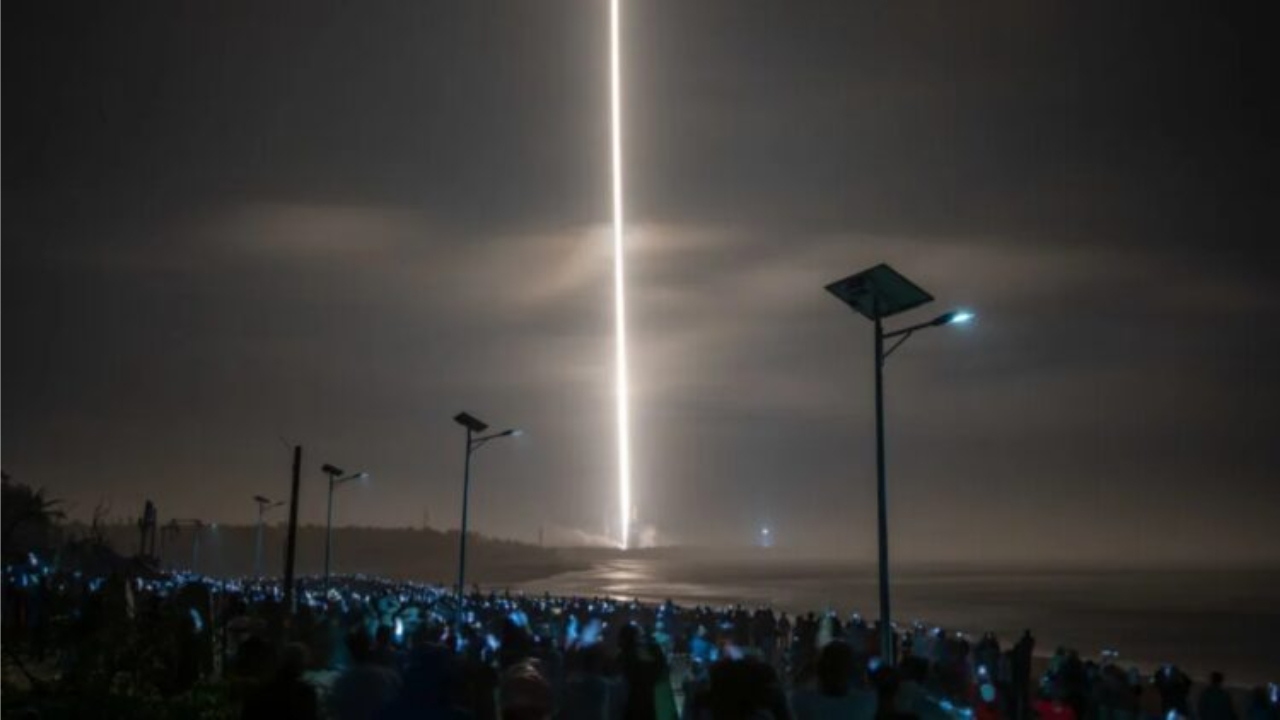


China Fires A High-Precision Infrared Laser And Hits The Tiandu-1 Satellite At 130 Thousand Km, Even In Bright Daylight
The world is entering a new contest for the region between Earth and the Moon, and this time, it was China that decided to raise the stakes. Chinese scientists managed to send a laser beam from Earth to a satellite approximately 130 thousand kilometers away and successfully received the signal back. The detail that made headlines in the space sector is what really grabs attention: everything was done in broad daylight, something that until now was considered practically impossible due to sunlight glare.
The experiment, disclosed by the Chinese Academy of Sciences, opens a door to navigation and communication technologies that until recently seemed like science fiction. At the center of it all is the Tiandu-1 satellite, one of the vehicles created to test communication systems in the region known as cislunar space, a strategic area that is becoming the stage for the next great global technological race.
The result showed that Beijing is more prepared than ever to compete for orbital precision, absolute positioning, and even future lunar and interplanetary missions. And this changes the geopolitical chessboard.
-
Swiss glaciers melting fast enough to fill an Olympic pool every 6 seconds, France confirms 3,700 heatwave deaths, and WMO predicts strong El Niño intensifying extremes until 2027

-
Sudden Sea Recession in São Paulo Sparks Tsunami Alert and Online Debate on Giant Wave Risks in Brazil

-
China Launches World’s First 307-Meter Floating Wind Platform to Supply Oil Rigs, Aiming to Cut 35,000 Tons of CO2 Annually
-
Japan Deploys Offshore Concrete Factory, Constructs Massive Caissons in 8 Days, Revolutionizing Port Construction with Industrial Efficiency


How China Managed To See At 130 Thousand Km In Broad Daylight
The feat was only possible because the Tiandu-1 carries special retro-reflectors capable of sending the laser beam back precisely to the point of origin. On Earth, the system used was a 1.2-meter telescope equipped with a state-of-the-art infrared laser. Engineers updated optical filters, reduced atmospheric interference, and increased the sensitivity of the receiver. All to overcome the greatest enemy of daytime observation: the Sun.
Normally, long-range laser experiments are conducted at night, when the background light is low. But operating during the day is another story. China was able to clearly record the return of the pulse, allowing for precise distance calculations within a few centimeters, even at a scale of 130,000 km.
It’s an unprecedented achievement, and until now, no other country has presented a similar verified result.

Why This Matters: Space Navigation, Lunar Race, And Cislunar Space Dominance
The advancement has immediate applications in high-precision navigation. With systems capable of measuring such large distances even under intense light, future missions can adjust trajectories more safely, land with a smaller margin of error, and maintain satellites positioned much more stably.
But there is another even more strategic factor.
The region between Earth and the Moon is becoming the new arena for global rivalry. Whoever dominates communication, positional measurement, and orbital tracking in this area will have a real advantage in the coming decades regarding space exploration, satellite security, and even route control for missions to Mars.
It’s no coincidence that several analysts are already calling this space the “new Middle East of technology.” Not because of oil, but due to its strategic and economic importance.
With the laser experiment, China shows that it wants this territory.
The Laser Did Not Destroy Anything: The Experiment Is Scientific, Not Military
Despite some sensational headlines around the world, there was no physical impact on the satellite. The term “hit the satellite” appears in reports only in a technical sense, as part of the orbital measurement process. The laser used is non-destructive and does not have the power to damage equipment.
The objective is purely scientific: to understand precisely where each object is in orbit and how it behaves in the cislunar region. However, like almost all modern space technology, this type of system ultimately has dual-use potential. Whoever controls measurement also controls orbital surveillance and the security of their own vessels.
This is the reason why the experiment has gained so much international attention.
What Comes Next: Lunar Missions, New Satellites, And Fight For Influence
The Tiandu-1 and its sister satellites are part of a larger program involving future lunar missions, expansion of space communication, and creation of a sort of “Lunar GPS.” China intends to establish a complete navigation and retransmission infrastructure in the coming years to support landings, robots, astronauts, and scientific stations.
This laser experiment is, so far, the clearest proof that the country has managed to advance to a new technological level, capable of operating with millimeter precision in broad daylight.
Meanwhile, other nations are watching closely. Dominance in deep space will define alliances, billion-dollar contracts, scientific research, and, of course, strategic power.
The game has only just begun.