






 Portuguese
  Spanish


The First Humanoid Robot in the World to Master the Frontflip Is Revealed by China’s Engine AI
EngineAI, a Chinese startup in robotics based in Shenzhen, stated that its humanoid robot PM01 has become the first in the world to successfully perform a forward flip.
The feat was captured on video, shared by the company, where the robot executes the movement accurately, receiving applause from the attending spectators.
The video ends with the PM01 walking through the Shenzhen Tourist Information Center, while EngineAI highlights that the robot is in constant evolution.
-
Texas Teens Win $50,000 at World’s Largest Science Fair for Developing Non-Surgical Brain-Controlled Bionic Prosthesis with 98% Accuracy

-
Samsung Galaxy A27 Launches with 6.7-inch Super AMOLED Display, Full HD+ Resolution, Android 16, Six Years of Updates, Snapdragon 6 Gen 3, and Dust and Splash Resistance; Available for Pre-order in the US for $350

-
Five Brazilian Students Invent Drug Test Pen That Detects Date Rape Drugs in Seconds
-
Viedma Glacier Retreat in Patagonia Uncovers 900-Meter-Deep Basin, Making Viedma the Deepest Lake in the Americas


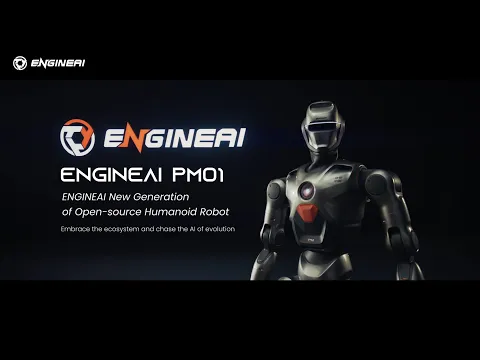
Launched in December 2024, the PM01 is a smaller version of the SE01, the company’s flagship model, known for its realistic walking.
Notable Advance in Humanoid Robotics
EngineAI gained global attention in October 2024 when it introduced the SE01, which drew attention for its human-like movement. Now, with the PM01, the company continues to impress the robotics market.
The forward flip performed by the PM01 is considered a milestone. This type of movement is more challenging for both humans and robots than the backward flip, as it requires more precise balance control and presents a higher risk of a bad landing.
Unlike the backward flip, the forward movement shifts the body weight in a way that challenges the alignment of the center of mass.
The advantage of the PM01 is its compact size. Being shorter, its center of mass is also lower, reducing the risk of tipping over and facilitating rotations.
In addition, robots require less torque to turn. In contrast, full-sized humanoids need stronger joints to withstand the impact of landing.

Power and Agility in a Compact Design
The PM01 robot was designed for specific researchers who want to explore the combination of human and robotic skills.
At 1.38 meters tall and weighing 40 kilograms, it is 27 centimeters shorter and 8 kilograms lighter than the SE01. Its exoskeleton is made of aluminum alloy, providing lightness and strength.
The humanoid robot features a highly interactive central screen and a bionic design that mimics human movement. One of its most impressive features is its 320-degree waist rotation.
On the technological front, the PM01 has advanced visual perception enabled by an Intel RealSense depth camera.
Its computational performance is ensured by a dual-chip design, which combines NVIDIA Jetson Orin and Intel N97 CPUs, providing high-level processing for complex tasks.
Competition in the Humanoid Robot Market
Currently, the PM01 stands out in the small humanoid robot market, competing with models like the Unitree G1 and the Booster T1. In terms of height, the PM01 is taller than the Booster T1 but shorter than the Unitree G1, which measures 1.3 meters.
The PM01 humanoid robot also features 24 degrees of freedom (DoF), allowing for smooth and dynamic movements. Its 12 DoF in joint motors offer superior flexibility, surpassing the 23 DoF of the Booster T1 and the base model of the G1.
However, the Unitree G1 can be configured for up to 43 DoF, expanding its movement capabilities.
In terms of speed, the PM01 matches the pace of the G1, both reaching 2 m/s (4.5 mph), outperforming the Booster T1, which reaches 1.2 m/s. Nevertheless, they fall behind the Unitree H1, which recently hit 3.3 m/s (7.5 mph) before being surpassed by the Robot Era Star1.


