






 Portuguese
  Spanish


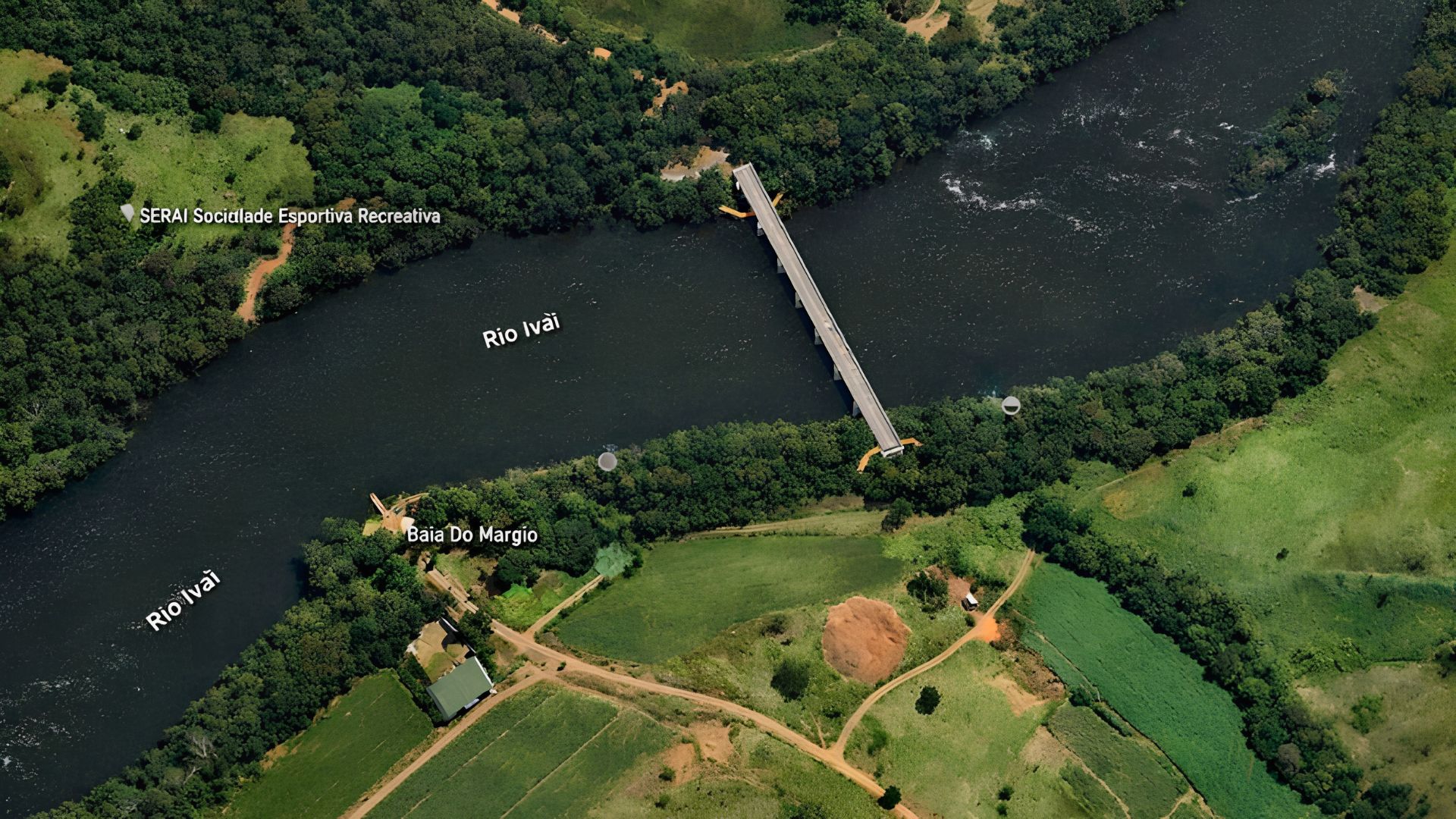

R$ 27.8 million bridge over the Ivaí River will connect Jardim Alegre to Grandes Rios, reduce a detour of up to 80 km, shorten travel to about 25 minutes, and fulfill a promise made since 1992 in the Ivaí Valley.
According to the Government of the State of Paraná, Governor Carlos Massa Ratinho Junior signed, on November 27, 2025, the agreement with the City Hall of Jardim Alegre that enables the transfer of up to R$ 27.8 million from the State Treasury for the construction of a concrete bridge over the Ivaí River. The structure will connect Jardim Alegre to Grandes Rios on a municipal road.
The bridge will be 242.30 meters long and will create a direct road corridor between the two municipalities, a connection that does not exist today. The bidding process was opened on April 23, 2026, with the opening of proposals from interested companies, ending a sequence of proceedings initiated with the executive project prepared by the City Hall of Jardim Alegre.
“The Ivaí Valley has grown a lot and deserves this special attention in the area of infrastructure. In the case of this new bridge over the Ivaí River, we are resolving a project promised since 1992 that will now finally come to fruition,” said Ratinho Junior when signing the agreement. It’s 33 years of promise, an open tender, and a bridge that can change the routine of 17.6 thousand people in the interior of Paraná.
ARTICLE CONTINUES BELOWSee also
U.S. City Builds Tiny Home Village on Water Company Land to House 136 Homeless People: Inside the Social Housing Units

Woman Turns Shipping Container into Home, Embraces Rural Life to Cut Monthly Expenses to Just Over $330
France Revamps 530 Social Housing Units with Large Balconies and Glass Facades Without Demolishing Existing Buildings

Facing high rent, couple transforms parents’ garage into a fully functional apartment, creating a complete home at a fraction of the market cost.




Bridge over the Ivaí River will eliminate a detour of up to 80 kilometers between Jardim Alegre and Grandes Rios
To understand what the bridge means for those who live in Jardim Alegre or Grandes Rios, it is necessary to understand what exists today between the two cities. Or, more precisely, what still doesn’t exist: a direct crossing over the Ivaí River.


The two municipalities are neighbors in the Ivaí Valley, a region in the interior of Paraná organized along the river and its tributaries. On the map, the distance seems small, and it really is in a straight line. The problem is that the absence of a bridge forces residents, producers, and transporters to bypass the river via regional roads.
In practice, a journey that could be less than 10 kilometers in a straight line turns into a route of about 80 kilometers via the available land route, with travel time that can reach 1 hour and 20 minutes. With the bridge, the expectation is to reduce this journey to approximately 25 minutes.
Current detour increases fuel costs, freight, driver time, and agricultural outflow in the Ivaí Valley
The detour is not just an inconvenience for visits between neighboring cities. It acts as a structural barrier to access services, regional economic integration, and the outflow of agricultural production, the basis of the local economy.
A rural producer from Grandes Rios who needs to take a harvest to a cooperative or warehouse in Jardim Alegre currently travels about 80 kilometers there and another 80 back. With the bridge, this total displacement could drop drastically.
The difference appears in fuel, driver’s time, vehicle wear, and the number of possible trips per day. The accumulated cost of decades without this bridge is invisible in statistics but permanent in the pockets of those who live and produce in the region.
Promise made since 1992 finally moves forward with agreement, executive project, and open tender
The bridge over the Ivaí River between Jardim Alegre and Grandes Rios is not a recent demand. Governor Ratinho Junior himself acknowledged that the project had been promised since 1992.
There were 33 years of political promises, projects that didn’t advance, demands resumed in different electoral cycles, and waiting for resource availability. During this period, the two municipalities grew, changed administrations, renewed generations of residents, and continued without the crossing.

What changed in November 2025 was the combination of a ready executive project, prepared by the Jardim Alegre City Hall, availability of State Treasury resources, and formal signing of the agreement. The long-standing demand moved from the realm of promises to the administrative execution process.
Mayors of Jardim Alegre and Grandes Rios advocate bridge as regional integration and safety for residents
The mayor of Jardim Alegre, Moisés Santos, stated that the construction will improve the daily commute of families, provide more safety, and open new prospects for the local economy. According to him, the bridge is a decisive step towards advancing the complete integration of Vale do Ivaí.
On the other side of the river, the mayor of Grandes Rios, William José Gonçalves, highlighted the everyday dimension of the connection. For him, the bridge signifies respect for those living in the region and relying on this crossing.
“It is a connection that transforms the population’s routine and creates opportunities for the entire region,” he stated. The statement summarizes the expected effect of the construction: less isolation, more access, and greater circulation between municipalities that are neighbors on the map today but distant by road.
Final value of the bridge will be defined by the bidding opened in April 2026
The amount of R$ 27.8 million represents the ceiling of the agreement, calculated based on the executive project prepared by the Jardim Alegre City Hall. The final cost of the construction will be defined after analyzing the proposals submitted in the bidding opened on April 23, 2026.
This stage is decisive because it transforms the agreement into an execution contract. After choosing the winning company, the construction can enter the effective phase of mobilization, site preparation, foundations, and structure construction.

The bridge depends, therefore, on a process that has already moved from the political stage to the technical and contractual stage. For a construction promised since 1992, the opening of the bidding represents the most concrete change in more than three decades.
242-meter bridge transforms a geographic barrier into a regional development corridor
The bridge will be 242.30 meters long, enough to cross the Ivaí River at the chosen point for the new route. It is not a spectacular engineering work by size, but an intervention with direct territorial impact.
The structure will be made of conventional concrete, without the complexity of large bridges over mighty rivers or dense urban areas. Still, its social and economic effect can be much greater than the absolute value of the construction suggests.
These are 242 meters of concrete capable of transforming a geographic barrier into a development corridor, connecting two cities that today rely on long routes to connect by land.
Travel between Jardim Alegre and Grandes Rios may drop from 1h20 to about 25 minutes
The most immediate impact will be felt in daily commutes. Residents of Grandes Rios who work in Jardim Alegre, or residents of Jardim Alegre who need to access services and properties on the other side of the river, will be able to reduce travel time from about 1h20 to approximately 25 minutes.
This time saving is not just comfort. It represents less fuel, less vehicle wear, less exposure on long roads, and more time available for work, rest, study, and family.
For rural workers who leave early for the field, an hour saved in commuting can mean an extra hour of sleep or productive work. The bridge transforms lost time into useful time.
Soy, corn, coffee, and livestock should gain shorter logistics between the two municipalities
Jardim Alegre and Grandes Rios have economies based on soy, corn, coffee, and livestock. These chains depend on efficient roads to deliver production to cooperatives, warehouses, buyers, processing industries, and regional markets.
Reducing the route from approximately 80 to 25 kilometers between the municipalities means direct savings in fuel and maintenance. It also allows for a higher frequency of trips per day without requiring more trucks or more drivers.
In an agricultural region, logistics is margin. The shorter the path between the property, the cooperative, and the market, the greater the producer’s competitiveness and the lower the accumulated cost of the chain.
Bridge integrates larger package of works in the Ivaí Valley and strengthens Paraná’s agricultural corridor
The bridge over the Ivaí River is not the only investment planned for the Ivaí Valley. The same event in November 2025, where the agreement was signed, also included authorization for the restoration and expansion of 52 kilometers of the PRC-466, with an investment of R$ 558.5 million, in addition to the inauguration of the new secondary access to Ivaiporã.
The state secretary of Infrastructure and Logistics, Sandro Alex, described this set as the largest investment package in the region’s history. The bridge has a smaller value within the package but can have a more direct impact on the daily lives of the communities involved.
The Ivaí Valley has been gaining attention as an agricultural hub in inland Paraná. With grain and coffee production growing, infrastructure needs to keep pace with the increased flow of cargo, workers, and services.
Tender opened in April places bridge delivery between late 2027 and early 2028
With the tender opened on April 23, 2026, the next step is to define the winning company and sign the contract. From then on, the estimated completion time is up to two years.
This timeline places the probable delivery of the bridge between late 2027 and early 2028, with the possibility of adjustments according to the pace of execution, field conditions, and seasonal variations of the Ivaí River.
Two years is a compatible timeframe for civil engineering works of this scale under normal conditions. The most sensitive stages will be foundations, piles, execution over the river, superstructure, accesses, and road finishing.
Ivaí River requires a schedule attentive to water levels, dry season, and foundation stages
The Ivaí River has seasonal level variations that need to be considered in the work planning. Foundation and piling work in the riverbed is usually more feasible during dry periods.
Therefore, the schedule needs to align execution phases with hydrological conditions. The executive project already considers these factors, and the technical monitoring by DER-PR will play a central role in maintaining safety, quality, and feasibility of deadlines.
What is certain is that the promise of 1992 now has a signed agreement, published tender, open bidding, and a process underway. For Jardim Alegre and Grandes Rios, after 33 years, this already represents a concrete change: the bridge has ceased to be a promise and has become a work in preparation.








