Portuguese
  Spanish


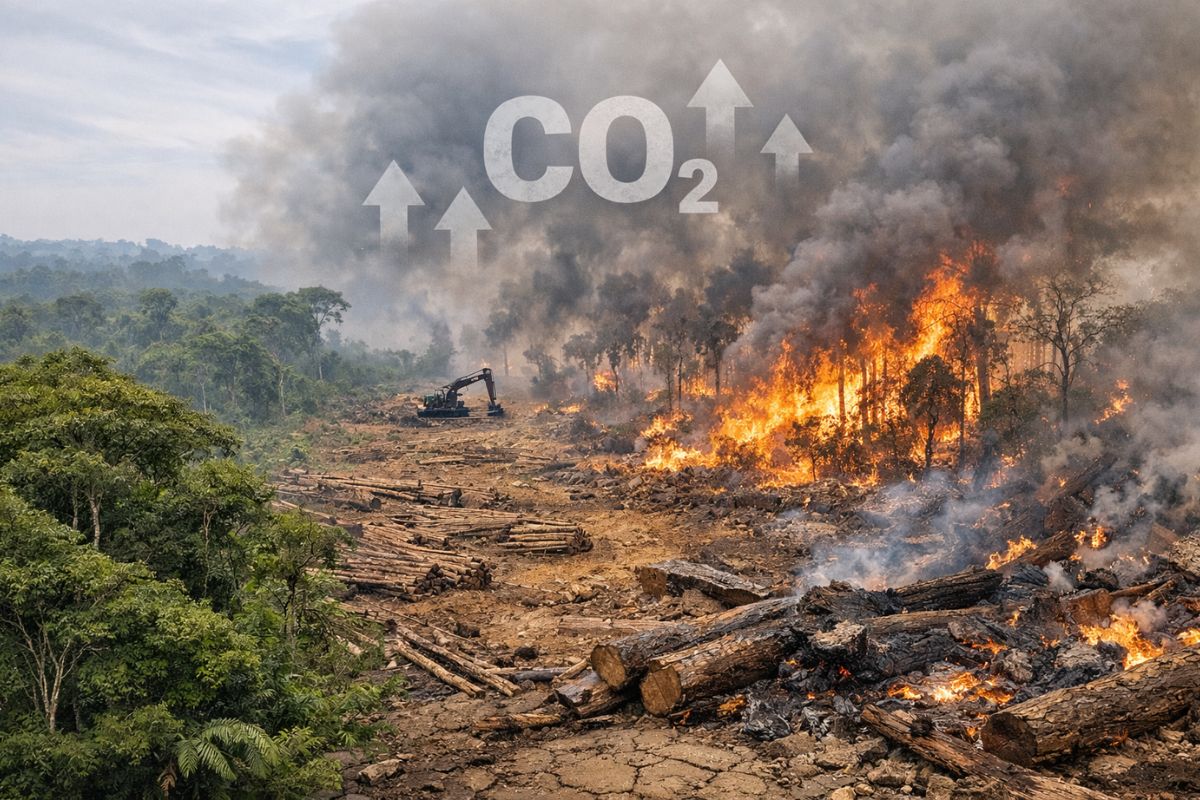


In Central Africa, the forest stopped working as a liquid carbon reservoir and, since 2010, has begun to emit more than it absorbs, amid continuous deforestation, an average annual loss of 106 billion kilos of biomass, and increasing pressure on current global climate temperature goals.
The African forest, which for decades helped remove carbon dioxide from the atmosphere, has entered a phase of reversal: instead of functioning as a sink, it has started releasing more carbon than it absorbs. This shift becomes clear from 2010 onwards and is concentrated in ecosystems of Central Africa, where continuous deforestation has altered the carbon balance.
According to a study by fapesp conducted in February 2026, the effect is not restricted to the region. When a large tropical forest loses its storage capacity, international climate efforts become more challenging, as the safety margin decreases. In practice, what was previously offset by vegetation now requires additional emission cuts in economic sectors and in countries already facing complex targets.
Where The Change Occurred And Why This Territory Is Decisive
The change is concentrated in areas of forest and wooded savannas of the Democratic Republic of Congo, Republic of Congo, Gabon, Equatorial Guinea, Cameroon, and the Central African Republic.
-
AI Video Generator Automatically Creates Subtitles and Animated Captions

-
São Paulo Unveils Latin America’s Largest Underground Reservoir, Holding 900 Million Liters, in the Greater São Paulo Area

-
Chinese Teen Wins Gold in Germany for Invention Turning Air Moisture into Underground Irrigation in Drought-Stricken Areas

-
Desertification Threatens Brazil’s Caatinga: 85% of Semi-Arid Region Affected, 30 Million at Risk, and Efforts Underway to Restore 10 Million Hectares by 2045




This territorial block forms one of the main tropical vegetation sets on the planet, playing a strategic role in the carbon cycle due to the continuous stretch of native cover.
When this system loses biomass, it is not merely a regional issue.
The loss of the forest’s climatic function alters the global account because the carbon that would stop circulating in the atmosphere resumes putting pressure on the planet’s average temperature. This amplifies the weight of international decisions on energy, land use, and conservation financing.
How Much Has Been Lost Since 2010 And What The Biomass Reveals
Between 2010 and 2017, the continent lost approximately 106 billion kilos of forest biomass per year.
This number summarizes a structural transformation: native vegetation stops accumulating organic matter at a sufficient scale and begins to reduce its stock, signaling that the capacity for carbon retention is compromised.
Biomass, in this context, is a central indicator because it translates the “biological vault” of the forest. When the stock declines year after year, the system loses efficiency in capturing atmospheric carbon through plant growth.
It is not just a loss of trees; it is the loss of an active climatic mechanism that had been helping to contain the advance of warming.
Why The Forest Inverted The Carbon Balance
The decisive factor indicated is continuous deforestation. With the removal of native vegetation, the area capable of capturing carbon at a sufficient rate to offset emissions associated with the degradation of the ecosystem itself decreases. The result is the inversion: the forest stops “holding” and starts to “release” carbon.
This process does not happen instantaneously but cumulatively. As deforestation progresses, the landscape loses ecological integrity and biological stability, reducing the system’s resilience.
The weakened forest absorbs less, stores less, and protects less, creating a cycle of progressive climatic pressure.
The Direct Impact On Global Climate Goals
Heiko Balzter from the University of Leicester classified the scenario as a crucial warning for global climate policy.
The answer is straightforward: if the African forest fails to fulfill its function as a sink, other regions will need to reduce their emissions even further to maintain the trajectory compatible with the 2 °C limit of the Paris Agreement.
This shifts responsibility and increases the political, economic, and technological cost of the climate transition. Every ton that the forest fails to absorb needs to be compensated elsewhere, whether through accelerated decarbonization of energy or changes in production patterns. Without this additional compensation, the gap between climate goals and reality is likely to grow.
The inversion observed since 2010 in African ecosystems shows that the forest is not just landscape: it is climate infrastructure.
When this infrastructure goes into deficit, the entire planet operates with less margin for error, and the international goals go from being merely ambitious to becoming even more demanding in the short term.
From your point of view, which measure should be the immediate priority: halting deforestation, funding large-scale restoration, or tightening emissions targets for major polluters? And considering your local context, what concrete decision about native vegetation do you consider most urgent today?