






 Portuguese
  Spanish


Project in Casablanca combines underwater intake, reverse osmosis, and wind energy to expand supply in one of the most populous regions of Morocco, with a structure planned to produce water on an unprecedented scale on the African continent.
Morocco advances in the construction of the Casablanca desalination plant, a project planned to draw water from the Atlantic through two underwater pipelines of 1.85 km and produce up to 300 million cubic meters per year, equivalent to 300 billion liters.
With this capacity, the structure is expected to serve about 7.5 million people in the Greater Casablanca region and neighboring cities, reinforcing supply in an area marked by high population density, intense economic activity, and growing demand for water.
Installed in Sidi Rahal, in the metropolitan area of Casablanca, the plant will occupy a coastal land of 50 hectares, a position that allows integrating direct ocean intake, onshore treatment, and regional distribution of the produced water.
-
Nigeria Dumps 120 Million Tons of Sand into Atlantic to Build Massive City with 8.4 km Sea Wall for Protection Against Ocean Waves and Erosion

-
German Engineer Developed Diesel Engine Running on Vegetable Oil Decades Before Electric Cars Became Popular; Can This Forgotten Idea Work in 2026?

-
James Webb Telescope Uncovers Unexpected Clues on Mysterious Moon, Potentially Redefining Planetary Origins

-
$1.5 Billion Sleipnir Vessel Transforms Ocean into Floating Construction Site with 12 Hybrid Engines and Capacity to Lift 20,000 Tons
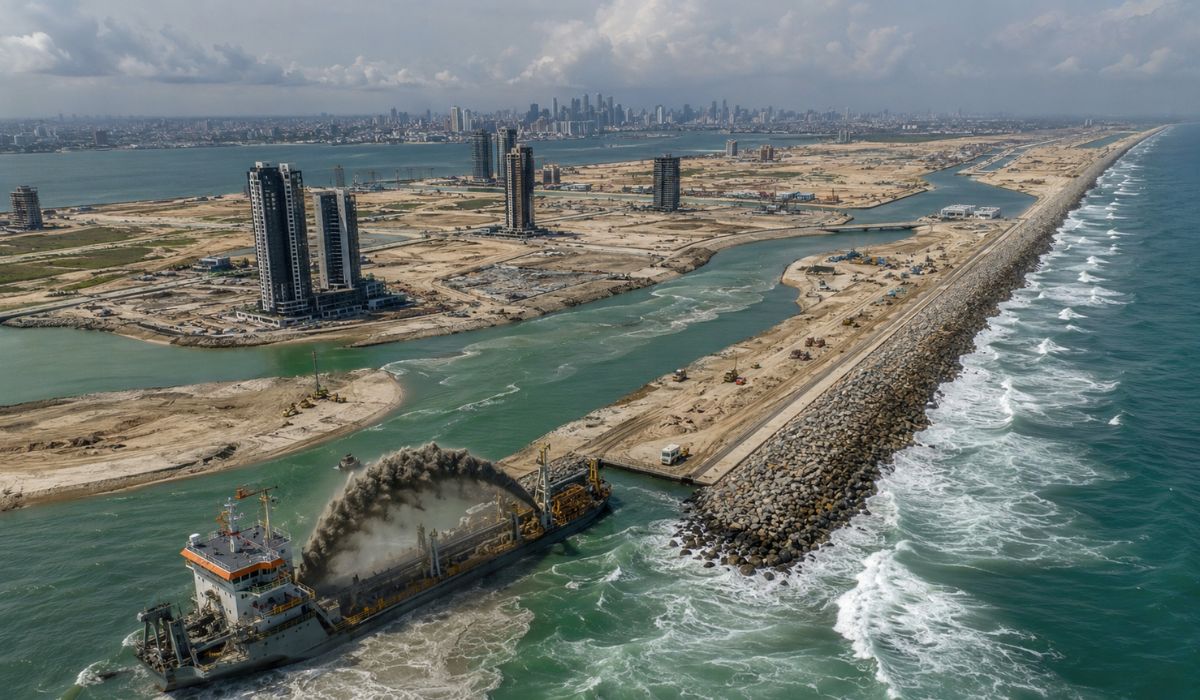


The choice of location facilitates the connection between the underwater system and the network that will supply urban and agricultural areas, without relying solely on reservoirs, aquifers, or other traditional sources already pressured by periods of lower water availability.
Casablanca desalination plant enhances water security in Morocco
With a final reported capacity of up to 838 thousand cubic meters per day, the future desalination plant appears in data from the Arab Urban Development Institute and Acciona as one of the most ambitious water projects underway on the African continent.
Due to the planned scale, the unit is presented as the largest of its kind in Africa and one of the largest in the world powered by renewable energy, a feature that extends the strategic reach of the enterprise beyond local supply.
Within Morocco’s strategy to expand non-conventional water sources, the project emerges in a context of pressure on reservoirs, aquifers, and traditional systems, exacerbated by rainfall deficits and the growth of urban and agricultural demand.
According to Reuters, the country aims to increase the share of desalinated water in the supply of drinking water to 60% by 2030, after recording a share of 25% in 2025 in meeting this type of demand.
Before reaching the onshore industrial units, the operation begins at the bottom of the Atlantic, where the two intake lines will be 1,850 meters each and will conduct the saltwater to the treatment station.
After arriving at the plant, the flow will go through pre-treatment, reverse osmosis, post-treatment, and quality control, necessary steps to transform seawater into a resource suitable for public supply and the uses planned in the project.
How Atlantic water will be transformed into supply
The central technology of the operation, reverse osmosis is used in large desalination plants to separate salts and other components present in seawater, through membranes capable of retaining a significant portion of the dissolved solids.
In the process, the pressurized water passes through these special membranes and proceeds to complementary treatment stages, allowing the final product to meet the standards required for supply after quality control and necessary adjustments.
In addition to the intake pipelines, the project includes a 2.5 km submarine outfall intended for the discharge of the saline concentrate generated during desalination, an inevitable part of the industrial cycle of this type of facility.
Through this structure, a fraction of the water taken from the sea returns to the ocean after the separation of salts, within the conditions established in the project and the environmental licensing procedures applicable to the enterprise.
The complexity of the work goes beyond the visible coastal strip and involves reverse osmosis units, pre-treatment and post-treatment systems, sludge treatment facilities, and a center dedicated to operational control and management.
This center will monitor water production, equipment performance, and the integration between the different stages of the system, which need to function in a coordinated manner to ensure regularity in supply and efficiency in energy use.
Outside the industrial area, the plan includes pumping stations, reservoirs, and about 130 km of pipelines to transport the treated water throughout the region, connecting the coastal plant to the planned consumption points.
The network was designed to supply Casablanca, Settat, Berrechid, Bir Jdid, and nearby localities, extending the reach of the desalination plant beyond the Moroccan economic capital and its immediate urban area.
Wind energy will supply the desalination plant
Among the points that differentiate the plant is the energy matrix planned for its operation, as large-scale desalination requires electricity for capturing, pumping, pressurizing, filtering, and distributing the produced water.
According to Acciona, the unit will be powered by renewable energy supplied by the Bir Anzarane wind farm, with 360 MW, which will allocate 47% of its production to the desalination plant through a supply agreement.
By using wind energy, the project aims to reduce dependence on fossil sources in an operation naturally intensive in electrical consumption, a factor that usually weighs on the final cost of water produced by large-scale plants.
In systems of this size, energy is among the central elements of operational viability, because the water needs to go through successive stages of capture, pressure, salt separation, pumping, and transportation to distribution points.
The division of annual production forecasts 250 million cubic meters for urban supply and up to 50 million cubic meters for regional agricultural activities, which extends the plant’s function beyond domestic consumption.
With this design, the desalination plant was also planned as support for economic activity in areas affected by limited water availability, especially where agriculture and urban growth compete for increasingly scarce water resources.
Casablanca brings together population, industry, services, and strategic infrastructure for Morocco’s economy, factors that make water security a decisive issue for the continuation of urban and productive activities in the region.
In metropolitan areas of this size, the regular supply of water increasingly depends on complementary solutions, especially when drought cycles reduce reservoir security and increase pressure on underground sources.
Consortium and Investment of the Largest Desalination Plant in Africa
The execution of the plant will be carried out by Al Baidaa Desalination Company, a consortium formed by Acciona, with 50%, Green of Africa, with 45%, and AfriquiaGaz, with 5%, according to information released about the project.
Under the public-private partnership contract with the Office National de l’Électricité et de l’Eau Potable, Acciona reported that it will be responsible for the construction, operation, and maintenance of the facility for 27 years.
The total investment reported for the plant is 6.5 billion Moroccan dirhams, an amount equivalent to about 613 million euros in Acciona’s communication about the financing of the work.
In the financial structure, debt and equity combine with the participation of Moroccan and international institutions, as well as instruments linked to Spain, the country of origin of Acciona and part of the announced financial support.
The completion of the plant is scheduled for 2028, according to Acciona, although public information about the project indicates implementation in phases before reaching the full capacity designed for the infrastructure.
This gradual model would allow for increased water production over time, as capture, treatment, energy, pumping, storage, and distribution systems are integrated and adjusted to the needs of the region served.
Although the two underwater pipelines concentrate the most striking image of the work, they represent only a part of the technical chain necessary to transform the Atlantic into an additional supply source.
For the water to reach consumers, it will be necessary to keep oceanic capture, renewable energy, desalination, pumping, storage, quality control, and regional transport connected in a continuous and highly coordinated operation.
The expansion of desalination shows how coastal countries are incorporating the sea into their water security policies, without completely replacing rivers, dams, and groundwater that remain relevant for supply.
In the case of Casablanca, much of the infrastructure will be submerged, buried, or distant from urban centers, while the water produced by the plant will reinforce a strategic region for the population and economy of Morocco.


