Portuguese
  Spanish



System developed by USP researchers uses laser, LiDAR, and computational modeling to assess balance of urban trees, guide safer pruning in São Paulo, and reduce risks of falling during strong winds
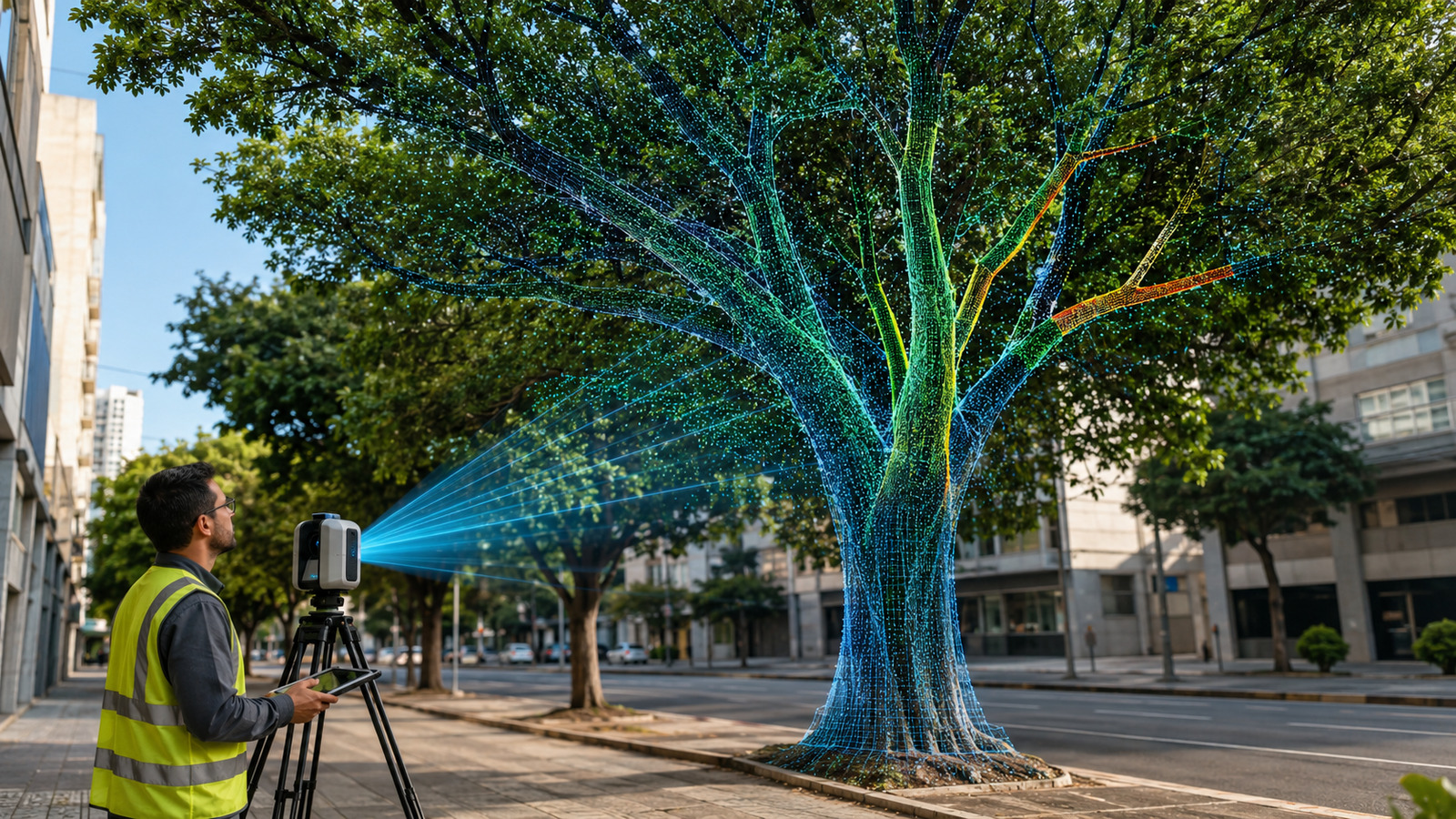
A system developed by USP researchers uses laser, computational modeling, and algorithms to make urban tree pruning safer and more efficient. The tool, described in the scientific journal Trees, is already being tested in São Paulo and can help reduce the risk of falling during strong winds.


Technology uses laser to map the structure of trees
The proposal arose from an informal conversation between Marcos Silveira Buckeridge, professor at the Institute of Biosciences at USP, and Emílio Carlos Nelli Silva, professor at the Polytechnic School of USP. The dialogue took place in front of a large tree at a restaurant in São Paulo.
From this point, the researchers developed a computational system capable of guiding urban pruning based on the biomechanical balance of the tree. The idea is to evaluate how the removal of branches affects weight distribution, canopy symmetry, and the structure’s response to wind.
-
China Develops Custom 140-Ton Electric Mining Truck with 770 kWh Swappable Battery, Deploys 290 Units in Xinjiang’s Largest Zinc Mine

-
Meta to Launch Arena, a New Prediction App Targeting 3.56 Billion Users, Competing with Polymarket and Kalshi

-
Scientist Challenges Famous Human Evolution Theory, Argues Homo Sapiens Evolved Gradually Over Thousands of Years
-
15-Year-Old American Builds Ocean Generator with PVC Pipe and 3D-Printed Propeller for $12, Wins National Prize, Presents at White House, and Makes Forbes 30 Under 30 List



The mechanism uses LiDAR technology, based on laser pulses. The equipment emits thousands of light beams that hit the tree and return to the sensor, allowing its geometry to be reconstructed in three dimensions.
This scan forms a point cloud, a digital representation showing trunk, branches, and canopy. With this data, the system measures volume, branch distribution, inclination, canopy symmetry, and possible structural responses to wind.
Tree pruning can alter resistance and increase risk of falling
The research analyzed the tipuana, or Tipuana tipu, one of the most common urban species in São Paulo. According to Marcos Buckeridge, it has vigorous growth, a wide canopy, and high tolerance to the urban environment, including pollution, heat, and dry periods.
At the same time, the species can become more vulnerable when subjected to excessive or poorly executed pruning. The study demonstrated that different forms of pruning significantly modify the tree’s structural resistance.
When done without biomechanical criteria, pruning can alter the natural architecture of the tree. This creates points of greater deformation and increases the risk of branch breakage or toppling, especially under wind loads.
The system aims to anticipate this problem. Before intervention, the digital model allows for the simulation of deformations and identification of the tree’s most vulnerable regions, indicating which branches can be removed with minimal impact on balance.
Tool can support municipalities and urban forestry teams
According to Buckeridge, the technology functions as a decision support system for municipalities, utilities, and urban forestry teams. The goal is to guide more precise and less aggressive pruning.
In practice, the tool can help to assess in advance the effect of branch removal. It can also contribute to prioritizing higher-risk trees, making urban management more targeted.
The application is especially relevant in cities with a large number of street trees and the risk of extreme weather events. The material provided by the research highlights concerns with strong winds and the safety of tree structures.
Scale adoption still depends on automation and new tests
For the system to be used on a large scale, some steps still need to be automated. Buckeridge specifically mentions the generation of three-dimensional models and the computational analysis of trees.
It will also be necessary to integrate the tool with existing urban inventories and expand testing with different species and environmental conditions. The scientific article points out that pilot projects in specific urban sectors could accelerate practical adoption.
According to the professor, there is an ongoing project in São Paulo to scan all the street trees in the city. The tool described in the study can help interpret the current state of these trees and support tree management.
The work involved researchers from the Institute of Biosciences and the Departments of Mechanical Engineering, Mechatronics, and Electrical Engineering at the Polytechnic School of USP. Participants included Luís Otávio Trotti Martins Guedes de Souza, Fernanda Mendes de Rezende, Marcelo Knörich Zuffo, Julio Romano Meneghini, Marcos Silveira Buckeridge, and Emílio Carlos Nelli Silva.
This article was prepared based on information from the Jornal da USP and the scientific article Improving tree stability with optimized pruning: a comprehensive cycle method, published in the journal Trees, with data, numbers, and statements preserved as per the consulted material.