






 Portuguese
  Spanish


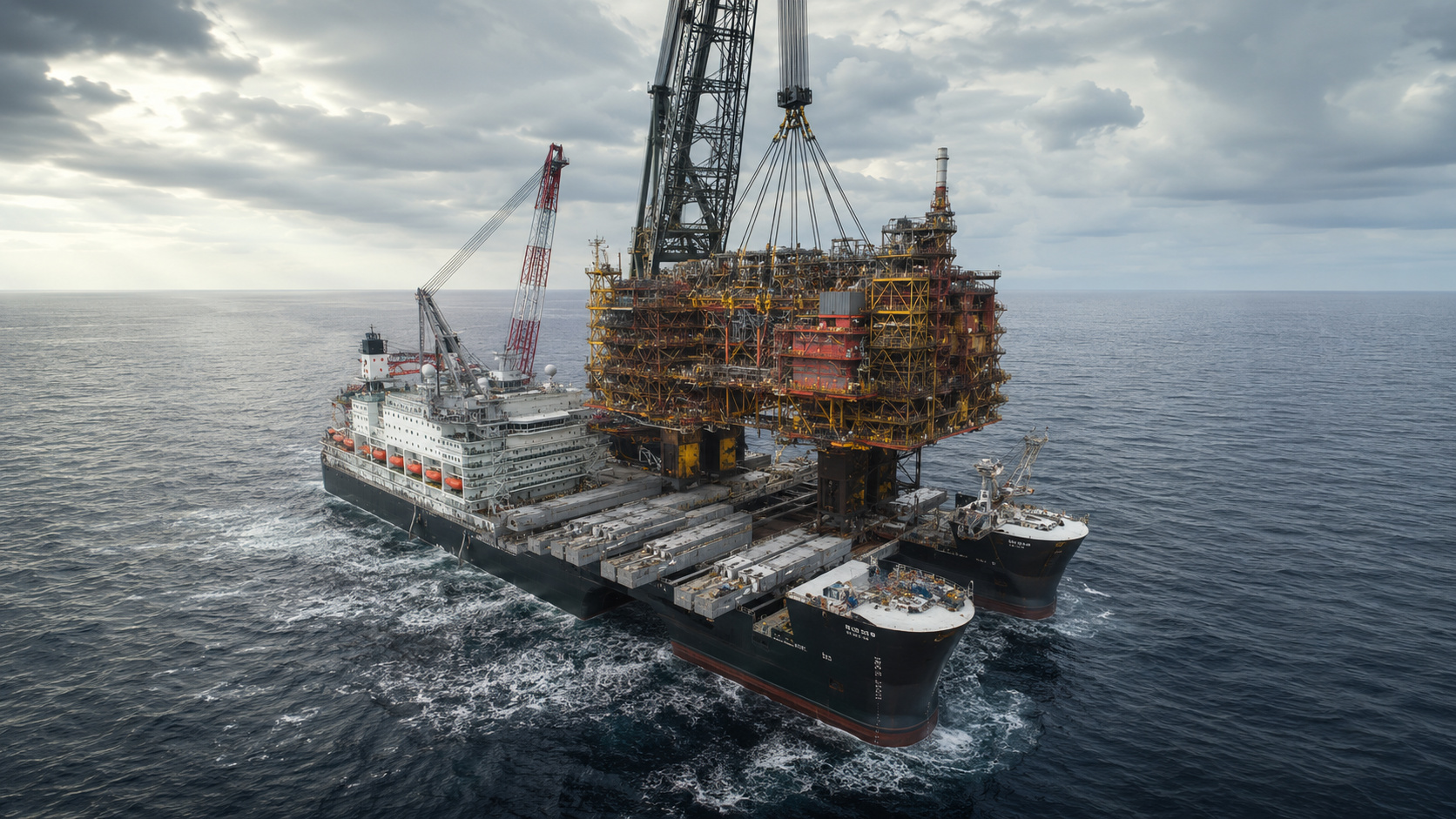

The removal of Heather Alpha shows how offshore decommissioning has become one of the biggest challenges in the oil industry, bringing together giant ships, heavy naval engineering, environmental risk, and the need to remove structures from the sea that have worked for almost half a century
The largest lifting ship in the world lifted 15,300 tons from a platform in the North Sea in a single lift. The operation involved Heather Alpha, a structure that was connected to the offshore oil industry for almost half a century.
The information was released by Allseas, an offshore engineering and maritime construction company. The case gained prominence because the Pioneering Spirit removed the top of the platform as a single piece, in a rare and highly visual operation.
For those not following the sector, the scene helps to understand a growing problem: old platforms also need to be removed from the sea. This process is called offshore decommissioning and involves dismantling, safety, heavy logistics, and environmental care.
-
Billionaire says the most valuable skill will help overcome job elimination caused by AI, following Bill Gates’ fears

-
A Dutchman created a ‘box’ that makes trees grow in the desert almost without water and without irrigation: the invention has already brought seedlings to dozens of countries and achieves up to 90% survival where common planting did not exceed 10%.

-
Abandoned warehouse hid a giant collection of rare computers, with over 2,000 artifacts from the 1930s to the 1980s.
-
Scientists warn that melting ice is triggering an alarming chemical transformation in preserved areas, and the first signs are already concerning researchers worldwide.




A 15,300-ton platform left the North Sea as if it were a giant piece
The Heather Alpha was not dismantled into small pieces at the operation site. The top of the platform was removed in a single lift by the Pioneering Spirit, a lifting ship created for large-scale work in the oil and gas industry.


This upper part is known as the topside. In simple terms, it is the area where equipment, systems, and spaces used in the platform’s operation are located.
The weight shows the size of the challenge. Lifting 15,300 tons at sea requires control, stability, and precise planning. Any error in such an operation can put teams, equipment, and the environment at risk.
What is offshore decommissioning and why it matters to the oil industry
The offshore decommissioning is the process of ending the life cycle of a structure used in oil and gas production at sea. When a platform ages, it needs to be safely removed or dismantled.
The challenge is not only in the size of the structure. After almost half a century exposed to the sea, a platform suffers from wear, corrosion, and harsh operating conditions.
Therefore, removing an old platform can be as complex as installing a new one. The difference is that, at the end of its life cycle, everything needs to be done with even more care because the structure has already spent decades in an aggressive environment.
The Pioneering Spirit changes the way old platforms are removed from the sea
The Pioneering Spirit was designed to install and remove large oil and gas structures through single lifting. This capability reduces the need to dismantle large parts directly at sea.
Allseas, an offshore engineering and maritime construction company, describes the Pioneering Spirit as a lifting vessel aimed at the installation and removal of large maritime structures. The Heather Alpha operation demonstrated this function in practice by concentrating the removal of the top part in a single movement.
In practice, the technology changes the logic of dismantling. Instead of keeping teams for long periods working on an old structure offshore, the vessel removes a large part and allows the next stage to proceed in a more controlled environment.
Lifting everything at once reduces exposure at sea and enhances operation safety
Offshore operations are difficult because they depend on weather, sea, wind, heavy equipment, and coordination between various teams. The longer the offshore work time, the greater the exposure to risks tends to be.
The single lift helps reduce this exposure. Removing the top part in a single step reduces part of the direct work at sea and concentrates the operation in a planned moment.
This type of solution does not eliminate complexity. However, it makes the process more controlled and shows why specialized vessels have come to play an important role at the end of the platforms’ life cycle.
Heather Alpha shows the less visible side of the energy transition
When talking about energy, many people only think about new sources, production, and consumption. But there is another important side: what to do with old structures that have already completed their cycle.
Heather Alpha spent almost half a century in the North Sea. Its removal shows that the industry also needs to deal with the legacy left by decades of offshore production.
This theme connects with the energy transition because it involves responsibility, engineering, and proper disposal of large structures. The future of energy depends not only on building the new but also on safely dismantling the old.
The image of 15,300 tons suspended summarizes a little-known billion-dollar industry
The scene of a platform emerging from the sea in one piece seems like something out of a movie, but it represents a real area of the economy. Offshore decommissioning involves contracts, special ships, technical teams, and companies focused on dismantling giant structures.
For the Brazilian public, the case draws attention because the country also has a strong presence in offshore oil. Even in another market, the operation in the North Sea helps to show the magnitude of the challenges that arise when platforms reach the end of their useful life.
The most important point is simple: producing oil offshore requires heavy engineering, but removing a platform after decades also demands cutting-edge technology.
The removal of Heather Alpha shows how the largest lifting ship in the world transformed a 15,300-ton structure into a piece removed all at once. The episode reinforces the importance of offshore decommissioning for the oil industry.
More than an impressive operation, the case reveals a question that is likely to grow in the coming years: how to remove old platforms from the sea without increasing risks for workers, companies, and the environment?
Do you think the oil industry is prepared to safely dismantle the large structures it has placed in the sea? Share your opinion.





