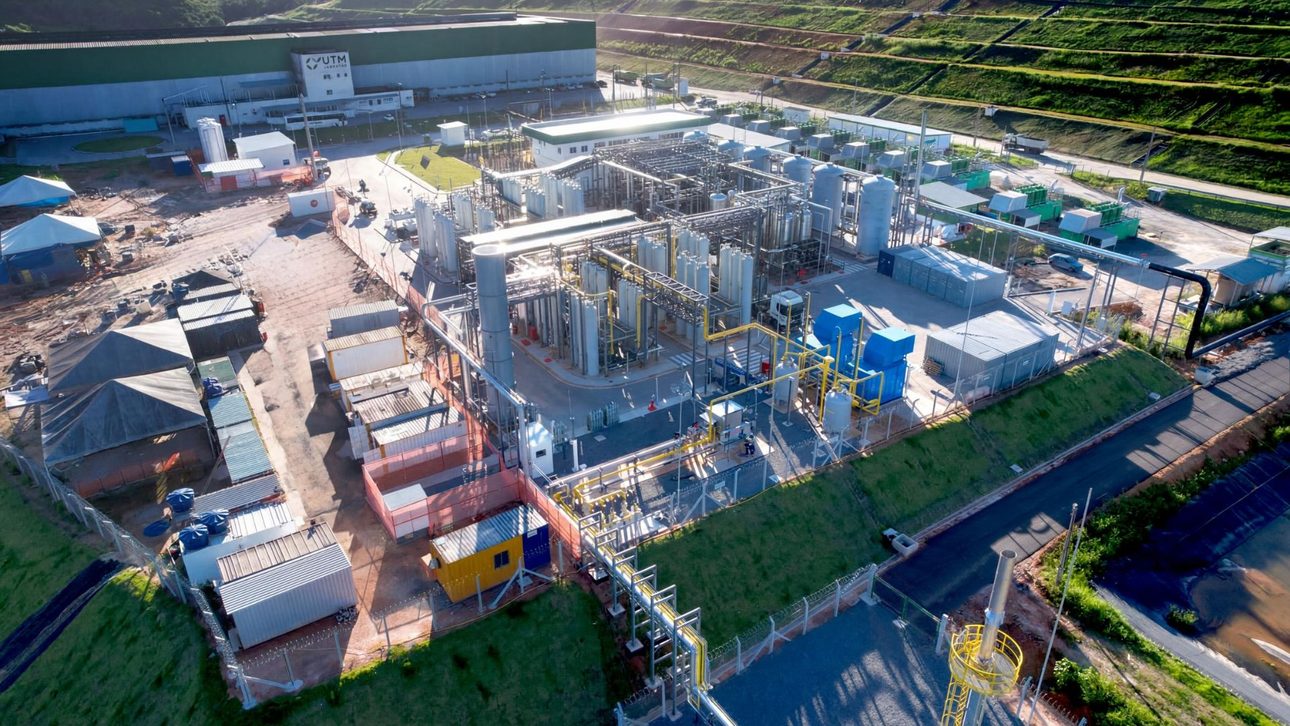

The operation at Ecoparque Jaboatão turns biogas from urban waste into renewable fuel. Months after opening, output was nearing 100,000 cubic meters a day, with production connected to the state gas grid through Copergás.
The biomethane plant at Ecoparque Jaboatão, in Jaboatão dos Guararapes, was already operating near 100,000 cubic meters per day within months of its opening. It uses biogas produced as urban waste decomposes and converts it into renewable fuel for Pernambuco’s gas market.
An Orizon Valorização de Resíduos earnings release republished by Financial Filings reports average output of 87,500 cubic meters per day from July through September 2026. It says the plant was nearing 100,000 cubic meters a day after the quarter ended.
-
D8 engine running on biofuel helps transform agribusiness by replacing fossil diesel without major modifications, preserving energy efficiency and reducing reliance on petroleum

-
Brazilian Ethanol-Powered Prototype Reaches 521 Kilometers per Liter in Efficiency Competition as UTFPR Team Tests Engineering Solutions
-
Brazil’s lower house advances bill proposing ethanol and other renewable fuels for federal vehicles; measure must clear four more committees
-
65% Emissions Reduction: UFLA Study Shows Macauba Could Enhance Aviation with SAF, Lower Emissions, and Bridge Agriculture with Clean Energy


Output approaches announced capacity
Current operations help put the project, which opened in March this year, in perspective. At the time, a report by Jornal do Commercio cited an investment of R$258 million and announced capacity of about 108,000 cubic meters of biomethane per day for the plant in the Muribeca area.
Actual output increased over the course of 2026. In the first quarter, while the plant was still ramping up, average production was about 27,000 cubic meters per day. It rose to 87,500 cubic meters per day in the third quarter, with September reaching about 94,600 cubic meters a day.
The figures distinguish announced capacity from actual output. The roughly 108,000 cubic meters per day cited at the opening represents the facility’s stated potential, while the quarterly figures show how much the plant produced at different stages of its ramp-up.
The project presentation linked daily capacity to approximately 40 million cubic meters of biomethane per year. Jornal do Commercio also reported an estimate of up to 60,000 metric tons a year in reduced carbon dioxide emissions, tied to the use of biogas and the replacement of fossil fuel.
How biogas becomes fuel
The process starts at the landfill, where organic matter in municipal solid waste decomposes. This breakdown produces biogas, a mixture containing methane and other components. Ecoparque’s infrastructure can capture the gas before it moves on to treatment.
The captured gas can then be sent to the purification plant. There, the biogas is treated to remove unwanted components and increase its methane concentration, producing biomethane, a renewable fuel with properties compatible with uses served by natural gas.
This use adds a second function to the waste-management process. The material received at the complex continues through its designated treatment, while the gas generated as it decomposes is no longer just a landfill byproduct. It becomes an energy feedstock.
Rather than simply releasing or burning the biogas produced by decomposition, Ecoparque’s infrastructure allows it to be captured and treated. The additional purification step turns the gas mixture into a fuel with a methane concentration suitable for energy use.
Muribeca and integration with the gas grid
The facility was built in Muribeca, an area historically associated with waste disposal in the Recife Metropolitan Region. At the opening, local officials linked the project to the transition from the former dump to a more organized waste-treatment facility, a process that also involved policies targeting about 2,000 waste pickers.
The change in the waste-disposal model made it possible to add new stages to the treatment process at the site. With biomethane output, the gas generated as waste decomposes becomes part of an energy recovery chain, without changing the need to receive and properly treat municipal waste.
The plant’s operation depends on the flow of waste arriving at the complex and the continuous generation of biogas as it decomposes. The volume received, the amount of gas generated, purification capacity and access to distribution infrastructure all determine the scale of fuel output.
The connection to Companhia Pernambucana de Gás, known as Copergás, allows biomethane produced at the Ecoparque to be integrated into the state’s supply infrastructure. The fuel made from waste can therefore reach customers served by the existing distribution system.
This compatibility reduces the need to create a wholly separate infrastructure for using the renewable fuel. Once purified to the required specifications, biomethane can be used in applications that already run on natural gas, making use of part of the state’s existing distribution system.
In the same results release, Orizon reported a contracted volume of 110,000 to 130,000 m³ per day for Jaboatão, with Copergás as the buyer. This range is reported separately from the actual output figures released for the quarter, which show how much the facility produced during the period under review.