Portuguese
  Spanish


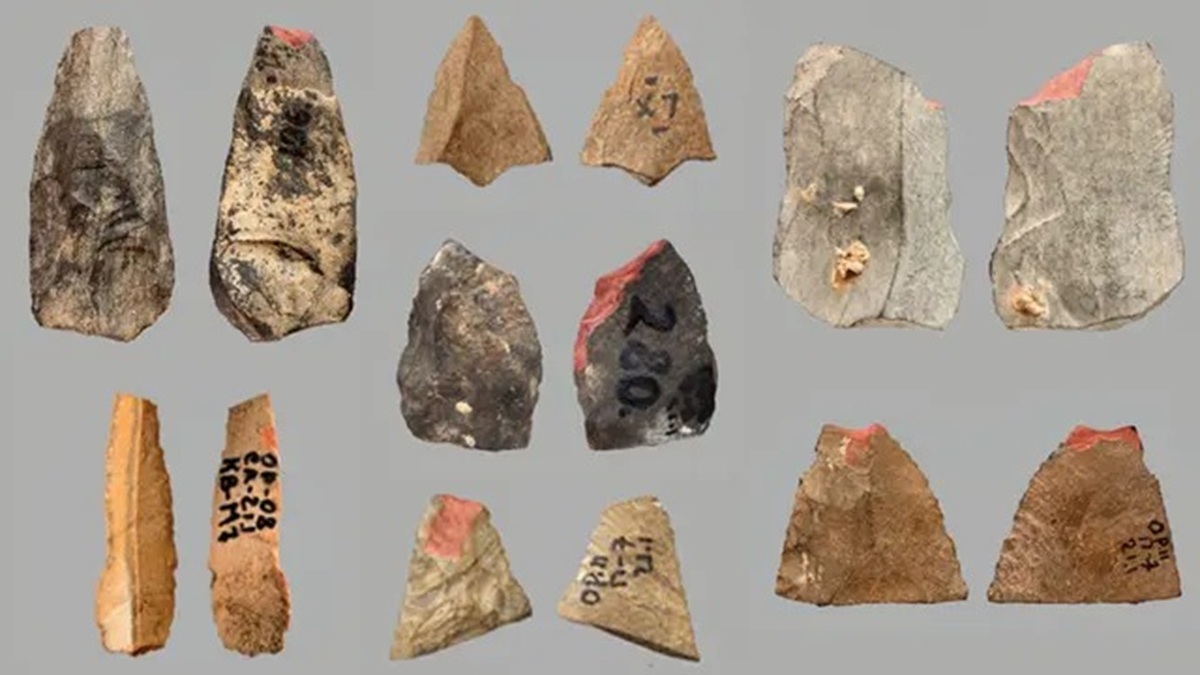

Micropoints of Stone Found in Uzbekistan May Represent the First Arrows Ever Used in Prehistory and Reignite Debate Over Authorship Between Neanderthals and Homo Sapiens.
Archaeologists working at the Obi-Rakhmat archaeological site in northeastern Uzbekistan have found tiny stone points dating back about 80,000 years.
The study, published on August 11 in the journal PLOS One, indicates that these micropoints may be the earliest known arrow tips.
The researchers assert that the fragments are so narrow that they would only fit onto thin shafts, similar to arrows. Additionally, the visible damage on the pieces suggests high-velocity impacts, compatible with use in bows and arrows.
-
OnePlus N6 Smartphone to Launch in India with 8,000mAh Battery and 45W SuperVOOC Charging, Lasting Up to Three Days

-
Scientists Plan to Release Air Bubbles Underwater to Protect Antarctica’s “Doomsday Glacier” from Melting

-
Chinese R6000 Drone Combines Airplane and Helicopter Features, Carries Up to 12 People for Multiple Missions
-
In the World’s Most Densely Populated Desert, Families Dig Funnel-Shaped Underground Cisterns to Capture Rare Rainfall and Store Drinking Water for Up to Eight Months





Pullback in the Timeline
If confirmed, the discovery would push the origin of this technology back by about 6,000 years. Until now, the oldest record came from Ethiopia, where specimens about 74,000 years old had already been identified.
According to Hugues Plisson from the University of Bordeaux, the marks seen on the stones are consistent with use in arrows. He explained to Live Science that the breakage pattern is exactly what is expected from projectiles launched at high speed.
Micropoints Reinterpreted
The site had already provided various stone tools, including wide blades and small ones. However, many triangular microliths were fractured and were initially overlooked.
In the new analysis, scientists reassembled the fragments and measured their dimensions. The result showed that the geometry of the pieces fits better with arrows, rather than with spears. Thus, the original use may have been misinterpreted for years.
Skepticism and Challenges
Despite the enthusiasm, experts point out that there are still doubts. Andrey Krivoshapkin, director of the Institute of Archaeology and Ethnography at the Russian Academy of Sciences, stated that skepticism is expected.
According to him, the bows and shafts of the arrows have not been preserved. Therefore, it is natural for part of the scientific community to question the hypothesis until new evidence emerges.
Who Made the Tools?
Another open question is the authorship of the artifacts. Central Asia was Neanderthal territory during the period when the micropoints were produced. In Obi-Rakhmat, remains of a child were also found in 2003.
Six teeth and 121 fragments of skull were recovered. The teeth show similarities to those of Neanderthals, but the skull exhibits ambiguous traits. This has sparked debate over whether the child was Homo sapiens, Neanderthal, or even a hybrid with Denisovan ancestry.
Homo Sapiens or Neanderthals?
The study suggests that Homo sapiens are the most likely candidates for creating the tools. Still, researchers do not dismiss a Neanderthal origin since the region was inhabited by them.
Krivoshapkin noted that the emergence of the Obi-Rakhmat population coincides with the period of dispersal of modern humans in Eurasia. Thus, the question remains open.
Evaluation of External Experts
Christian Tryon, a Paleolithic archaeologist from the University of Connecticut who did not participate in the research, commented on the impact of the discovery.
He stated that the evidence shows that complex hunting technologies were more widely used than previously thought.
He emphasized that archaeologists tend to underestimate the skills of their ancestors. Therefore, the confirmation of this finding could change the way we understand the evolution of prehistoric weapons.
Comparison with Other Regions
The points found in Uzbekistan are older than those from Ethiopia, dated at 74,000 years. In Europe, small projectiles from Grotte Mandrin in southern France already showed the use of bows about 54,000 years ago.
In the Americas, projectile points from Cooper’s Ferry in Idaho are about 15,700 years old. These artifacts are older than the famous Clovis toolset and reinforce the idea of early human settlement in the continent.
Advancement in the Bronze Age
Over time, the bow and arrow became established as a weapon of war. At the Tollense Valley battlefield in Germany, about 3,200 years ago, numerous arrowheads were found.
Meanwhile, in Mörigen, Switzerland, a single tip made of iron meteorite, about 2,800 years old, demonstrated how weapon production could be valuable and creative.
Future Investigations
The team at Obi-Rakhmat is now seeking to understand when the manufacturers arrived in Central Asia. The scientists are also investigating possible connections with groups from the Levant, considered plausible candidates for the origin of this innovation.
Krivoshapkin stated that such technologies might have emerged much earlier and persisted over time. Tryon added that finding direct hunting sites would be the strongest proof of the hypothesis.
“It would be wonderful to discover the places where the arrows actually hit the prey,” he said. However, finding such traces is difficult, as the landscape changes over thousands of years.