Portuguese
  Spanish


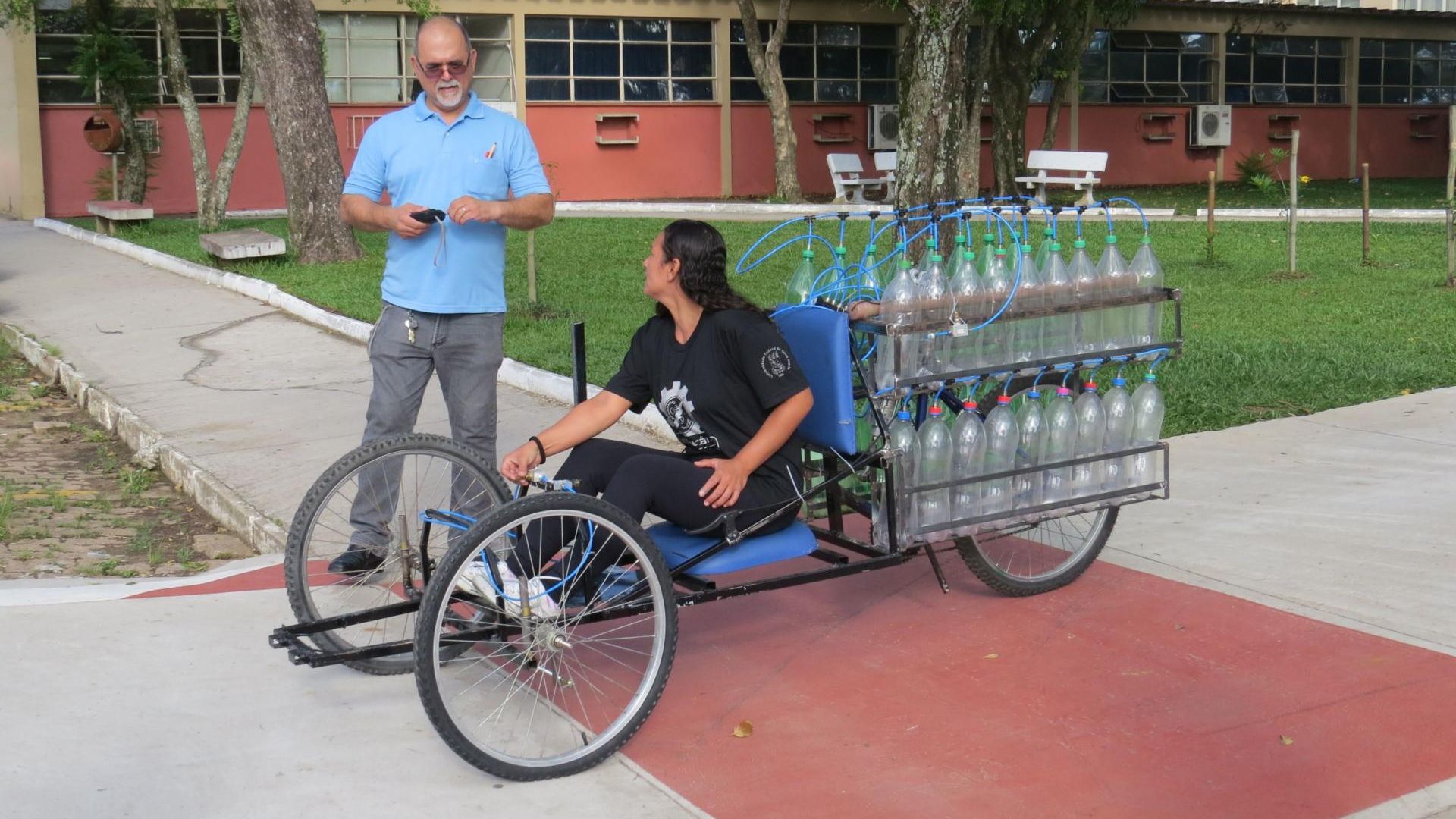


Compressed air engine with PET bottles moves tricycle without fuel and reveals a simple alternative to combustion.
In 2015, students from the Industrial Technical College of Santa Maria, a unit linked to the Federal University of Santa Maria, developed a prototype that attracted attention for deviating from the standard of conventional engines. According to Revista Arco, from UFSM, in a publication dated May 25, 2016, the project was born in the Pneumatics Laboratory under the guidance of Professor Sergio Adalberto Pavani and used compressed air stored in PET bottles to generate mechanical movement.
The experimental vehicle was built with a steel structure, wheels, brake, pedal, bicycle chain, and a set of 36 PET bottles, used as a reservoir for the compressed air. The proposal was not to compete with gasoline, diesel, or battery-powered cars, but to demonstrate an educational, functional, and low-cost solution based on pneumatics, material reuse, and simple engineering concepts.
The result was a compressed air-powered tricycle, capable of moving without internal combustion, without direct emission of pollutants during use, and without relying on a battery to drive the vehicle. Next, understand how this system transforms pressurized air into movement, what its technical limits are, and why the CTISM project gained prominence as a real experience of experimental mobility.
-
World Cup Ball Chip Uses Technology to Detect Invisible Touches, Confirms Offside, Secures Portugal’s Victory Over Croatia

-
36-Meter Hydrogen-Powered Superyacht Arrives in Brazil to Debut German Engines and Showcase Future of Clean Navigation

-
Indian Students from Jaipur Win Top Prize at World’s Largest Science Fair with EcoFog, an Affordable Mesh to Harvest Fog Water Without Energy

-
Italy Sinks Massive 11-Story Concrete Structures in the Ligurian Sea to Create a 6.2 km Barrier, Clearing the Way for 400-Meter Ships in Genoa


Compressed air engine works without combustion and uses pressure to generate mechanical movement
The principle behind the project is different from the combustion engine. Instead of burning fuel to generate energy, the system uses compressed air stored under pressure.
When released, this air expands rapidly. This expansion moves pistons or internal mechanisms, transforming pressure energy into mechanical movement.
This type of engine is already known in engineering, but it rarely appears in homemade solutions. The project’s differential was adapting the concept using simple and accessible materials.
36 PET bottles store the compressed air that replaces liquid fuel
The storage system is one of the most curious points of the project. The 36 PET bottles function as compressed air reservoirs, forming a kind of alternative tank.
Before use, the air is compressed and stored in the bottles. During operation, this air is gradually released to power the engine.


This eliminates the need for gasoline or diesel. However, it is important to understand that the system still depends on external energy to initially compress the air.
Tricycle reaches 10 km/h and travels up to 750 meters with one air charge
According to data released by the developers themselves, the tricycle can reach about 10 km/h maximum speed.
The prototype’s range is approximately 750 meters with the air stored in the PET bottles. This range depends on the initial pressure, the weight of the vehicle, and the conditions of use.
These numbers show that the system works, but it is still far from large-scale commercial applications.
Project was developed with scrap, bicycle parts, and low cost
One of the main points of the project is the reduced cost. The students used reused materials, including bicycle parts and simple components.
This approach shows that engineering concepts can be applied even without access to advanced industrial equipment.
Furthermore, the use of scrap reduces costs and encourages the reuse of materials, something relevant in educational projects.
Engine does not use a battery during operation, but depends on energy for air compression
An important point needs to be clarified. The engine does not use a battery while in operation, which reinforces the idea of independence during use.
However, compressed air needs to be generated beforehand. This process requires energy, usually supplied by electric compressors.

In other words, the system does not create energy from nothing. It stores energy in the form of pressure and then releases it in a controlled manner.
Compressed air technology is already being studied as an alternative in experimental vehicles
Compressed air engines are not exclusive to this project. They have already been studied by companies and research centers as an alternative to fossil fuels.
The main advantage is the absence of direct emissions during use. The engine does not burn fuel, which eliminates polluting gases at the point of operation.
On the other hand, efficiency is still a challenge. Air compression consumes energy, and part of this energy is lost in the process.
Technical limitations currently prevent large-scale use
Despite being functional, the system has clear limitations. Range is low, speed is limited, and compressed air storage requires safety precautions.
Furthermore, the energy density of compressed air is lower than that of liquid fuels. This means that a large volume is needed to store enough energy.
These factors make it difficult to apply in conventional vehicles, especially over long distances. Even with limitations, the project has significant value. It demonstrates in practice concepts of physics, engineering, and sustainability.
For the students, the development of a functional engine represents applied learning, something that goes beyond theory.
In addition, initiatives of this type help stimulate innovation in educational environments.
Alternatives like this gain attention in scenarios seeking cleaner energy
The search for alternatives to traditional combustion has intensified in recent years. Technologies such as electrification, hydrogen, and biofuels dominate the debate.
Compressed air projects appear as experimental solutions within this scenario. They do not replace consolidated technologies but expand the range of possibilities.
In specific contexts, such as small applications or controlled environments, they can offer advantages.
PET bottle engine shows that innovation does not depend only on large industries
The case of the UFSM students reinforces an important idea. Not all innovation is born in large laboratories or multinational companies.
Simple projects, developed with creativity and technical knowledge, can generate functional and inspiring solutions.
Even without industrial scale, these initiatives help expand the understanding of how energy can be used and transformed.
The engine developed by the students does not solve all mobility problems, but it raises a relevant discussion.
It shows that it is possible to create functional systems without combustion, using simple physical principles and accessible materials. At the same time, it highlights that all technology depends on an energy source, even if that source is stored differently.
Do you think simple solutions like this PET bottle engine can evolve and gain space in the future, or will they remain just interesting experiments outside of industry?