Portuguese
 Spanish


Mais Parque, in northern Barretos, São Paulo state, recorded 4 loud, rumbling tremors between 9:20 p.m. Friday (20) and 12:37 a.m. Saturday (21). The strongest, estimated at magnitude 1.5 to 2.0, was the first in the sequence detected by Brazil’s national seismic network, and the University of São Paulo is already monitoring the ground with 4 instruments.
The booms followed by ground shaking began in late October, residents told g1 Ribeirão e Franca, and have become more frequent in recent weeks.
The sequence from Friday into Saturday was the strongest so far. The 9:20 p.m. tremor was felt in 12 neighborhoods in northern Barretos, the city government said.
The other three, which were weaker, were felt only in Mais Parque, a recently developed neighborhood on elevated ground in the northern part of the city.
-
Westminster Abbey archaeologist Warwick Rodwell says the skeleton inside a Roman coffin made for a Briton of 300-400 AD probably belongs to a Saxon abbot, after radiocarbon dating placed the burial between 987 and 1052.

-
Elon Musk’s company says brain chip that promises to restore sight is ready

-
Does AI function like the human brain? New test shows machines use different shortcuts to recognize objects
-
The Secret of DNA’s Evolution: Study Reveals How the Molecule Became a Natural Sunscreen Allowing Life to Survive Extreme Radiation on Early Earth


What the magnitude numbers mean
The independent Brazil Earthquakes profile, which tracks seismic events in the country, estimated the 9:20 p.m. tremor at magnitude 1.5 to 2.0.
The 11:59 p.m. event was estimated at 0.5 to 1.0. The 12:37 a.m. tremor was calculated at magnitude 0.8. No magnitude has been released for the fourth event reported by the city government.
Magnitude measures the energy released at the source of a tremor. The scale is logarithmic: each whole-number increase corresponds to a seismic wave about 10 times larger on a seismograph.
In practical terms, Barretos’ strongest tremor falls in the microseismic range. Such events are usually felt only near their source and rarely cause damage.
What stands out is the noise. Residents compare the sound to a bomb going off, and the shaking lasts about 2 seconds, the city’s Public Safety Department said.
Six stations in the national network detected the tremor
As of Friday, none of the events reported in Barretos had appeared on stations in the Brazilian Seismographic Network, which has about 100 units across the country.
The 9:20 p.m. tremor changed that. It was detected by at least 6 stations, including one in Bebedouro, São Paulo state, and others in southern Minas Gerais, said Jackson Calhau, a seismology specialist at the University of São Paulo’s Institute of Astronomy, Geophysics and Atmospheric Sciences.
“This was certainly the largest event in the sequence that has been occurring here in Barretos,” the researcher told g1.
Detection by distant stations provides useful data. By comparing when the wave reaches each instrument, seismologists can estimate where the tremor originated.
University of São Paulo installs 3 seismographs and 1 accelerometer in the neighborhood
A team from the University of São Paulo’s Institute of Astronomy, Geophysics and Atmospheric Sciences arrived in Barretos at the city government’s request and installed the equipment on Friday (20), hours before the strongest sequence.
The instruments are 3 long-period seismographs and 1 accelerometer for strong ground motion, buried in Mais Parque, Brasil em Folhas reported. The instruments operate independently and record around the clock.
The seismograph continuously records ground movement. The accelerometer measures stronger tremors, when the signal saturates the more sensitive instruments.
Calhau said the equipment has already recorded events of magnitude below 1, which go unnoticed by residents. Geophysicist Marcelo Belentani de Bianchi, a University of São Paulo professor, said the system is already operating to map the source of the shaking.
Why the analysis takes 3 to 4 weeks
A local network of instruments needs to collect multiple events to determine three things: the epicenter, the depth and the exact magnitude of each tremor.
That is why the University of São Paulo estimates it will need 3 to 4 weeks of data collection before conducting a detailed analysis. Until then, the figures in circulation are preliminary estimates.
With the 4 instruments close to the source, measurements are much more precise than those from national stations farther from the neighborhood.
Bomb ruled out; artesian well is one of the hypotheses
The University of São Paulo’s (USP) first conclusion was that a bomb was not involved. “What we can already say is that it was not any kind of bomb,” Calhau told g1.
The researcher identified well-induced seismicity as one line of investigation. Seismologists use the term for tremors caused by human activity underground.
Civil Defense listed two other possibilities: a pressure surge in the water distribution network and the settling of soil layers, since the area is relatively new and elevated.
None of the three explanations has been confirmed. Mayor Odair Silva ruled out an earthquake, and the Autonomous Water and Sewer Service (SAAE) said it had no construction work that could explain the tremors. The neighborhood’s developer was also consulted and identified no apparent cause.
A precedent in Bebedouro, in the same region
The well hypothesis has a precedent in the region itself. About 10 years ago, Bebedouro, in São Paulo state, experienced a similar sequence of tremors.
There, the tremors were attributed to deep-well drilling, according to Brasil em Folhas. I found no publicly available technical report detailing the magnitudes and depths in that case.
Bebedouro is also home to one of the stations in the national seismic network that recorded Friday’s tremor (the 20th).
What the city government and Civil Defense say about the risk
As of Saturday (the 21st), no structural damage to homes or streets had been reported, municipal Secretary of Public Safety Igor Santiago said.
A preliminary technical inspection found no cracks or damage in buildings or pavement, Tribuna Ribeirão reported.
Even so, some residents temporarily left their homes and went to stay with relatives. The official guidance is to remain calm and stay in their homes.
Crisis response center operates in Mais Parque
The city government set up a crisis response center in the neighborhood, bringing together the state Civil Defense agency, firefighters, geologists and the USP team. Teams are working around the clock.
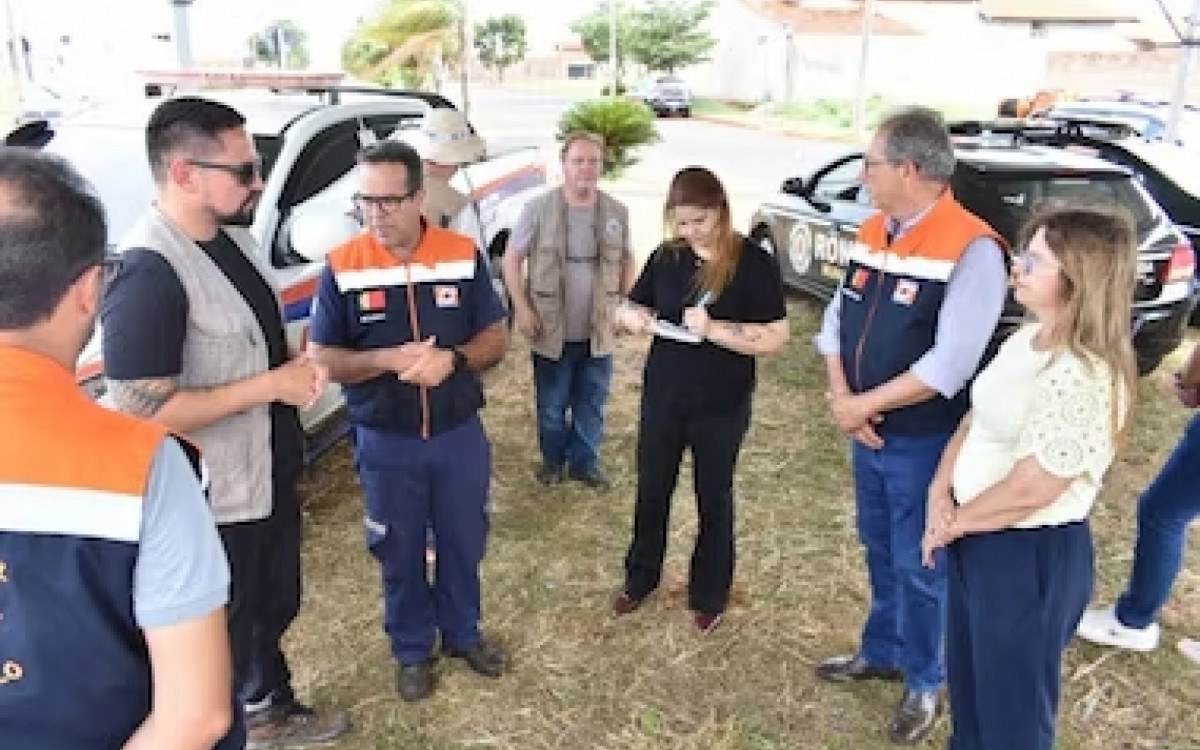
Anyone with questions can go directly to the crisis response center or contact Civil Defense. Home security cameras can also help: one of them recorded the boom at 9:20 p.m.
Small tremors are common in Brazil
Brazil lies in the middle of the South American Plate, far from the boundaries where major earthquakes occur. Even so, low-magnitude tremors frequently occur in the country’s interior.
For comparison, events of magnitude 6 or higher, such as those during the week of the magnitude 7 earthquake in Tibet, release vastly more energy than Barretos’ strongest tremor because the scale increases exponentially.
The Mais Parque case stands out because the tremors have repeatedly struck one location and are accompanied by a boom. That is what the USP’s four instruments will try to explain in the coming weeks.
Residents of inland São Paulo: has anyone felt a tremor or heard a similar boom in your neighborhood?