






 Portuguese
  Spanish
  6 min of reading
  0 comments


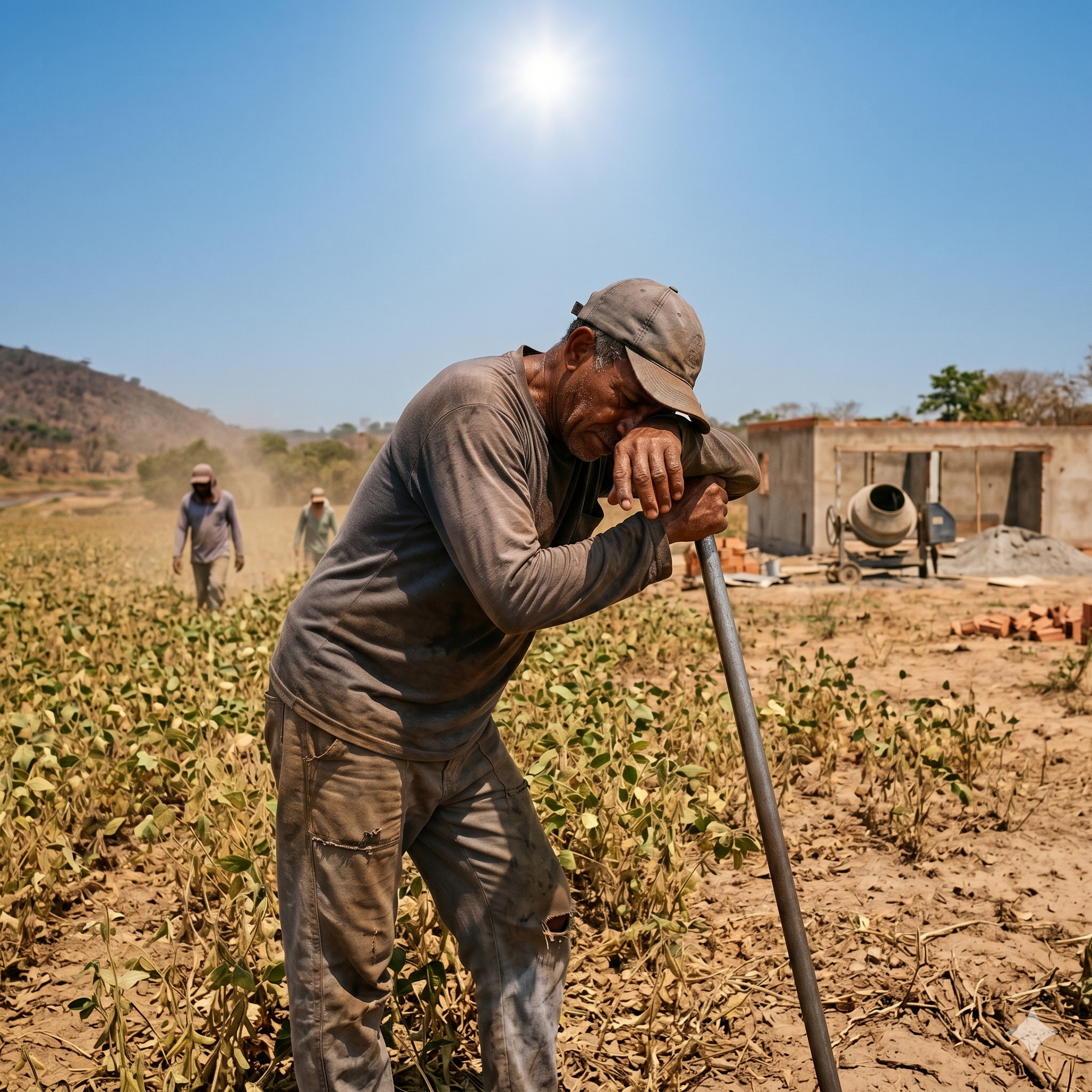
Study projects extreme heat in Brazil with productivity losses above 90% in the North by 2100, affecting work, economy, and health.
On November 13, 2025, a study published in Scientific Reports raised a direct alert about the future of climate and work in Brazil: the advance of extreme heat could increasingly compromise the performance of outdoor activities, especially in the North, Northeast, and Central-West regions of the country.
The research, authored by Leydson Galvíncio Dantas and other authors, used CMIP6 climate projections in the SSP2-4.5 and SSP5-8.5 scenarios and adopted the WBGT (Wet Bulb Globe Temperature) index as a reference, which combines air temperature, humidity, solar radiation, and wind speed to estimate the actual heat load imposed on the human body during outdoor work.
The results show that, in the higher emissions scenario, parts of Brazil could record WBGT above 34 °C, a level treated in the study as critical for occupational safety, which tends to make outdoor physical work much more difficult under current conditions. According to the authors, productivity losses in sectors such as agriculture and civil construction could reach 90%, with direct impacts on workers’ health and the economy
-
A Brazilian city decided to purchase a piece of the Atlantic Forest with more than 153,000 square meters, and owners of preserved areas will be able to submit proposals to transform the forest into a conservation unit.

-
Brazilian siblings aged 11 and 7 read 240 books in just one year and caught attention on social media: while many children spend hours on screens, they turned their family’s routine into an example of reading, discipline, and curiosity.
-
The legendary oak that, according to the story, hid Robin Hood from the Sheriff of Nottingham, died at the impressive age of 1,200 years in England, and the first chilling sign of its end was that no leaves sprouted on the tree this spring.

-
While the world looks at forests, the UN warns that the Earth is also threatened by the silent degradation of natural grasslands and savannas, ecosystems that cover half of the planet, support billions of people, and can exacerbate water, food, and climate crises.


The most critical data from the study indicates that productivity losses could exceed 90% in parts of northern Brazil by the end of the century, especially in outdoor activities.
WBGT index shows that the problem is not just temperature, but the combination with humidity
The use of the WBGT index is central to understanding the severity of the projected scenario. Unlike conventional temperature, WBGT considers the combined effect of environmental factors that influence the human body’s ability to dissipate heat. In tropical regions like Brazil, high humidity hinders the evaporation of sweat, which is the body’s primary cooling mechanism.
This means that, even with seemingly bearable temperatures, the body can reach dangerous levels of thermal stress.

When the WBGT exceeds certain limits, the risk of heat exhaustion, heatstroke, and even death increases significantly, especially in activities requiring continuous physical effort.
North of Brazil concentrates the most critical scenario with risk of outdoor productivity collapse
Projections indicate that the North of Brazil will be the most impacted region. States in the Legal Amazon present a combination of high heat and intense humidity, creating ideal conditions for increased thermal stress.
In future high-emission scenarios, the study points out that workers exposed to the outdoor environment may face heat levels that make the activity practically unfeasible for much of the day.
Productivity losses exceeding 90% mean, in practice, that full workdays may become impossible during certain periods, especially in activities such as agriculture, civil construction, and logistics.
Northeast and Central-West also enter the risk zone with significant losses
Although the North concentrates the most extreme scenarios, other regions of the country also appear with concerning projections.
The Northeast and Central-West are expected to record a significant increase in days with high thermal stress, with relevant impacts on productivity, though at lower levels than in the North.
These regions already face episodes of intense heat and climate variability, and the projected increase tends to amplify the frequency and duration of these events.
The result is a gradual expansion of the thermal risk zone in Brazilian territory, affecting different sectors of the economy.
Agriculture, construction, and informal labor are among the most vulnerable sectors
The impact of extreme heat will not be uniformly distributed among economic sectors. Activities that depend on outdoor work are the most exposed, especially those with lower levels of mechanization or environmental protection.

In Brazil, this includes:
- Agriculture, especially on small properties
- Civil construction, with a large number of exposed workers
- Transport and logistics in open areas
- Informal work in urban centers
These sectors concentrate millions of workers and are fundamental to the economy, which amplifies the potential impact of increased heat stress.
Risk goes beyond productivity and directly affects public health
The study also highlights that the problem is not limited to productivity. Increased heat stress raises the risk of serious medical conditions, such as heat exhaustion, severe dehydration, and sunstroke.
In extreme situations, the human body can lose its ability to regulate its temperature, leading to systemic failures.
This type of risk is especially high for more vulnerable workers, such as the elderly, people with chronic diseases, and those without access to adequate rest and hydration conditions.
Urbanization and heat islands can further worsen the scenario
Another factor that can intensify the problem is the effect of so-called urban heat islands. Cities with high concrete density and low vegetation cover tend to retain more heat, raising the local temperature compared to rural areas.
This phenomenon can further increase heat stress levels in urban environments, where a large part of the Brazilian population lives.
The combination of global warming and disordered urbanization can create even more severe conditions for the urban population.
Projections depend on emission scenarios and may vary according to climate policies
The study’s results are based on greenhouse gas emission scenarios. In the most extreme scenario, known as SSP5-8.5, emissions continue at high levels throughout the century, leading to the most severe projected impacts.
In more moderate scenarios, with emission reductions, the effects still occur, but with less intensity.
This means that the projected future is not fixed, but depends directly on the decisions made regarding global climate policy.
Adaptation requires changes in work methods and investment in infrastructure
Given this scenario, experts point out that adaptation will be essential. This may include changes in working hours, with activities concentrated during milder times, as well as the use of protective equipment and adequate infrastructure.
Investments in shaded areas, access to water, and cooling systems are also considered important to reduce risks.
Without these adaptations, the impact of extreme heat can translate into economic losses and an increase in large-scale health problems.
Brazil may face significant economic impacts with reduced productivity
The reduction in outdoor work capacity has direct implications for the economy. Lower productivity means lower output, increased costs, and potential impact on supply chains.

In the case of agriculture, this can affect food production. In construction, it can delay works and raise costs. In the informal sector, it can reduce the income of millions of workers.
These combined effects can generate significant economic impact, especially in more vulnerable regions.
Given this scenario, extreme heat could redefine how Brazil works in the coming decades
The projections presented by the study indicate that the increase in thermal stress is not an isolated event, but part of a broader climate transformation.
As extreme heat becomes more frequent and intense, the way work is organized may need to be reevaluated.
If outdoor activities become unfeasible for much of the day in some regions, the impact will not only be climatic but structural for the economy and society.
Given this situation, a central question arises: to what extent is Brazil prepared to adapt its way of working and protect millions of people from a scenario where heat ceases to be discomfort and becomes a physical limit to human activity?







Be the first to react!