






 Portuguese
  Spanish


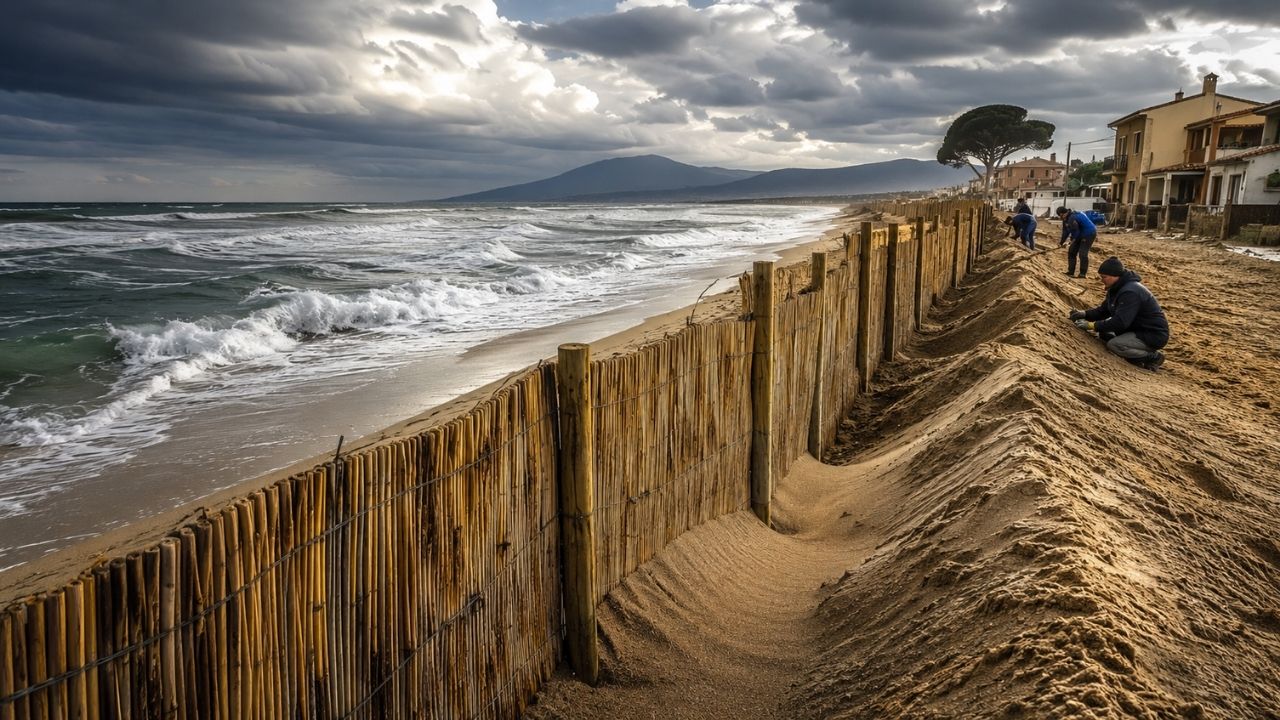
In Catalonia, researchers, residents, and authorities use cane fences as sand traps to protect cities, rebuild dunes, and contain coastal erosion. In Sant Pere Pescador, the beach lost 50 meters in 50 years, while Calafell removed sections of the boardwalk to return space to local natural sand deposits.
In Catalonia, cane fences have become sand traps to protect cities from coastal erosion and rebuild dunes. The technique traps sediments carried by the wind, increases the volume of the beaches, and creates a natural barrier against storms on the European coast.
The initiative gained momentum in the IMPETUS project, which monitors experiences in Sant Pere Pescador and Calafell. The logic is different from traditional works: instead of just replenishing sand in an expensive and temporary way, researchers and communities try to restore the natural functioning of the beach-dune system.
Catalonia faces erosion aggravated by ports, dams, and coastal occupation

Coastal erosion is advancing in various parts of the world and has left areas of the European coast more vulnerable to floods, extreme tides, and habitat loss. In Catalonia, the problem is aggravated by human interventions such as the construction of ports, dams, boardwalks, and buildings close to the sand strip.
-
Smart Glass Revolutionizes Privacy: Touch-Activated Opacity Transforms Windows into Connected Home Features with App and Voice Control

-
Young Innovators from Brazil Turn Discarded Plastic into Eco-Friendly Bricks Using Coconut Fiber, Offering a Sustainable Alternative for Construction
-
Brazilian Scientists Among Team Proposing to Turn Ocean Depths into Giant Gravity Battery Using Cargo Ships and Subsea Cranes

-
Chile’s Plan for a 20,000 km Undersea Cable to Hong Kong Halted by U.S. Pressure, Highlighting the Silent Data Control Battle in Latin America




These structures can block the natural flow of sediments, reducing the beaches’ ability to recover. When the sand stops circulating, the coast loses volume, the dunes disappear, and the sea advances more easily.
The source highlights global forecasts indicating that 50% of the world’s beaches could disappear by the end of the century. This scenario helps explain why nature-based solutions have started to gain space in coastal planning.
In practice, protecting beaches has ceased to be just a tourist issue. In coastal regions, dunes, sand, and vegetation serve as defense against storms, property protection, support for biodiversity, and an economic base for cities dependent on the coast.
Sant Pere Pescador lost 50 meters of coastline in 50 years

The beach of Sant Pere Pescador has become one of the strongest examples of the Catalan experience. According to Carla Garcia-Lozano, a researcher at the University of Girona and partner of the IMPETUS project, the area has lost 50 meters of coastline in the last 50 years due to erosion.
The response came with collaboration between the Government of Catalonia, the Costa Brava Natural Park, residents, and local businesses. The goal was to restore the beach-dune system, recovering the beach’s natural ability to accumulate sand and better resist storms.
In 2020, sand traps made with cane fences were installed. The function of these structures is to capture sediments transported by the wind and allow the sand to accumulate slowly, increasing the height and volume of the dunes.
The method draws attention because it uses simple materials and a natural logic. Instead of trying to impose a rigid barrier to the sea, the fences help the beach itself to rebuild its protection.
Drones show a 40% increase in dune height
Since 2021, researchers from the IMPETUS project have been monitoring changes with drones equipped with advanced sensors. The regular flights allow precise measurement of dune growth and track the terrain’s evolution over time.
According to Carla Garcia-Lozano, this monitoring showed a 40% increase in dune height in three years. The data reinforces that sand traps are not just a symbolic intervention but a technique with measurable results.
Technology comes in to prove what the landscape begins to show. The cane fences trap sand, the dunes grow, and the beach gains more volume to face waves, wind, and extreme tides.
This monitoring also helps guide new decisions. With drone data, researchers can assess where the traps work best, how sediment accumulates, and what adjustments can increase the process’s efficiency.
Protected dunes helped during storm Gloria

The importance of dunes became clear during storm Gloria, in early 2020, which caused widespread damage along the coast. Frederic Suñe Tobella, owner of Camping Las Dunas, reported that the well-maintained dunes helped prevent seawater from flooding his property.
This case shows the practical function of coastal restoration. A preserved dune is not just a landscape; it acts as a natural barrier between the sea and occupied areas.
In extreme events, each meter of accumulated sand can reduce the force of water on properties, streets, and tourist equipment. Therefore, dune reconstruction is directly connected to climate resilience.
The experience of Sant Pere Pescador demonstrates that local solutions can have a real impact when they combine scientific knowledge, public management, and the participation of residents and businesses that depend on the beach.
Calafell tries to bring the technique to urban areas
After the results in more rural areas, the IMPETUS project seeks to apply the same logic in urban environments, starting with Calafell. The city is located in a region that concentrates 43% of Catalonia’s population, which increases the pressure on the coast.
In Calafell, natural dunes have been replaced over time by boardwalks and buildings. This type of urbanization reduces the space available for sand to accumulate naturally, leaving the beach less prepared for storms.
The response was bold: the municipal council removed parts of the seafront boardwalk to create more space for natural sand deposits. The measure shows that protecting cities may require giving space back to the beach itself.
According to Xavier Roig Munar, manager of coastal dune systems, the sand traps in Calafell managed to capture and retain sediments, reshaping the beach to better withstand storms.
Tourism and coastal protection now depend on the same solution


In cities like Calafell, the beach is not just a natural environment. It also supports an important part of the local economy, especially through tourism. Aron Marcos Fernández, councilor for Environment and Public Works, highlighted the crucial role of the beach for the city.
This creates a delicate challenge. The same coastal strip that attracts visitors needs to be protected to continue existing. If erosion advances, the city loses protection, landscape, economic activity, and environmental quality.
The cane fences offer a low visual impact response. They don’t turn the beach into heavy construction, but guide the natural accumulation of sand and help rebuild dunes where there was previously sediment loss.
The case reinforces a change in mindset: protecting the coastline doesn’t just mean building walls or periodically dumping sand. In many cases, it means allowing the coastal system to function again.
Natural solutions can replace expensive and temporary measures
The source points out that traditional methods of sand replenishment have proven expensive and unsustainable. In general, they require repeating the process frequently because the replaced sand can be carried away again by the sea and wind.
Dune restoration offers a long-term strategy. It doesn’t eliminate all risks, but strengthens the natural defense of the beach and can reduce the dependence on emergency interventions.
Measures like elevated houses and dikes can offer immediate relief in some areas, but don’t always restore the ecological dynamics of the coast. Dunes, on the other hand, help protect, store sediments, and create habitat.
With rising sea levels and more intense storms, nature-based solutions are gaining importance. Catalonia shows that instead of fighting the coastline only with concrete, it is also possible to work with sand, wind, vegetation, and time.
Simple fences become a strategy against a global problem
The cane fences of Catalonia show that an apparently simple intervention can respond to a complex problem. By trapping sand, they help rebuild dunes, protect beaches, and reduce the vulnerability of coastal areas.
The IMPETUS project transforms this experience into a monitored model, with drone data, local participation, and application in different contexts, from Sant Pere Pescador to Calafell.
The most important thing is that the solution does not try to dominate the beach, but to restore its natural defense capability. In a scenario of erosion, extreme tides, and stronger storms, this difference can be decisive.
And you, do you think coastal cities should invest more in sand traps and natural dunes, or do you still see dikes and walls as safer solutions against the advancing sea? Share your opinion.






-

-

-

6 people reacted to this.