Portuguese
  Spanish


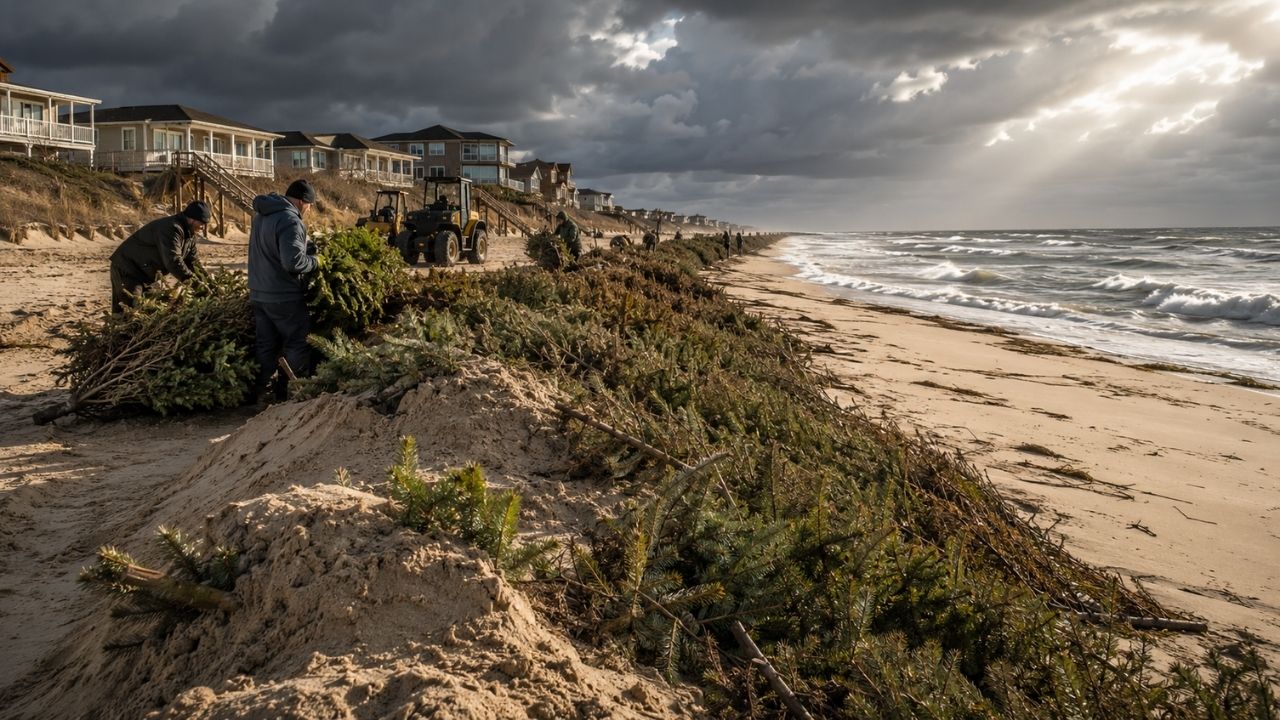

In Gulf Shores, natural Christmas trees are collected between December and January to form U-shaped barriers in the dunes, trap wind-blown sand, and restore coastal habitats. The Gulf State Park program has been repurposing pines for nearly four decades to strengthen beaches against storms and hurricanes in Alabama.
The Christmas trees that might have ended up in the trash gain a second purpose on the Alabama coast. In Gulf Shores, natural pines discarded after the holidays are collected by public teams and used to help restore coastal dunes.
The technique is simple: the trees are placed at the edges of the dunes in groups of three, forming a kind of “U.” With the wind, the sand carried from the beach gets trapped in the branches and begins to accumulate, creating a new base for the natural growth of the dunes.
Discarded trees become a barrier against wind and water

The recycling program operates every year after Christmas. In 2026, the city of Gulf Shores announced that collection takes place from December 29 to January 16, with the collection of natural trees placed on the sidewalk, separate from other waste.
-
Brazilian Startup Converts Tucumã Seeds into Bioplastic for Bicycle Pedals, Cups, and Construction Materials

-
NASA Captures Rare Encounter of South Korean “Surfboard” Spacecraft Crossing Lunar Orbit at Over 11,000 km/h

-
Germany Opens World’s Largest Smart Power Semiconductor Factory with €5 Billion Investment, Creating 1,000 Jobs and Doubling Capacity for AI and Energy Needs

-
Kazakhstan’s Torysh Valley Holds Thousands of Giant Stone Spheres, Intriguing Scientists with Ancient Oceanic “Cannonballs”

There is also the option of delivery at the Gulf State Park Beach Pavilion. The main rule is to remove all ornaments, lights, and decorations, as only natural trees can be repurposed on the beach.
After collection, the pines stop being decorations and start acting as biodegradable coastal structures. They hold the sand transported by the wind and help form small accumulations that, over time, become the base for new dunes.
This process does not happen overnight. The sand gradually clings to the branches, creating natural elevations that are later planted with native species by park staff and local volunteers.
Gulf State Park has been using pine trees for almost four decades
According to Gulf State Park, the Christmas tree restoration program has been happening for almost four decades. The proposal was born out of the need to strengthen the dunes, considered one of the most important natural protections against storms and hurricanes.
Coastal dunes act as a barrier between the sea and urban areas. They help absorb the impact of wind and water, reducing the risk of flooding on roads, houses, and structures near the beach.
Therefore, the park does not allow pedestrian traffic over the dunes. Trails opened by trampling can become pathways for storm waves and facilitate dangerous flooding.
By reusing Christmas trees, the park creates a temporary, natural, and biodegradable structure. Over time, the pine trees become covered with sand and practically disappear within the new dune formation.
U-shaped groups trap sand carried by the wind

The arrangement of the trees is an essential part of the technique. They are placed in groups of three, in a horseshoe or “U” shape, to capture the sand carried by the prevailing winds.
When the wind crosses the beach, the branches reduce the speed of the airflow and cause the sand to fall around the structure. What seems like just a set of dry pine trees begins to function as a natural sediment trap.
Over the months, the sand accumulates and creates volume. Then, in the spring, native dune species are planted around the trees to reinforce the habitat and stabilize the new formation.
This work combines reuse, ecological restoration, and coastal protection. Instead of using only rigid structures, Gulf Shores relies on a process that mimics the natural behavior of dunes.
Storms and hurricanes make dunes essential

The Alabama coastline faces every year the possibility of storms and hurricanes. Such events can change the shape of the beach, push sand inland, or remove sediments from the coast.
Gulf State Park highlights that it is not possible to completely prevent this movement. But it is possible to reduce damage and strengthen the beach so that it better withstands impacts.
Dunes are the first line of natural defense against the sea. When they are healthy, they help absorb wave energy and protect urbanized areas behind the sand strip.
The example cited in the source reminds us that hurricanes can cause significant destruction in the region. Hurricane Sally, in 2020, damaged the park’s pier, showing how the coast can be vulnerable to extreme events.
Program also restores natural habitat
The restoration of dunes not only serves to protect homes and structures. It also improves the coastal habitat, creating conditions for plants and animals that depend on this environment.
In the spring, park staff and volunteers plant native species around the Christmas trees buried or partially covered by sand. These plants help stabilize the dune and enhance ecological recovery.
A healthy dune system supports wildlife and reduces the vulnerability of the beach. The vegetation holds the sand, reduces erosion, and provides shelter for coastal species.
Among the animals linked to the local ecosystem is the Alabama beach mouse, an endangered species considered an indicator of dune health. Protecting this habitat also means protecting part of the coastline’s biodiversity.
Thousands of trees have already found a new destination


The source informs that, in programs of this type, up to 400 trees can be repurposed annually in restoration actions in Alabama. Over decades, this represents thousands of pine trees removed from common disposal and used to strengthen the coast.
The process is simple but requires community organization. Residents need to donate natural trees without decorations, teams collect them, and volunteers help in the subsequent restoration stage.
The repurposing transforms a seasonal waste into an environmental tool. What served as a Christmas symbol inside homes now helps protect the beaches for months or years.
This logic also creates a bridge between community and conservation. Those who donate a tree participate directly in the reconstruction of the dunes that protect their own region.
Simple solution shows the strength of natural restoration
The case of Gulf Shores shows that not all coastal defense needs to start with concrete, walls, or large constructions. In some scenarios, nature-based solutions can reinforce beaches with low visual and environmental impact.
Christmas trees do not replace all types of infrastructure against hurricanes, but they help strengthen the natural system that already exists. When the sand accumulates, the dune grows; when native vegetation takes hold, the protection becomes more resilient.
The technique also draws attention because it uses biodegradable materials. Over time, the pine trees decompose under the sand, while the dune continues to form and gain stability.
In times of coastal erosion, more intense storms, and greater pressure on coastal areas, turning waste into natural protection can inspire other communities.
Christmas trees become coastal defense after the holidays
The trees repurposed in Gulf Shores show how a year-end tradition can gain environmental impact after the lights go out. Instead of occupying landfills, the pine trees start to trap sand, rebuild dunes, and support coastal habitats.
The Gulf State Park program has existed for nearly four decades and reinforces a simple idea: protecting the beach also depends on taking care of what seems small, like branches, wind, sand, and native plants.
On the Alabama coast, this combination helps create a natural barrier against storms and hurricanes. It is not an instant barrier, but a defense that grows over time.
And you, do you think coastal cities should adopt more Christmas tree recycling programs to restore dunes, or does this type of solution still seem small compared to the power of hurricanes? Share your opinion.