






 Portuguese
  Spanish


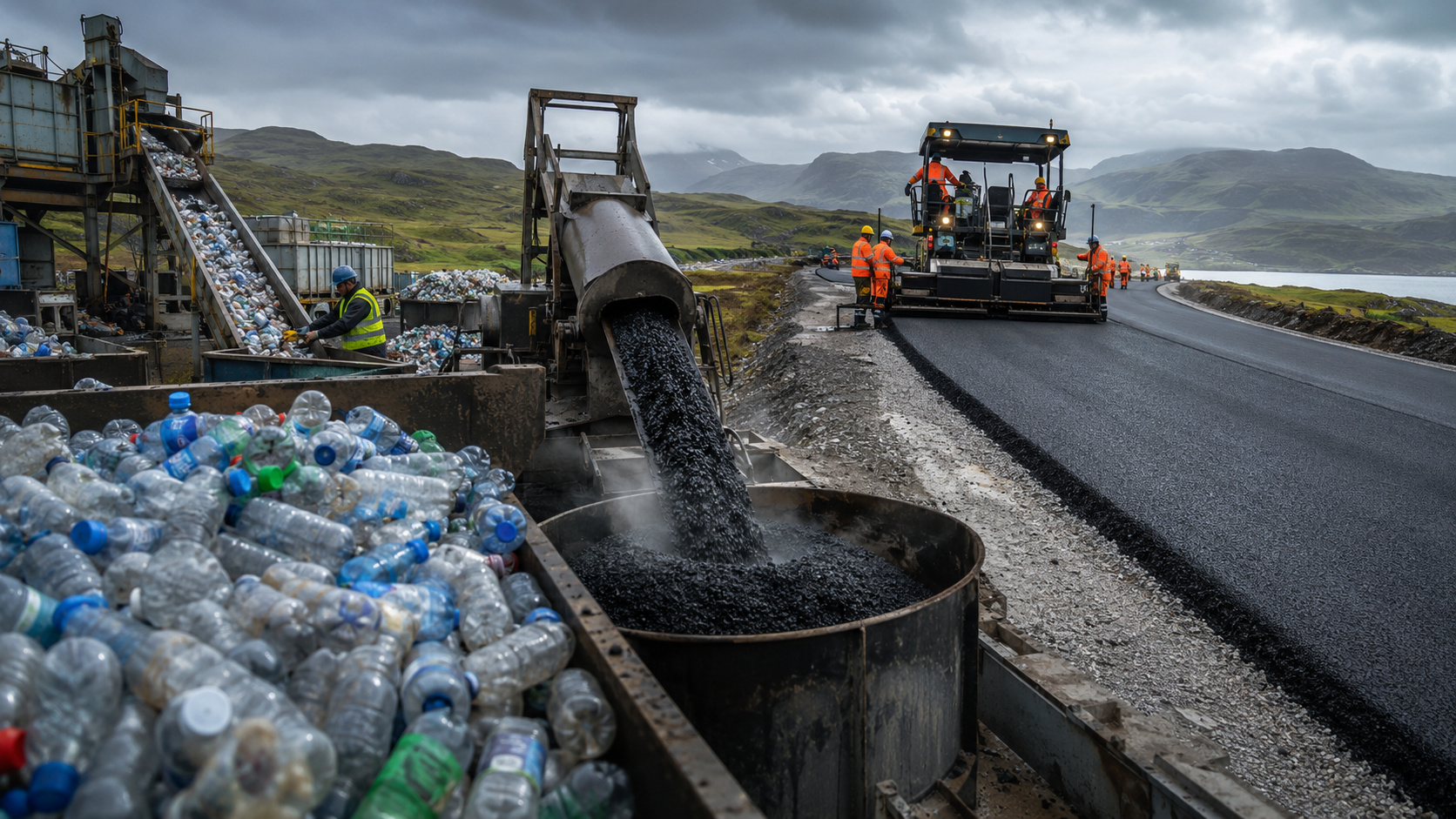


MacRebur transforms recycled plastic into asphalt additive, reduces bitumen use, and brings sustainable roads to over 30 countries.
MacRebur, a company founded in Lockerbie, Scotland, has created a technology that transforms recycled plastic into asphalt additive, reducing the use of bitumen, a petroleum-derived material used as a binder in traditional roads. According to the company itself, their products MR6 and MR8 are already used in roads in over 30 countries and help asphalt manufacturers reduce costs and environmental impact. The technology repurposes plastics that could end up in landfills or incineration.
The most striking data is the scale: each ton of MacRebur mix can use the equivalent of 80,000 plastic bottles, while 1 km of road can consume the equivalent of 684,000 bottles or 1.8 million disposable bags.
Asphalt with recycled plastic replaces part of petroleum-derived bitumen
MacRebur’s system does not use whole bottles in the pavement. The discarded plastic is processed into small granules and transformed into polymers capable of replacing or reducing part of the bitumen in the asphalt mix. The company states that MR6 was created to replace polymer-modified bitumen, while MR8 reduces the total bitumen content in the asphalt. This allows the process to remain within the industrial logic already used by paving plants.
-
Scientists Convert Food Waste into Aviation Fuel, Successfully Test 50% Blend with Conventional Kerosene to Cut Emissions and Promote Sustainable Flights
-
OnePlus N6 Smartphone to Launch in India with 8,000mAh Battery and 45W SuperVOOC Charging, Lasting Up to Three Days

-
Scientists Plan to Release Air Bubbles Underwater to Protect Antarctica’s “Doomsday Glacier” from Melting

-
Chinese R6000 Drone Combines Airplane and Helicopter Features, Carries Up to 12 People for Multiple Missions

MacRebur claims that their roads can be up to 60% more resistant and last up to ten times longer than conventional asphalt. These figures appear in commercial materials and publications about the company, but should be treated as performance claims dependent on testing, climate, traffic, and application.

The main technical advantage lies in the modification of the asphalt binder. By reducing part of the fossil bitumen and incorporating recycled polymers, the mix can gain flexibility, fatigue resistance, and better performance against cracks.
I cannot confirm this as a universal rule for any road: that every pavement with MacRebur lasts ten times longer in any country. The actual durability depends on the design, base, vehicle load, temperature, and maintenance.
MacRebur was born after an idea seen in India and became paving technology
The origin of MacRebur is linked to Toby McCartney, who observed in India the improvised use of melted plastic to fill potholes in roads. From this idea, he took the concept to Scotland and began testing an industrial and controlled version.
The base text informs that the company was founded in 2016 by Toby McCartney, Gordon Reid, and Nick Burnett, in Lockerbie. The proposal was to create a material capable of reusing plastic waste and improving asphalt performance.
Today, MacRebur positions itself as a circular economy company in road construction, selling additives to asphalt manufacturers in different international markets.

Recycled plastic in asphalt should not become loose microplastic
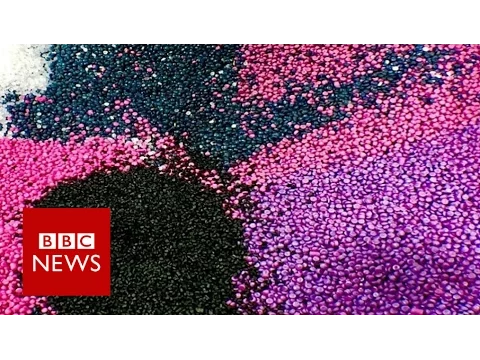
One of the most sensitive points of the technology is the concern with microplastics. MacRebur’s proposal is to use plastics that melt during the mixing process and incorporate into the asphalt binder, rather than remaining as loose fragments on the road.
In practice, the company sells processed polymers, not shredded plastic waste directly thrown onto the pavement. This difference is essential to understand the technology and avoid a misinterpretation of the project.
Even so, the application needs to follow technical standards and independent tests. Public roads require safety, resistance, adhesion, thermal stability, and proven performance before large-scale adoption.
Sustainable roads have already reached the United Kingdom, Australia, Bahrain, and other markets
MacRebur claims to have a presence in over 30 countries, with applications in roads, parking lots, and paving projects. The expansion began in the United Kingdom and advanced to markets such as Australia, Bahrain, New Zealand, South Africa, and other countries.
This growth shows that the market for asphalt with recycled plastic is no longer just an environmental curiosity. The technology has begun to compete with traditional paving and road maintenance solutions.

The advancement, however, depends on regulatory approval, acceptance by public engineers, and technical proof. Road infrastructure does not adopt new materials solely for sustainable appeal; it requires performance measured in real-world projects.
Sustainable asphalt can reduce landfill plastic and petroleum use
MacRebur’s greatest strength lies in tackling two problems at once: the excess of discarded plastic and the dependence on petroleum-derived bitumen. Each project using the material reduces part of the plastic waste and decreases the demand for fossil binders.
According to the company, the products generate financial and environmental savings for asphalt manufacturers. The Scottish government also cites MacRebur as a case of innovation in circular manufacturing, with bitumen reduction and carbon gains. On a global scale, the potential impact is large because the world has millions of kilometers of highways. Even a partial replacement of bitumen can represent a large volume of repurposed plastic.
MacRebur’s technology does not alone solve the global plastic crisis, but it shows a concrete path to repurpose waste in high-volume projects. Roads consume large amounts of material, making the sector strategic for the circular economy.
The case also reinforces an important trend: sustainable infrastructure depends not only on new energy sources but also on new materials. Asphalt with recycled plastic fits precisely into this point.
If technical results continue to be positive in different climates and types of traffic, MacRebur could transform a problematic waste into an input for more durable, cheaper roads with less dependence on petroleum.








Unfortunately this company have made the plastic problem a lot worse! The roads will break down under use. Micro and nano fragments of plastic will be created. The rain will wash these fragments into water system. As the plastic continues to degrade it wears into smaller and smaller particles. These particles are too small to be filtered out. Our crops are sprayed wth this contaminated water. Our **** food source eats the crops and drinks the water. We eat the animals and drink the water. We are all walking around with plastic in us right now. What’s worse is plastic is now found in the placenta of pregnant women. Our plastic problem is going worse if the well meaning solutions aren’t worked through to their full conclusion.
We are interested to your projects
Plastic is made from oil.
Thank you. I was just about to say that.