






 Portuguese
  Spanish


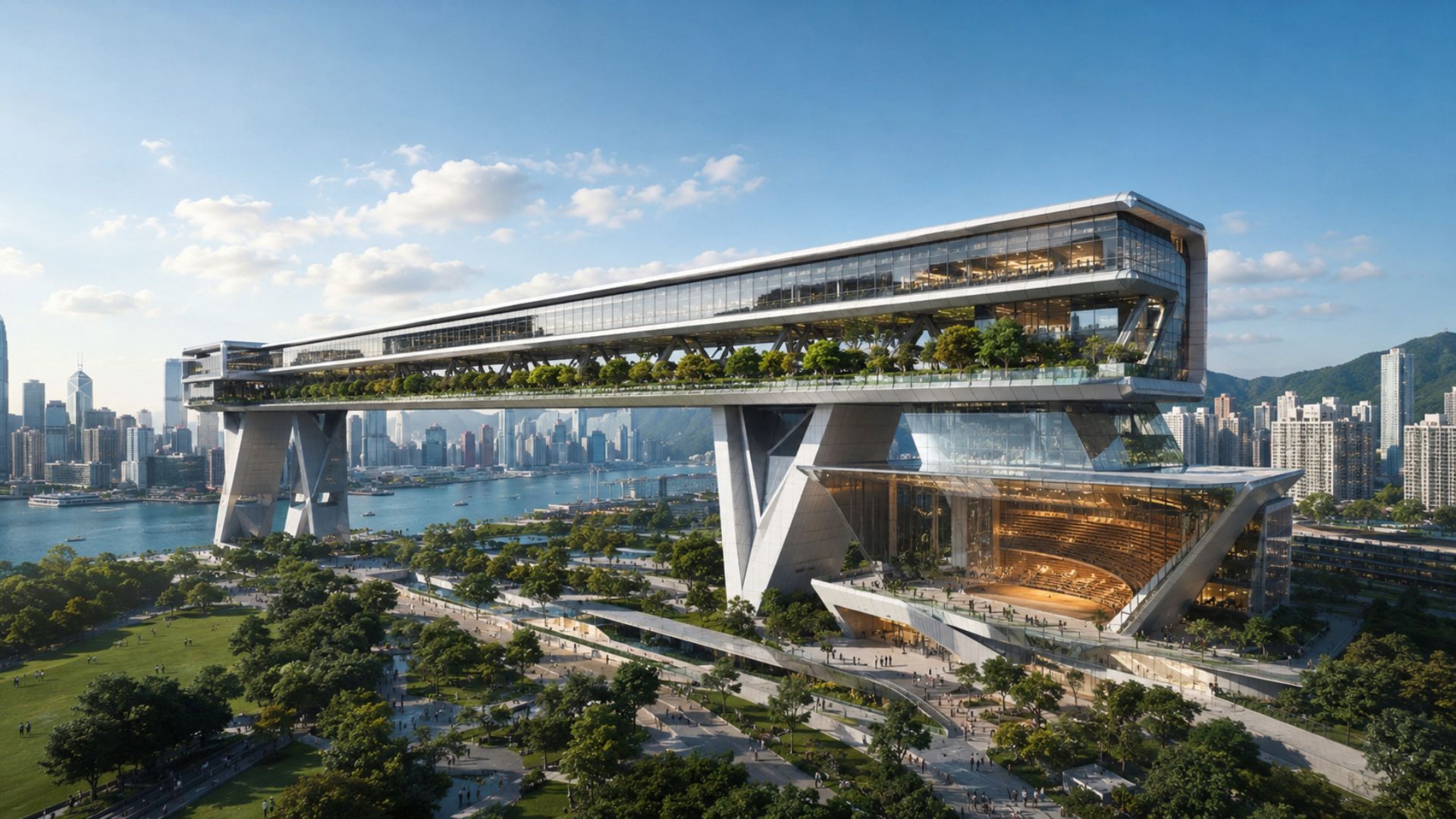


Hong Kong will inaugurate in 2027 a horizontal skyscraper, the Central Yards, a project by Henderson Land nicknamed The Bridge. Instead of reaching for the skies, the lying skyscraper will extend about 400 meters along the edge of Victoria Harbour, with a 300-meter hanging garden, over 400 trees, and a theater for 1,100 people.
On November 17, 2025, Monday, the developer Henderson Land Development officially revealed the name and design of Central Yards, a mixed-use development on Hong Kong’s New Central Waterfront, conceived as a horizontal skyscraper nicknamed The Bridge. Instead of following the city’s vertical tradition, the building will extend about 400 meters along Victoria Harbour, forming the longest architectural structure in the Central district and drawing a new skyline on the waterfront. Henderson Land’s chairman, Martin Lee Ka-shing, stated that the project arises from the group’s commitment and love for the city, aiming to connect retail, culture, commerce, nature, and entertainment in a single space.
The concept of a lying skyscraper, known in English as a groundscraper, is a direct response to specific urban challenges in Hong Kong. The land is within a legally protected visual corridor, which imposes strict height limits to preserve the view of Victoria Harbour, making it impossible to erect another tall tower on the site. Instead of creating a vertical wall between the city and the sea, planners opted for a low and fluid structure, allowing movement, openness, and the creation of wide public spaces. The horizontal skyscraper is, therefore, an urban planning choice, not an aesthetic whim.
What is the Central Yards, the horizontal skyscraper of Hong Kong

The Central Yards is a mixed-use development that totals more than 1.6 million square feet of gross area, equivalent to about 150,000 square meters, delivered in two phases. Phase 1 is scheduled to open in 2027, while Phase 2 is planned for 2032. The complex will house more than 700,000 square feet of high-standard offices, with the largest office floor in Hong Kong’s commercial district, in addition to commercial areas, cultural spaces, and extensive green zones open to the public.
-
Netherlands Builds Road from 218,000 Recycled Plastic Cups and 500,000 Bottle Caps, Featuring Smart Sensors and Promising Triple the Lifespan of Traditional Asphalt

-
Brazil to Convert 80 Public Properties into 11,000 Affordable Homes Across 44 Cities to Address Housing Shortage

-
Brazilian Company Develops Wall Panels from Recycled Refrigerator Foam with Comparable Thermal and Acoustic Performance

-
Brazil’s São Paulo Region Unveils Latin America’s Largest Timber Shopping Mall, Built in 7 Months, Capturing Carbon and Preventing 900 Tons of Emissions


The project was conceived by Henderson Land in partnership with an international team of architecture and design firms. The design leadership is by Lead8 from Hong Kong, in collaboration with AL_A, by British architect Amanda Levete, UNStudio from the Netherlands, landscaping by PWP Landscape Architecture from California, and lighting by Speirs Major from London. This combination of renowned studios is what gives the horizontal skyscraper its identity as an urban spine, connecting the different neighborhoods of Central to the waterfront in a single architectural gesture.
Why build horizontally in one of the most vertical cities in the world

Hong Kong is possibly the most vertical city on the planet, with nearly 700 towers over 150 meters high, a world record. Precisely for this reason, the decision to build a horizontal building draws so much attention. The central reason is regulation. The land is within a visual protection area that severely limits the height of constructions, so nothing blocks the iconic view of Victoria Harbour, one of Asia’s most valuable landmarks.
In addition to the legal restriction, there is a clear urbanistic intention. Instead of erecting a wall of concrete and glass between the city and the sea, the project bets on a low and permeable design, inviting pedestrians to cross, circulate, and contemplate the landscape. The intended result is a lively public space day and night, with terraces, green areas, a theater, and pedestrian paths, something a traditional skyscraper would hardly be able to offer on the same land, precisely because it concentrates everything vertically.
The 300-meter hanging garden and the living engineering of the project


One of the major highlights of Central Yards is the 300-meter-long hanging garden on top of the structure, facing Victoria Harbour. The space will gather more than 400 trees and 280 species of plants, creating naturally cooler zones, combined with fountains and water mirrors integrated into the landscaping. In total, about 28,000 square meters will be dedicated to green areas distributed across various levels and fully accessible to the public, in a concept of an oasis within the concrete jungle.
But the garden is not just decoration: it is living engineering. A mature tree can weigh up to a ton, and with more than 400 trees, this means several hundred additional tons on the structure, a considerable load that engineers need to calculate precisely. To support this urban forest, the horizontal skyscraper will integrate rainwater harvesting and smart irrigation systems, with moisture sensors that adjust water supply according to the real needs of the plants, reducing waste.
Theater, offices, and retail: the city within the city
Central Yards was conceived as a city within the city. On the ground floor, open spaces will surround a main avenue filled with shops, contributing to the project’s extensive commercial area. Starting in 2027, with the opening of Phase 1, residents and visitors will be able to stroll through courtyards, boutiques, terraces, and cultural zones, in a district designed to be a destination, not just a passage.
Among the cultural facilities, the highlight is a theater with a capacity for 1,100 spectators, designed according to international scenography and lighting standards, capable of hosting large-scale shows. For a global city like Hong Kong, which recently inaugurated the Kai Tak Sports Park, with 28 hectares, and hosted shows like Coldplay’s, having a new cultural hub integrated into an office skyscraper reinforces the strategy of repositioning the city as a cultural capital and event center of Asia.
The engineering challenges by the edge of Victoria Harbour
Building so close to the sea imposes significant technical challenges. The complex will be fully exposed to salt and sea air, requiring the use of corrosion-resistant materials, such as stainless steel, at strategic points of the structure and facade. Additionally, Hong Kong frequently faces typhoons, which require both the structure and facade to withstand extreme winds without compromising the safety or comfort of the occupants.
The released images show a sequence of glass volumes with smooth and fluid lines, connected by elevated walkways and surrounded by vegetation. Large openings traverse the volumes, creating protected terraces and channels that bring natural light and fresh air into the building. At night, the dynamic facade will transform into a choreographed light show, designed to highlight the structure during events while minimizing light pollution, according to the lighting studio responsible for the horizontal skyscraper.
Sustainability and Energy Efficiency of Central Yards
Sustainability is one of the pillars of Henderson Land’s discourse on the project. The developer promises an intelligent facade capable of reducing energy consumption by up to 30% compared to conventional Class A offices. This efficiency would come from dynamic windows, high-performance glass, and intelligent sunshades that adjust to weather and sunlight conditions throughout the day, modulating heat and brightness according to exposure.
The building is also designed to create an internal microclimate, with strategically positioned openings that channel fresh air and natural light into the structure. Another announced innovation is a seawater-powered cooling system aimed at reducing energy consumption and ensuring thermal comfort year-round. According to the company, the project has already secured nine international environmental certifications, positioning the horizontal skyscraper as a sustainability benchmark for the city.
Jane Street and the Financial Bet on the Horizontal Skyscraper
Market interest in Central Yards is already translating into concrete numbers. Henderson Land announced that more than 70% of the office space in Phase 1 has already been leased, even before the completion of the work. The anchor tenant is Jane Street, an American quantitative trading firm, which signed a contract to occupy more than 223,000 square feet, spread over six floors, about two years before the expected delivery in early 2027.
According to the South China Morning Post, the contract provides for a rent of about 3.9 million dollars per month, with a five-year term starting in 2028 and an option to renew for another four years. Henderson itself classified the agreement as the largest single office leasing transaction in the Central district in decades. For an office market that had been facing high vacancy and weak demand in Hong Kong, closing this contract so far in advance is a strong sign of confidence in the horizontal skyscraper and the city’s economic recovery.
Central Yards proposes a symbolic inversion in one of the most vertical cities in the world: instead of competing for height, it bets on horizontality, connection with the sea, and the creation of public space. It is an ambitious project not only in scale but in concept, trying to prove that a metropolis can continue to innovate without necessarily building taller. Legitimate doubts remain about public access and usage barriers, but the fact is that Hong Kong’s horizontal skyscraper is already one of the most talked-about architectural works in the world for the coming years.
Do you identify more with traditional vertical skyscrapers or with the idea of a horizontal skyscraper like the Central Yards in Hong Kong? Do you think projects like these, which prioritize public space and green areas, should inspire Brazilian cities? Leave your comment, tell us which iconic building in the world impresses you the most, and share the article with those interested in architecture, urbanism, and innovation in large cities.





It will be the ugliest thing on earth. What else can these HKG estate thugs do apart from mixing cement. Can’t they come up with some sort of invention like ASMIL NVEDA, Samsung, Toyota, BYD, or HUAWEI?