






 Portuguese
  Spanish


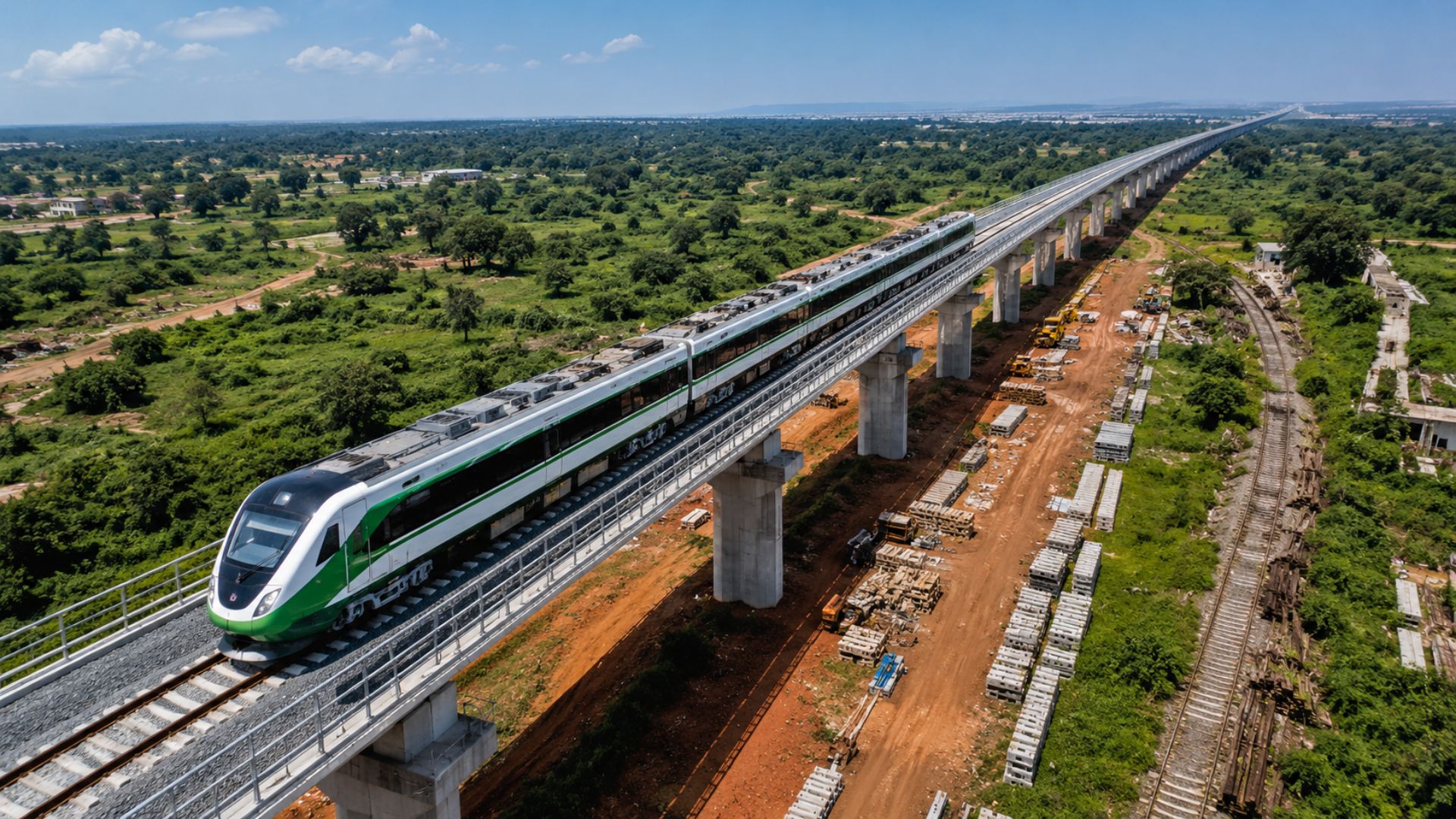


China leads the reconstruction of Nigeria’s railway network with billions in loans from Exim Bank and works by the state-owned CCECC. The project abandons the old British colonial gauge and builds the Lagos-Kano Railway, a corridor of over 1,300 kilometers to remove cargo from the roads of Africa’s largest economy.
In June 2021, China, through the state-owned China Civil Engineering Construction Corporation (CCECC) and with major financing from the country’s Export-Import Bank (Exim Bank), delivered and inaugurated for operation the standard gauge railway between Lagos and Ibadan, in southwestern Nigeria, the most visible milestone of a project that reconstructs from scratch the railway network of Africa’s largest economy. The section, about 156 kilometers long, cost approximately 1.5 billion dollars, financed by a 1.3 billion dollar loan from China’s Exim Bank and another 200 million dollars from the Nigerian government, and is part of the Lagos-Kano corridor, over 1,300 kilometers long, which aims to remove a large part of the cargo from the roads in a country with over 230 million inhabitants.
The context explains the urgency. The railway network inherited from the British colonial period was built in the early 20th century with the aim of extracting raw materials from the interior to the ports, and not to integrate cities or sustain a modern industrial economy. Over the decades and with the deterioration of the old tracks, cargo transport almost entirely migrated to the highways, and today more than 90% of freight in Nigeria circulates by road. It is in this gap that China entered, not to patch up the old system, but to replace it with a completely new standard gauge network.
Why Nigeria’s colonial railway network became scrap

Built by the British to transport products like cocoa, peanuts, and minerals from inland regions to coastal ports, it was never intended to connect large cities in a balanced way nor to support industrial growth or high passenger demand. Technically, the entire network depended on the so-called Cape gauge, 1,067 millimeters wide, narrower than the modern international standard, which limited speed and load capacity.
-
Brazil to Auction 9,000 km of New Railways, Aiming to Attract $28 Billion by 2026

-
Brazil Plans $160 Billion Investment to Revitalize Railways and Reduce Reliance on Long-Distance Trucking

-
Retired Railway Workers in Brazil Preserve Locomotive for 52 Years, Now See It Donated by the Government

-
Railway returns to prominence in Brazil after STF approval: a R$ 25.2 billion project promises to save R$ 9 billion in freight, transport 50 million tons per year, and transform Sinop into a logistics powerhouse for agribusiness.


After independence, instead of a complete modernization, the system faced years of underinvestment, reduced maintenance, and aging equipment. In the early 2000s, Nigeria still had more than 3,500 kilometers of lines on paper, but only a fraction remained operational, with slow and inconsistent service. As the railway network weakened, roads took the lead, creating the current logistical bottleneck that the partnership with China is trying to resolve.
How China entered the railway reconstruction of Nigeria

Nigeria fits into this strategy: it is the most populous country in Africa, has one of the largest economies on the continent, and occupies a key position in West Africa, with access to Atlantic shipping routes. For Beijing, investing there means operating in a market with long-term infrastructure demand and gaining regional influence.
On the Nigerian side, the priority was to find a partner capable of financing and executing large projects quickly. Traditional options, such as multilateral institutions and Western development programs, usually come with long timelines and stricter conditions. China offered a different model: loans through the Exim Bank, generally linked to the hiring of Chinese contractors, which reduces the interval between planning and execution and delivers the project as a complete package, from financing to construction.
The new standard gauge that replaces the old tracks


The most important technical change begins with the track itself. The new network is being built to a standard gauge of 1,435 millimeters wide, the same standard used in modern railway systems around the world. This difference from the old Cape gauge of 1,067 millimeters allows trains to run faster, carry heavier loads, and operate more efficiently over long distances, three decisive factors for a country of continental dimensions like Nigeria.
But the track width is just part of the plan. The larger goal is to connect the country’s main economic zones through a structured network, linking coastal ports to inland cities, integrating industrial hubs, and creating reliable corridors for passengers and cargo. Instead of isolated lines, each section is developed as part of a broader system because a railway only becomes truly effective when it functions as a connected corridor, not as loose segments on the map. This is the leap that China is helping Nigeria to make.
The Abuja-Kaduna line, the country’s first standard gauge railway

Construction began around 2011 and the line was officially inaugurated in July 2016, becoming Nigeria’s first modern standard gauge railway. The cost was around 874 to 876 million dollars, with 500 million coming from a concessional loan from China’s Exim Bank and the rest financed by the Nigerian government.
Technically, the line introduced standard gauge infrastructure on a scale in the country, with trains operating at speeds of up to about 120 kilometers per hour. Quickly, the Abuja-Kaduna became one of Nigeria’s busiest passenger railways, with trains operating near maximum capacity and consistently high demand, as well as supporting freight transport. The success of this first line paved the way for subsequent sections of the project led by China.
The Lagos-Ibadan line and the connection with the busiest port
The second major milestone was the Lagos-Ibadan railway, about 156 kilometers long, which connects Lagos, the main economic center and busiest port city in the country, to Ibadan, one of the largest cities in southwestern Nigeria. Construction began in 2017 and the line was inaugurated in June 2021, also executed by CCECC. Passenger trains on this route can reach speeds of up to about 150 kilometers per hour under normal operating conditions.
The most significant impact, however, is on freight. The Lagos-Ibadan line connects directly to the Lagos port area via branches, allowing containers to travel by train to the interior instead of relying solely on trucks. Since Lagos handles a significant portion of Nigeria’s imports, moving cargo out of the port faster reduces congestion within the terminal and on surrounding highways, where trucks can wait days to access the terminals. This logistical relief is one of the main arguments for the partnership with China.
The Lagos-Kano Megacorridor and National Integration
The two completed lines are pieces of a much larger project: the Lagos-Kano corridor, considered the backbone of the entire network. The logic is to link sections starting from Lagos, the main port and economic center, moving inland to Ibadan, then north to Abuja, and finally to Kano, one of the largest commercial centers in northern Nigeria. In total, the corridor extends over 1,340 kilometers when fully connected.
Development occurs in phases. The Lagos-Ibadan section is already operational, the Abuja-Kaduna line forms another crucial section in the middle of the country, and the remaining link between Kaduna and Kano is under construction, with works aimed at closing the last gap. When all segments are connected, Nigeria will have a continuous standard-gauge railway linking its busiest port to commercial centers inland, integrating the southern coastal economy with northern markets. It is the realization of the long-term plan designed by China in conjunction with the Nigerian government.
The Financial Risks of the Chinese Loan Model
Despite the logistical benefits, the model raises legitimate concerns. Loans from the Exim Bank are often tied to hiring Chinese contractors and, in some cases, to guarantee clauses that direct revenues from the projects themselves to overseas accounts controlled by the lender, to ensure debt repayment. This format speeds up the execution of works but imposes long-term financial commitments on Nigeria that need to be closely monitored.
There is also a history of delays and difficulties. The original contract for the Lagos-Kano corridor was signed back in 2006 but was stalled for years due to a lack of funding from the Nigerian counterpart, later being divided into segments. The devaluation of the local currency, the need for land expropriation, and even theft of railway materials delayed sections of the work. This context fuels the debate on whether the partnership with China is building the foundation for Nigeria’s long-term growth or creating a debt burden that may weigh in the future.
The railway reconstruction in Nigeria is one of the clearest examples of how China exports infrastructure capability to Africa, combining financing, engineering, and execution in a single package. For Nigeria, the logistical gain is real and measurable: faster trains, cargo leaving ports more swiftly, and previously isolated regions beginning to integrate. The big open question is the balance between this advancement and the long-term financial cost, in a country that needs to turn tracks into sustainable economic development.
Do you think that China is helping Nigeria build a solid foundation for growth, or that this loan model could become a debt trap in the future? Should Brazil seek similar partnerships to unlock its own railways? Leave your comment, share your thoughts on China’s role in global infrastructure, and share the article with those who follow geopolitics, logistics, and transport investments.




Thank you for reminding us of the beginning of Chinese colonisation and the unending British colonisation.
I think China is helping Nigeria to a solid foundation for growth. Infrastructure is capital intensive and therefore there is no way you can be able to avoid heavily binding financial commitments to build it. Fiscal discipline on the part of the Nigerian government is vital cog to prevent future debt trap
Most developed nations have good railway network. The train is a mass transit system for passengers and also for freight distribution.
The long term benefits are enormous and justifies the Chinese model