






 Portuguese
  Spanish


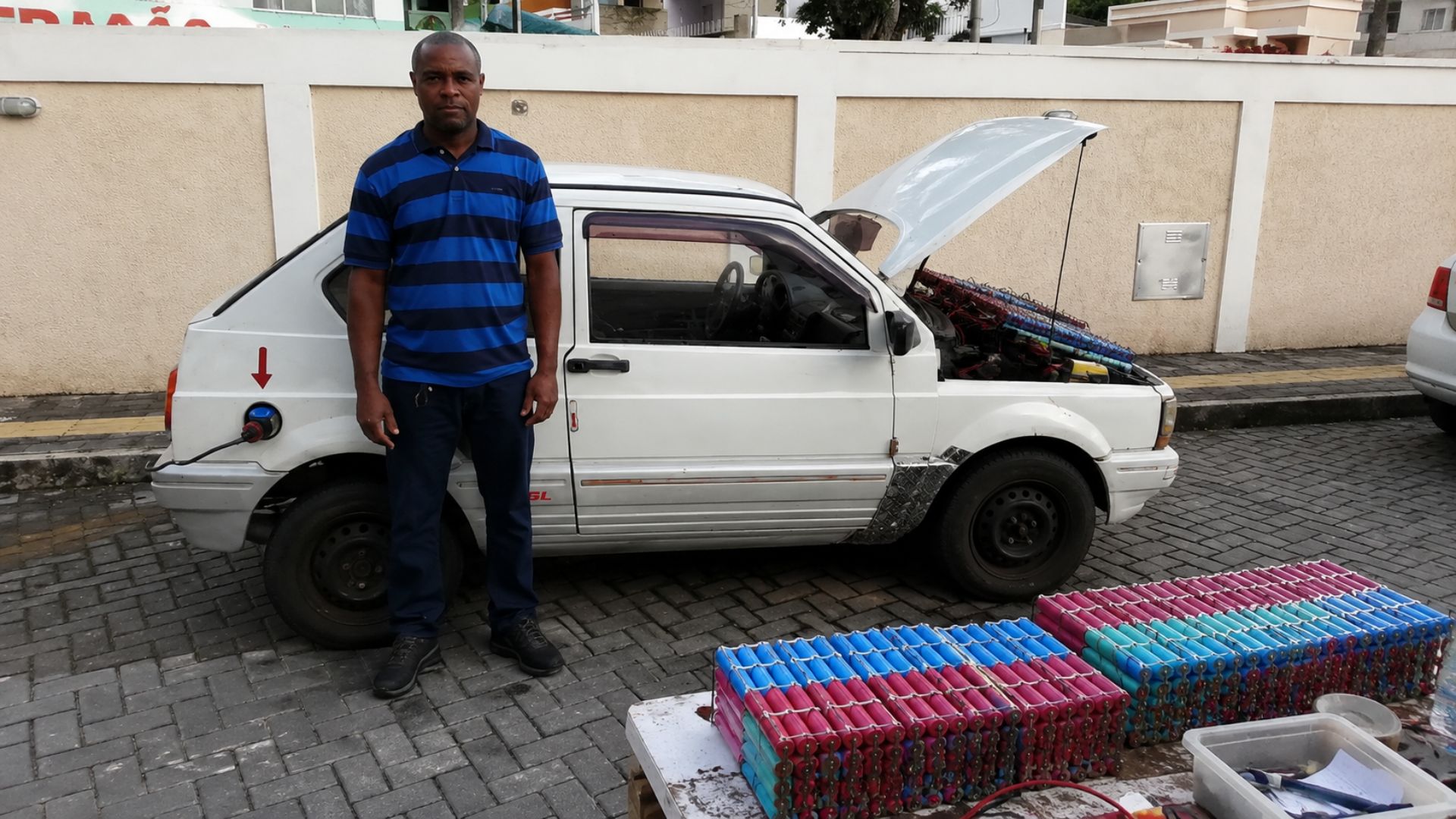

Project in Salvador draws attention by reusing laptop batteries, forklift motor, and discarded parts to transform an old Gurgel Supermini into electric, maintaining manual transmission, urban use, and curious performance in a Brazilian compact outside the conventional standard.
An old Gurgel Supermini got a second life on the streets of Salvador by being converted into an electric car with reused laptop batteries, forklift motor, and components that would be discarded, in an adaptation outside the conventional standard.
Leading the project, public servant Alfredo Correia adapted two examples of the Brazilian compact and put one of them to run in urban use, preserving the car’s simple proposal while replacing the original set with a handcrafted electric solution.
The contrast between the chosen vehicle and the applied technology is the point that makes the transformation especially curious, as the Supermini was born as a small, light, and urban car, associated with the final phase of Gurgel’s trajectory in Brazil.
-
Samsung Unveils Smart Oven with Built-In Camera, AI Food Recognition, and Real-Time Monitoring via Smartphone.

-
Ocean Transformed into Sci-Fi Lab: 87-Meter Structure with Submarines, Deep-Sea Robots, Helicopter, Genetic Labs, and 8K Cameras Unveils Rare Creatures
-
Brazil Launches Mobile ID as Mercosur Approves Mutual Recognition of Digital Identities for Public Services Across Member Countries
-
Denmark sinks 20 massive concrete blocks to build a 3.5 km tunnel under the strait, connecting the country to Sweden by road and rail.



In the conversion made in Salvador, the compact body and low weight helped make feasible an unusual adaptation, built with reused parts and far from the industrial standard found in modern electric cars.
Electric Gurgel Supermini used laptop batteries and forklift motor
According to UOL report, Correia used laptop batteries, forklift motor, and other components that would be discarded to convert two 1994 Gurgel Supermini, one silver and the other white.
Part of the electrical material came from partnerships and the reuse of electronic waste, including batteries that would no longer be used in laptops but could still be reorganized into a new set to power the vehicle.
Instead of starting from a high-value car or a luxury classic, the adaptation was based on a national compact for urban use, with reduced dimensions, simple mechanics, and the appearance of an old vehicle.
This profile made the conversion even more curious, as it brought together two universes that rarely appear together: a Brazilian car produced on a small scale and an electric solution assembled from discarded equipment.
Among the central pieces of the change, the forklift motor played a decisive role in the functioning of the electric assembly, replacing the logic of a new automotive engine with a repurposed industrial solution.
By utilizing equipment used in another application, Correia adapted the project’s logic to what was available, reinforcing the artisanal nature of the conversion and the need to combine components from different origins.
Repurposed laptop batteries became a package to move the car
Another highlight came from the repurposed laptop batteries, which were gathered into hundreds of cells to create a package capable of moving the car in urban use.
This solution requires electrical organization and careful control to function, but in the reported case, the proposal was precisely to utilize discarded material and demonstrate that part of electronic waste could find another application in a small vehicle.
On the streets of Salvador, a city known for its inclined roads and urban stretches that require power at low speed, the converted Gurgel managed to circulate while maintaining unusual characteristics for a handcrafted electric vehicle.
Besides the repurposed motor and laptop batteries, the compact preserved a manual transmission and rear-wheel drive, two elements that increase the strangeness for those who associate electric cars with automatic transmissions and factory-designed systems.
In the reported use, the converted Supermini achieved a range of up to 100 km and could reach close to 90 km/h when in motion, numbers reported in the UOL article.
These data gain relevance because it was not a model developed by a manufacturer, but an adaptation made with repurposed equipment, in an old car with an essentially urban proposal.
Within this context, the cited speed and range place the project in a limited everyday use, especially for short commutes, without turning the Supermini into a direct equivalent of modern electric vehicles.
Manual transmission and rear-wheel drive retained part of the original experience
The retention of the manual transmission helps explain part of the interest around the car, because the adapted Gurgel preserved a feature normally absent in factory-developed electric vehicles.
In modern electric vehicles, the motor delivers torque directly and dispenses with conventional shifts; however, in the converted Supermini, the driving experience mixes the silence of electric propulsion with an operation still linked to the world of old cars.
There is also a symbolic weight in the choice of model, as Gurgel was a national brand associated with its own solutions, small cars, fiberglass bodies, and projects aimed at local needs.
Seeing a model from the manufacturer transformed into an electric vehicle with discarded parts adds an extra layer of curiosity, because the conversion seems to extend, in a different way, the tradition of technical improvisation and experimentation associated with the brand.
Unlike commercial electric conversions, which usually involve imported kits, new batteries, and specialized workshops, Correia’s project gained attention precisely for its reuse and adaptation of existing parts.
This approach does not reduce the technical complexity, but changes the narrative of the transformation: the car does not attract attention for luxury or extreme performance, but for making an old compact run with an electric solution built outside the standard.
Electronic waste helped give new function to the Brazilian compact
The idea of using laptop batteries arose after the public servant learned about similar experiences on the internet, as reported in the article, and began to look for ways to apply the concept to his own cars.
From there, local suppliers linked to the recycling of technological materials and computer maintenance companies helped in accessing used cells, creating a reuse network around the conversion.
Even with modest performance compared to current electric vehicles, the adapted Supermini delivers a type of curiosity that speaks directly to the Brazilian reader interested in old cars, accessible technology, and unlikely solutions.
The combination brings together an uncommon national car, a conversion made in Salvador, notebook batteries, forklift motor, and real use on streets with hills, turning the story into something more than a simple engine swap.
On the outside, the Gurgel maintains the appearance of an old compact, with small proportions and design from another era; on the inside, the operation depends on reused cells, an electric motor, and solutions made to fit incompatible parts originally.
This difference between appearance and operation is precisely the point that most arouses curiosity, as the car continues with an old visual identity, but starts to move with electric energy coming from discarded components.
The conversion also shows how old cars can gain new uses when there is technical knowledge, access to parts, and willingness to experiment, without turning the vehicle into a modern factory electric.
In the case of the Supermini, the adaptation showed that a Brazilian urban vehicle could continue running with another type of propulsion, using materials that would normally be discarded and maintaining part of the original mechanical experience.
The fascination of the story lies in the fact that the car does not appear futuristic, as it remains a Gurgel Supermini with a national identity, but has started to circulate with electric energy from reused batteries.
The image of a Brazilian compact climbing hills in Salvador without relying on the original engine helps explain why this type of project captures the attention of those who like cars, technology, and unlikely solutions.
An electric car made with laptop batteries and a forklift motor: a garage experiment or a real alternative to give new life to old models?


