






 Portuguese
  Spanish


87-meter ship gathers manned submarines, deep-water robots, helicopter, genetic laboratories, and real-time mapping systems, creating a structure capable of bringing scientific research, rare images, and advanced exploration to ocean regions that few expeditions can reach.
The OceanXplorer gathers, in a single 87-meter structure, a research vessel, a scientific laboratory, a submarine launch base, and an audiovisual production center created to explore deep and little-observed regions of the ocean.
According to OceanX, the organization responsible for the vessel, the ship carries two manned Triton submersibles, remotely operated vehicles capable of reaching 6,000 meters depth, Airbus helicopter, dry and wet laboratories, acoustic mapping systems, and a mission center that integrates real-time data.
The vessel’s proposal is to bring scientists, filmmakers, pilots, engineers, and advanced equipment to locations where traditional research usually depends on specialized ships, long expeditions, complex logistics, and restricted access to large structures.
-
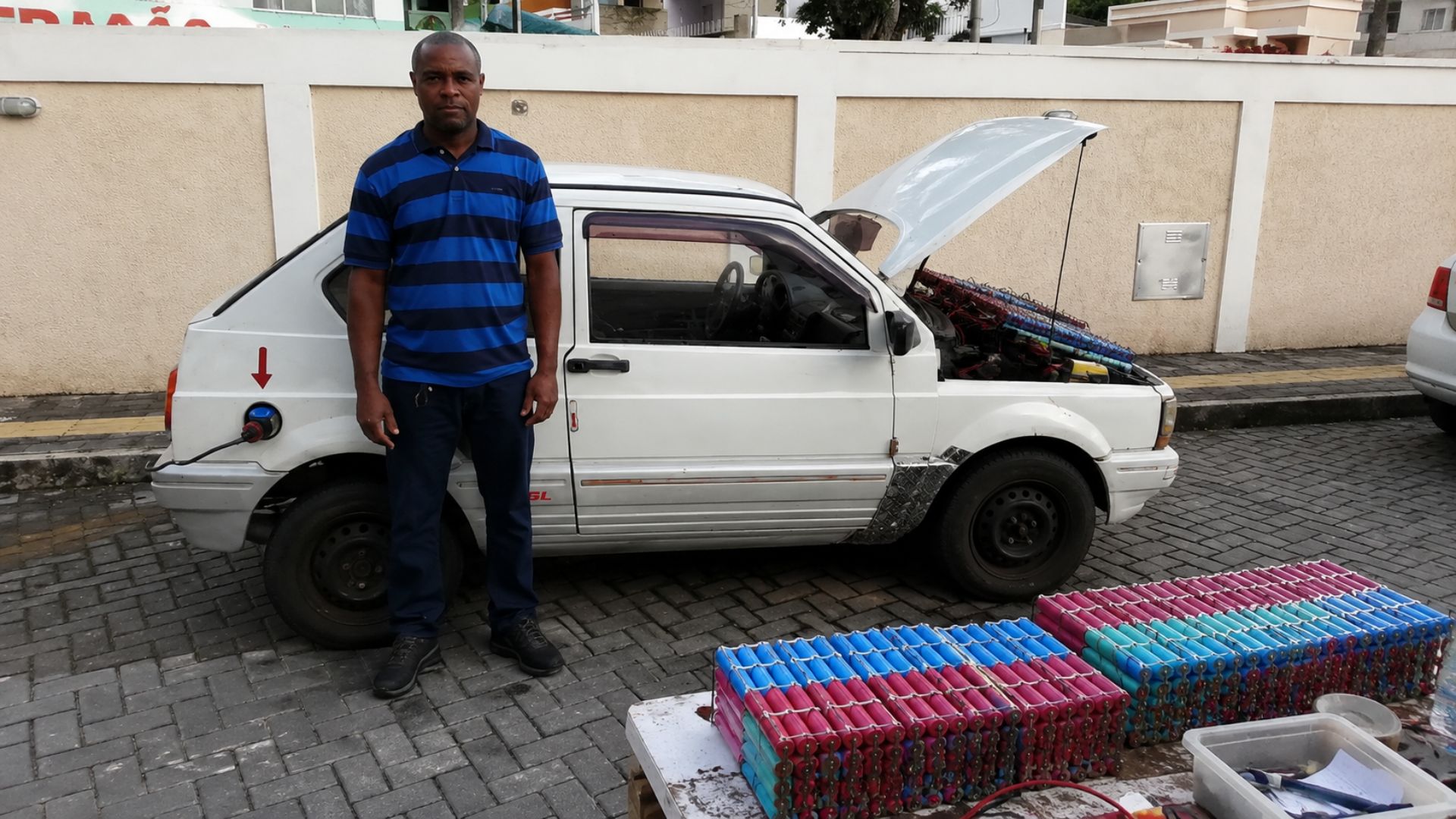
Brazilian Innovator Converts Old Car into Electric Vehicle Using Laptop Batteries and Forklift Motor, Achieves Nearly 90 km/h in Urban Settings

-
Samsung Unveils Smart Oven with Built-In Camera, AI Food Recognition, and Real-Time Monitoring via Smartphone.
-
11-Year-Old Develops Solar Water Purifier to Aid Communities in Kenya and Gambia

-
Xiaomi 18 Pro and 18 Pro Max May Debut with Snapdragon 8 Elite Gen 6 Pro, Featuring Dual 200 MP Cameras and 8,500 mAh Battery, Ahead of Competitors



Instead of functioning only as transport, the OceanXplorer operates as a complete platform to observe marine animals, collect samples, map the seabed, process biological material onboard, and transform discoveries into high-quality images for scientific dissemination.
OceanXplorer laboratory ship concentrates science, exploration, and audiovisual production
Due to its size and the variety of onboard systems, the OceanXplorer draws attention by concentrating functions that would normally be spread among different research bases, support ships, land laboratories, and teams specialized in submarine operations.
With 87 meters in length and total capacity for 72 people onboard, the vessel gathers on its decks scientific areas, filming systems, deep exploration equipment, and technical spaces prepared for prolonged missions at sea.
In OceanX’s description, the ship functions as a floating laboratory, filming studio, and launch platform for deep-water exploration, a rare combination in a sector where science, engineering, and visual communication need to operate under extreme conditions.
Among the most striking equipment are the two manned submersibles, called Nadir and Neptune, which allow researchers and filmmakers to go below the surface on missions for direct observation of the marine environment.
According to OceanX, the Triton vehicles can reach 1,000 meters deep, allowing the tracking of animals in their natural habitat, observing ocean floor formations, and collecting biological or geological samples with precision.
This capability reduces the distance between the researcher and the studied environment, as observation no longer relies solely on images sent by remote sensors or records made by remotely operated equipment.
Abyssal robots take exploration to 6,000 meters deep
To reach even deeper regions, the ship uses remotely operated vehicles that extend the investigation to areas where direct human presence is not possible due to extreme pressure, low light, and difficult access.
OceanX reports that the Argus ROV system can operate at depths of up to 6,000 meters, returning with samples, videos, and data from underwater zones that require highly specialized equipment.
This type of robot extends the reach of expeditions and allows the investigation of deep ocean points that remain poorly documented, even in large-scale scientific missions, due to the physical and technical limitations imposed by the environment.
Within the vessel itself, the collected material goes through a scientific chain set up to operate at sea, preventing part of the analyses from relying solely on the subsequent transport of samples to institutions on land.
The wet lab receives organisms, sediments, and materials freshly removed from the marine environment, with cold tanks and aquarium tables that can be filled with water from the natural habitat to aid in the observation of deep species.
The dry labs gather tools to study ocean life and ecosystems, including genetic sequencing and advanced microscopy prepared to operate at sea, which strengthens the scientific capability of the expedition during the mission.
Genetic laboratories allow sample analysis still at sea
The presence of genetic analysis within the vessel makes the OceanXplorer different from a conventional support ship, as it allows an important part of the scientific investigation to take place in the same environment where the collection was carried out.
According to OceanX, the dry labs enable environmental DNA sequencing and genetic analyses without the samples needing to be immediately taken to universities, research centers, or laboratory structures on land.
This configuration accelerates scientific work during the expedition and allows researchers to adjust field decisions based on data obtained at the study site itself, while the mission is still ongoing.
In the vessel’s operational center, the OpenVDM system integrates information from instruments such as acoustic arrays, submersibles, ROVs, and CTD sensors, used to measure water properties at different depths.
OceanX claims that this setup allows monitoring, analyzing, and visualizing complex information in real-time, offering teams the possibility to adapt research as new images, readings, or samples appear during the mission.
Real-time mapping helps reveal the ocean floor
Among the core resources of the OceanXplorer are the mapping and acoustic systems, used to transform submerged areas that are difficult to observe into visual models capable of guiding scientific navigation and equipment deployment.
OceanX reports that the ship has advanced sonars and multibeam systems capable of producing three-dimensional maps of the seabed, water column, currents, and the presence of marine life.
This information helps scientists understand the submerged geography before sending submersibles, robots, or divers to specific areas, reducing operational risks and increasing the accuracy of missions carried out at depth.
The onboard Airbus helicopter extends the operation beyond the ship’s surface, offering a useful aerial view for reconnaissance, image capture, and tracking marine life over extensive areas.
According to OceanX, the aircraft is used for aerial reconnaissance, media production, and animal tracking, especially large marine mammals that can travel long distances during a scientific expedition.
From the helicopter, scientists can locate animals, communicate their position to the vessel, and guide the ship’s movement or the deployment of teams for closer observations, integrating air, surface, and depth.
Autonomous vehicle expands operation in shallow and dangerous areas
In addition to the main systems, the structure includes an unmanned surface vehicle, the Otter USV, used in shallow, narrow, or dangerous areas where the main ship cannot safely enter.
Equipped with sonar, LiDAR, and 360-degree cameras, this vehicle can map reefs, glaciers, and coastal zones with high precision, extending the reach of expeditions to environments that require greater operational flexibility.
This resource allows the OceanXplorer to connect data from the coastline, surface, and ocean floor in a single mission, instead of limiting research only to the deep waters reached by submersibles and abyssal robots.
Beyond science, the vessel was designed to produce cinematic-scale images, using live broadcast tools, post-production suites, and customized cameras to capture discoveries in high quality.
OceanX highlights this structure as part of the effort to bring to the public images of rarely seen ocean regions, bridging scientific research, global communication, and marine conservation through high-impact visual records.
Ocean exploration combines submarines, robots, and rare images
The interest in such platforms is growing because much of the deep marine environment still relies on specialized equipment to be observed in detail, especially in regions where pressure, darkness, and distance hinder conventional expeditions.
Instead of presenting the ocean merely as a distant and abstract space, the OceanXplorer transforms the investigation into a visual and scientific operation, where robots, submersibles, laboratories, and data systems work together.
The vessel has already appeared in OceanX expeditions in regions such as the Red Sea, Azores, United Arab Emirates, Indonesia, Malaysia, Seychelles, Cape Verde, and the African coast, always combining research and content production.
Each mission gathers biodiversity research, mapping, sample collection, and audiovisual records, with the aim of expanding knowledge about marine ecosystems and supporting actions related to conservation and sustainable use of the oceans.
More than a traditional ship, the OceanXplorer resembles a mobile scientific base, equipped to bring to the high seas an operational capacity that previously depended on multiple platforms, separate laboratories, and distributed teams.
With manned submarines, abyssal robots, helicopter, genetic laboratories, and real-time mapping systems, the vessel concentrates science, technology, and imagery in a structure prepared to explore hard-to-access environments.
If a single vessel can already take scientists to 1,000 meters, robots to 6,000 meters, and complete laboratories to the middle of the ocean, what kind of discovery might still be hidden in the deep areas that almost no one has managed to observe up close?


