Portuguese
 Spanish


Daikin’s 9,000-BTU EcoSwing Gold tops Canaltech’s March 2026 energy-use ranking at 263 kWh a year. Run 8 hours a day at a rate of R$0.95 per kWh, it costs about R$28.80 a month
The Daikin EcoSwing Gold is the lowest-energy-use 9,000-BTU inverter air conditioner in the ranking published Friday, March 13, 2026. It uses 263 kWh a year, costing about R$28.80 a month.
The ranking was compiled by Canaltech, by Renato Moura Jr., and updated Tuesday, March 17. WebPrice selected the models, and the calculation uses the annual energy consumption shown on Brazil’s Inmetro label.
The Samsung WindFree Pro Energy also appears in the ranking at 263 kWh a year. In the official Inmetro table dated December 31, 2025, however, the model is listed at 273 kWh a year.
-
KTM launches 2027 Macina Gran 830 e-bike with 120 Nm Bosch Performance Line CX motor, 800 Wh PowerTube battery, 10-speed Shimano Cues drivetrain, weighing 26.9 kg and priced around €3,330

-
Home solar costs R$2.91 per watt for a 4 kWp residential system in 2026, R$7,200 for a 2 kWp system after kit price rise
-
Samsung Odyssey G6 Offers 1,100-Hz HD Gaming in U.S. Stores This December
-
Scientists develop smart floss that measures glucose and uric acid in minutes, sends results to a phone, and could transform oral hygiene into a health-monitoring tool


For Brazilian consumers, the difference shows up on the electricity bill. At R$0.95 per kWh, the top-ranked models cost R$0.12 per hour to run. The lowest-ranked models, from Gree and Electrolux, cost R$0.18.
Monthly energy costs for the most efficient 9,000-BTU air conditioner
Canaltech starts with the annual consumption listed on the label and assumes 2,080 hours of use per year. It divides annual kWh by 2,080 to calculate hourly consumption.
The Daikin EcoSwing Gold uses 0.126 kWh per hour. At R$0.95 per kWh, it costs R$0.12 for each hour of use.
Run 8 hours a day, the Daikin EcoSwing Gold uses R$0.96 worth of electricity per day and R$28.80 per month. The Samsung WindFree Pro Energy has the same result in Canaltech’s ranking.
The metric behind the figure is IDRS, the Seasonal Cooling Performance Index. Canaltech says inverter air conditioners operate at partial load 98% of the time.
Full table: energy use by 9,000-BTU air conditioner brand
The list shows each manufacturer’s most efficient model, according to Canaltech. The hourly cost is based on a rate of R$0.95 per kWh.
| Brand | Model | Consumption (kWh per year) | Cost per hour |
|---|---|---|---|
| Daikin | EcoSwing Gold (FTHP09S) | 263 | R$0.12 |
| Samsung | WindFree Pro Energy | 263 | R$0.12 |
| Fujitsu | Airstage Premium | 266 | R$0.12 |
| Elgin | Eco Inverter II | 287 | R$0.13 |
| Britânia | BAC9000IFM15 | 292 | R$0.13 |
| Prime Air | 9000ITF2 Eco Inverter | 292 | R$0.13 |
| Midea | Airvolution Connect | 308 | R$0.14 |
| Consul | Triple Inverter EconoMaxi | 311 | R$0.14 |
| Hitachi | AirHome 600 | 338 | R$0.15 |
| TCL | Elite Series A2 (TAC-09CSA2) | 355 | R$0.16 |
| Vix | Inverter 9k (AS-09TW) | 360 | R$0.16 |
| LG | Dual Inverter Voice | 363 | R$0.17 |
| Aiwa | AWSAC9F | 363 | R$0.17 |
| Vedacit | Inverter 9k | 363 | R$0.17 |
| Philco | Eco Inverter (PAC9FC) | 376 | R$0.17 |
| EOS | Master Inverter R32 | 380 | R$0.17 |
| HQ | CFHQ09PIS2BX | 380 | R$0.17 |
| Komeco | Kohi Inverter | 380 | R$0.17 |
| Hisense | AS-09TW2RLR | 387 | R$0.18 |
| Agratto | Neo Top (ICST9FR4) | 396 | R$0.18 |
| Gree | G-Top Connection | 396 | R$0.18 |
| Electrolux | Color Adapt (JI09R) | 397 | R$0.18 |
Canaltech calculated the monthly cost only for the two top-ranked models. For the others, the article provides annual energy consumption, hourly consumption and hourly cost.
What is included in the R$28.80-a-month figure, and what is not
The figure covers only the electricity used by the unit during 8 hours of daily operation. The calculation uses a single rate of R$0.95 per kWh, selected by Canaltech to compare the models.
The purchase price of the air conditioner and installation costs are not included. The article provides links to retailers for the two top-ranked models but does not compare their retail prices.
Anyone who pays a different rate should replace R$0.95 with the amount on their own electricity bill. The formula for hourly consumption remains the same.
What the Inmetro label says about Daikin and Samsung
The air conditioner table in Inmetro’s Brazilian Labeling Program was updated on December 31, 2025. It lists two 9,000-BTU Daikin models at 262.6 kWh per year.
They are the FTHP09S5VL, with heating and cooling, and the FTKP09S5VL, with cooling only. Both have an IDRS of 8.30, an A rating and active registration with Inmetro.
Both versions use R-32 refrigerant and operate at 220 V. Standby power consumption is 1 W, also according to the official table.
The 9,000-BTU Samsung WindFree Pro Energy, model AR09CVFAAWKNAZ, with cooling only, appears in the same table at 273 kWh per year. Its IDRS is 9.00, also in the A rating range.
Cooling capacity measured at 35 °C under full load is 2,637 W for the Daikin and 3,010 W for the Samsung, according to the same table.
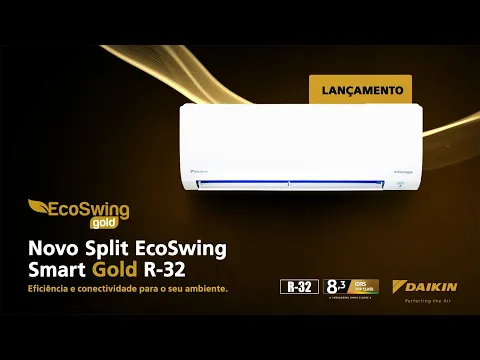
Daikin Brasil introduced the EcoSwing Smart Gold R-32 line in a video dated November 10, 2023. The description cites an IDRS of 8.3, compared with the 5.5 then required by Inmetro for an A rating.

Samsung WindFree Pro Energy: specs of the model tied in the rankings
Samsung launched the WindFree Pro Energy in Brazil on June 13, 2023, in a Samsung Newsroom Brasil announcement. The company called it the No. 1 model for efficiency under Inmetro’s new rules.
The unit uses Digital Inverter Ultra technology with a dual compressor in WindFree mode. That mode distributes air through 23,000 micro-holes, without direct airflow.
In WindFree mode, Samsung says the unit can save up to 77% on energy compared with rapid-cooling mode. The compressor has a 10-year warranty.
The product page on Samsung’s website lists a capacity of 9,000 BTU/h, with a range of 2,800 to 12,000 BTU/h. Power consumption in cooling mode is 600 W at 220 V.
The indoor unit weighs 9.7 kg, and the outdoor unit weighs 28.1 kg. Noise levels range from 38 to 19 decibels for the indoor unit and reach 47 decibels for the outdoor unit. The refrigerant is R410.
The model has built-in Wi-Fi. The Energy feature in the SmartThings app lets users monitor the unit’s energy consumption, according to Samsung’s launch announcement.
The Mundo Conectado channel posted a nine-minute video about the model on October 8, 2023, labeled as advertising. Its description calls it Brazil’s most energy-efficient inverter air conditioner.

How air conditioner energy use affects electricity bills in Brazil
In Canaltech’s table, costs range from R$0.12 per hour for the top-ranked models to R$0.18 per hour for models from Gree and Electrolux.
Several brands commonly found in Brazilian stores rank in the middle of the list. The Midea Airvolution Connect uses 308 kWh per year, while the LG Dual Inverter Voice uses 363 kWh per year.
Canaltech notes that some appliances marketed as inverter models, including those from Gree and Electrolux, have higher annual energy consumption than the top-ranked units.
Electric utilities also offer advice to consumers. Light, a utility serving Rio de Janeiro, posted on X on July 31, 2025, that appliances with the Procel A efficiency label use less energy while delivering the same performance.
Neoenergia Cosern, a utility in the state of Rio Grande do Norte, offered another tip on April 22, 2024. The utility recommends setting the thermostat to 23 °C and using the timer to prevent unnecessary operation.
How to compare the energy use of two air conditioners in a store
Canaltech compared only the annual energy consumption in kWh listed on the Inmetro label. That figure determined the ranking of the 9,000-BTU models.
In the Inmetro table, the Samsung model has an IDRS of 9.00 and uses 273 kWh per year. The Daikin EcoSwing Gold has an IDRS of 8.30 and uses 262.6 kWh per year.
The official table also sorts models by type, function, voltage, and refrigerant. The same model may appear on multiple rows, with different function or voltage versions.
Where to check an air conditioner’s energy use before buying
The air conditioner table is available on the Brazilian Labeling Program page on Inmetro’s website. The file can be downloaded as a PDF.
The document itself warns that it does not replace the list of products registered with Inmetro, Brazil’s national standards and accreditation agency, published on its registry search website. Suppliers are responsible for the accuracy of the information.
Another note in the table concerns dual-voltage units. These products may be listed with their worst performance figures or with the figures for each voltage.
For the Daikin EcoSwing Gold, Inmetro’s table lists 262.6 kWh per year. Canaltech rounds that figure to 263 kWh and also puts the model at the top of the list.