






 Portuguese
  Spanish
  4 min of reading
  0 comments


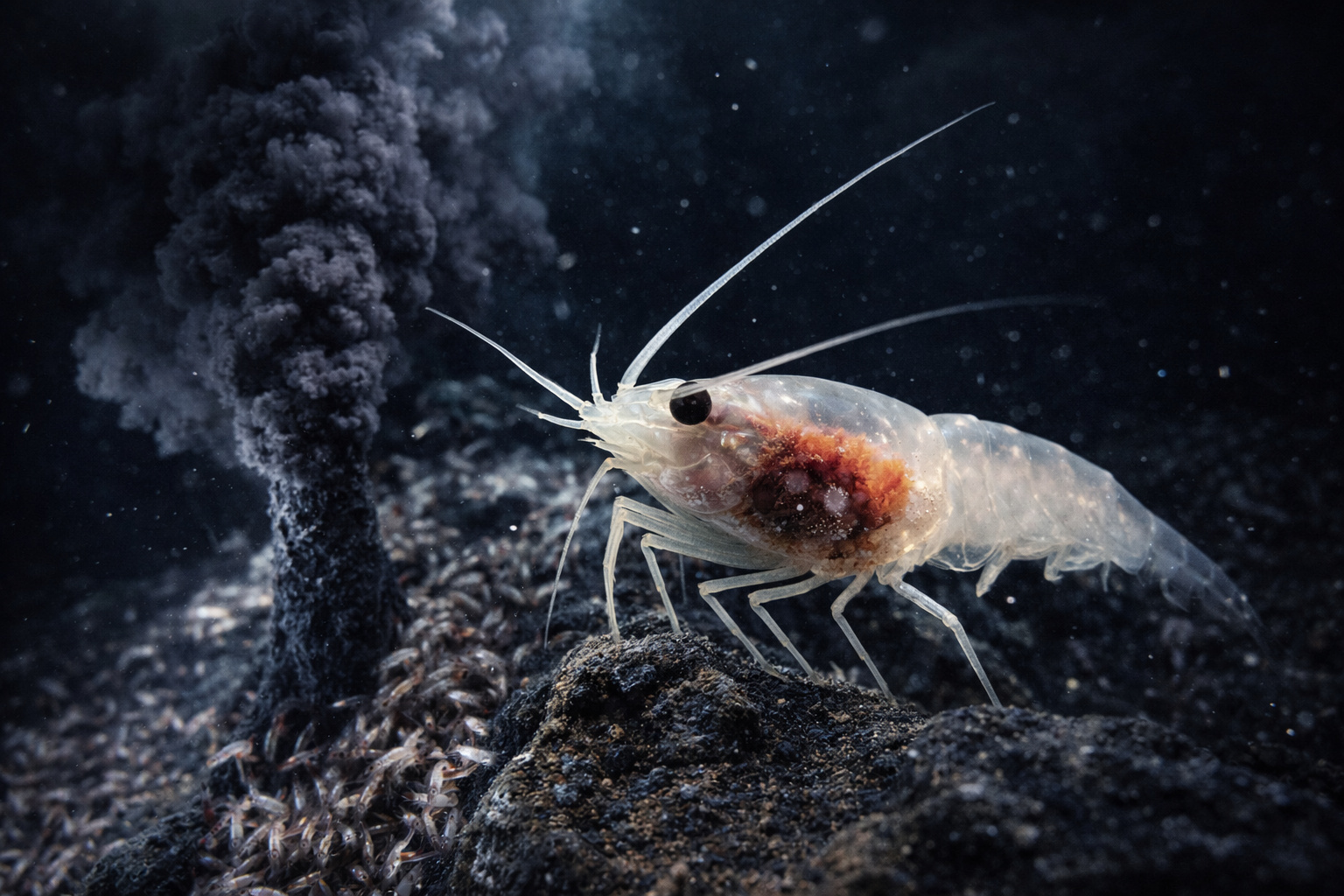
Deep-Sea Shrimps At 4,000 M Use Symbiotic Bacteria And Hydrothermal Sources To Survive Without Light And Almost Without Digestive System.
Few people imagine that, at the bottom of the ocean, well below the reach of sunlight, there are “living cities” fueled not by plants, but by chemical reactions that release energy. In these regions, known as hydrothermal vents, life relies on chemosynthesis, a process based on the oxidation of compounds such as hydrogen sulfide and methane. It was in this extreme scenario that biologists recorded one of the most impressive behaviors ever observed in crustaceans: shrimps that, instead of digesting their own food, harbor internal colonies of bacteria to do the work for them.
This discovery is not only intriguing. It changes the way we understand the limits of life, especially in environments where photosynthesis is not possible. Species such as Rimicaris exoculata, recorded in Atlantic mid-ocean ridges, have become a scientific model of this adaptation.
Rimicaris Exoculata Shrimps And Life At Hydrothermal Vents
Hydrothermal vents were first identified in the 1970s, when manned submersibles encountered “chimneys” releasing superheated fluids at the ocean floor. The most studied regions are located on the Mesoatlantic Ridge and Eastern Pacific Ridge, at depths ranging from 2,000 to 4,000 meters.
-
Two Brazilian students created a hospital bed with voice control to help their sick grandmother and won an award in Portugal: the prototype allows patients to adjust height and inclination just by speaking, without cranks, and promises more autonomy for the elderly and people with reduced mobility.

-
Public school students from Sertão de Pernambuco create a $5 filter using sugar-apple peel, transform toxic cassava waste into drinking water, and win 1st place nationally in Samsung’s innovation contest.

-
8-year-old boy found small balls in the yard, thought they were seeds, and helped U.S. universities reveal a hidden natural strategy in oak galls, showing how small domestic observations can change scientific research on discrete natural processes.
-
The owner of Facebook, Mark Zuckerberg, opened his wallet and paid the equivalent of R$ 72.9 billion, or US$ 14.3 billion, to hire a 28-year-old and put him in charge of Meta’s new superintelligence.


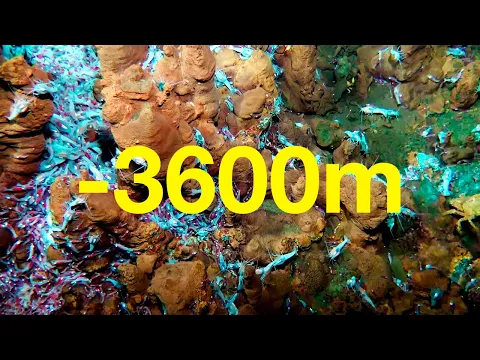

It is in this environment that shrimps of the genus Rimicaris thrive. They cluster in dense aggregations around the chimneys, often forming living carpets with thousands of individuals per square meter. The surrounding water can reach 400°C inside the chimneys, although it quickly mixes with the cold ocean water, which is between 2 and 4°C, creating an extreme thermal gradient.
It is a hostile zone with pressures exceeding 400 atmospheres, total absence of light, toxic concentrations of sulfides, and limited oxygen. Nevertheless, this environment supports a highly active food chain — not by light, but by chemistry.
Symbiotic Bacteria Replace The Traditional Digestive System
The most impressive aspect of Rimicaris exoculata is their feeding method. Unlike most shrimps, these animals lack a complete functional digestive system. Their stomach is reduced, and their nutrition primarily depends on symbiotic bacteria housed in a special cavity located in the cephalic region, near what would be the “rostrum.”
These bacteria oxidize hydrogen sulfide (H₂S) and methane (CH₄) present in hydrothermal fluids, transforming inorganic compounds into organic matter — a process analogous to photosynthesis, but without light. This type of metabolism defines chemosynthesis.

Scientists have already identified two complementary strategies in these shrimps:
- Internal Cultivation of Bacteria, which grow in specialized tissues.
- Scraping of External Bacterial Biofilms, which form on rocks and chimneys.
The result is a living being that functions like a “mobile bacterial farm.” The animal provides sulfides, oxygen, and mineral compounds, while the bacteria produce food.
How These Crustaceans Survive Without Light And With High Toxicity
The biological challenge is enormous. Without light, vision becomes useless — and indeed, Rimicaris have reduced eyes or modified photoreceptor structures. Instead of seeing shapes, they detect variations in infrared light generated by the thermal contrast of the chimneys, helping them locate areas with higher chemical activity.
Moreover, they possess specialized gills and hemocyanin, a protein that carries oxygen (analogous to hemoglobin, but based on copper). These structures are crucial for removing toxic sulfides from the body, providing oxygen to the symbiotic bacteria, and resisting thermal stress.
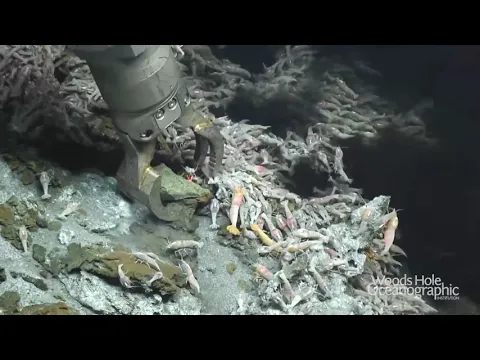
The symbiosis is so well adjusted that some researchers describe the whole as a “meta-organism”: part crustacean, part chemosynthetic micro-colony.
Ecosystems That Emerge From Carcasses, Smoke, And Chemistry
Hydrothermal vents do not only harbor shrimps. Around them, communities emerge with polychaetes, anemones, crabs, bioluminescent fireflies (in some regions), symbiotic bivalve mollusks, such as Bathymodiolus.
This grouping forms what the literature calls “hydrothermal fauna,” an ecosystem that sustains itself without photosynthesis, something that was believed impossible on Earth until the 1970s.
The collapse of a vent can mean local extinction, but the larvae of these animals are carried by deep currents, recolonizing new vents as geothermal fissures emerge on the ocean floor.
What The Discovery Means For Current Science
The study of these shrimps is relevant for three reasons:
1. Origin of Life on Earth: There are robust hypotheses that primordial life may have emerged in similar environments, based on chemical and mineral gradients.
2. Astrobiology: Worlds such as Europa (moon of Jupiter) and Enceladus (moon of Saturn) have subsurface oceans and possible hydrothermal vents, making bacterial symbiosis a model for extraterrestrial life.
3. Biotechnology: Symbiotic bacteria have enzymes capable of functioning under extreme pressures and temperatures, which is of interest to industrial and pharmaceutical sectors.
In 2021, a study published in Nature Communications reinforced the role of Rimicaris as ecological engineers, shaping bacterial distribution and local chemistry.
The Future Of Abyssal Exploration
Access to this world is still limited. We depend on manned submersibles like Alvin, ROVs (remotely operated vehicles), and high-precision chemical sensors.
Even with all this technology, it is estimated that less than 5% of the ocean floor has been directly observed. This means that much of what exists there remains completely unknown.


-

-

-

-

-

14 people reacted to this.