Portuguese
  Spanish


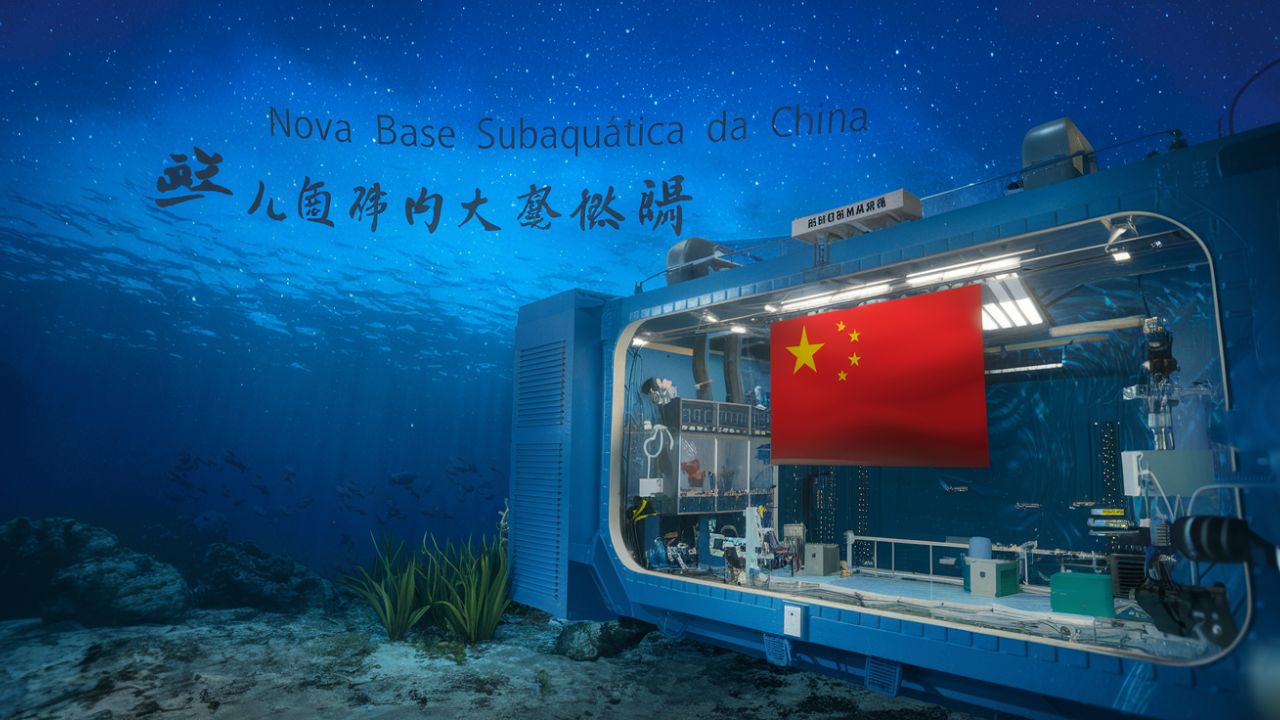


Installation Will Be Anchored on the Ocean Floor, Allowing Scientists to Live Submerged for Up to a Month and Investigating 70 Billion Tons of Methane, Alongside Valuable Minerals Such as Cobalt and Nickel – All This in One of the Most Disputed Regions of the Planet!
China has announced an ambitious project that could redefine ocean exploration: an underwater mega-laboratory that will be installed 2,000 meters deep in the disputed South China Sea.
In addition to being an impressive technological feat, the station has a clear objective: to study the “cold seep” ecosystems, marine areas rich in biodiversity that may conceal vast reserves of methane. But could this initiative generate new geopolitical tensions?
What Is the Mega-Laboratory and Where Will It Be Built?

The installation will be a true submerged headquarters, anchored on the ocean floor and continuously monitoring the depths. Its main focus will be analyzing the chemical and biological processes in cold seep areas, environments rich in life and potentially filled with valuable energy resources.
-
California Startup Develops Giant “Space Sling” to Launch Vehicles at Mach 6, Reducing Fuel Use and Enabling Thousands of Satellite Deployments

-
ChatGPT Alerts FBI to Prevent Planned Murder of 8-Year-Old in Brazil’s Espírito Santo
-
Scientists Discover 125-Million-Year-Old “Pregnant Fossil” with Preserved Embryos and Microscopic Larvae Inside Mollusk in England

-
17-Year-Old Justin Bernstein Develops Bacteria to Produce Glass on Arctic Ice to Reflect Sunlight, Wins $50,000 U.S. Scholarship



The project has been in the planning phase for years, and its construction could intensify territorial disputes in the region. After all, the South China Sea is a sensitive area, with several nations claiming parts of the maritime territory.
Submerged Headquarters: What Will the Laboratory Structure Be Like?
The underwater laboratory will be equipped with state-of-the-art life support systems, allowing teams of up to six scientists to live and conduct research on-site for up to a month.
With highly precise sensors, the mega-laboratory will take constant readings of methane levels and other substances present in the ocean. The presence of this gas is crucial, as it could represent a new frontier for energy production, significantly increasing China’s reserves.
Four-Dimensional Network and Connection to Chinese Infrastructure
In addition to the submerged laboratory, the project includes an integrated ocean exploration network. Unmanned submarines, research ships, and seabed observatories will be part of a system called the four-dimensional network, designed to provide China with unprecedented information about its territorial waters.
Another important detail is that the mega-laboratory will be connected to China’s underwater fiber optic network, allowing real-time communication with researchers on the surface. Although scientists have not yet revealed what the energy source for the station will be, nuclear energy is a possibility.
Mega-Laboratory and the Dispute in the South China Sea
The construction of the laboratory could generate intense international reactions, as the South China Sea is one of the most disputed areas on the planet.
Several countries, including Vietnam, the Philippines, and Malaysia, also claim parts of the region. The presence of a Chinese scientific station on the ocean floor could be interpreted as a claim of territorial control, generating new diplomatic tensions.
The project also recalls an initiative from the United States: the ocean research center Proteus, being developed by the Proteus Ocean Group. Both countries seem to be in a race to dominate ocean exploration.
Strategic and Economic Resources of the Ocean Floor
The South China Sea is not only strategically important — it may conceal an underwater fortune. It is estimated that there are 70 billion tons of methane trapped beneath the ocean sands.
This gas, which exists in the form of solid hydrate, could boost China’s oil and gas reserves by 50%. The region contains large deposits of cobalt, nickel, and other rare minerals that are essential to the high-tech industry.