Portuguese
  Spanish


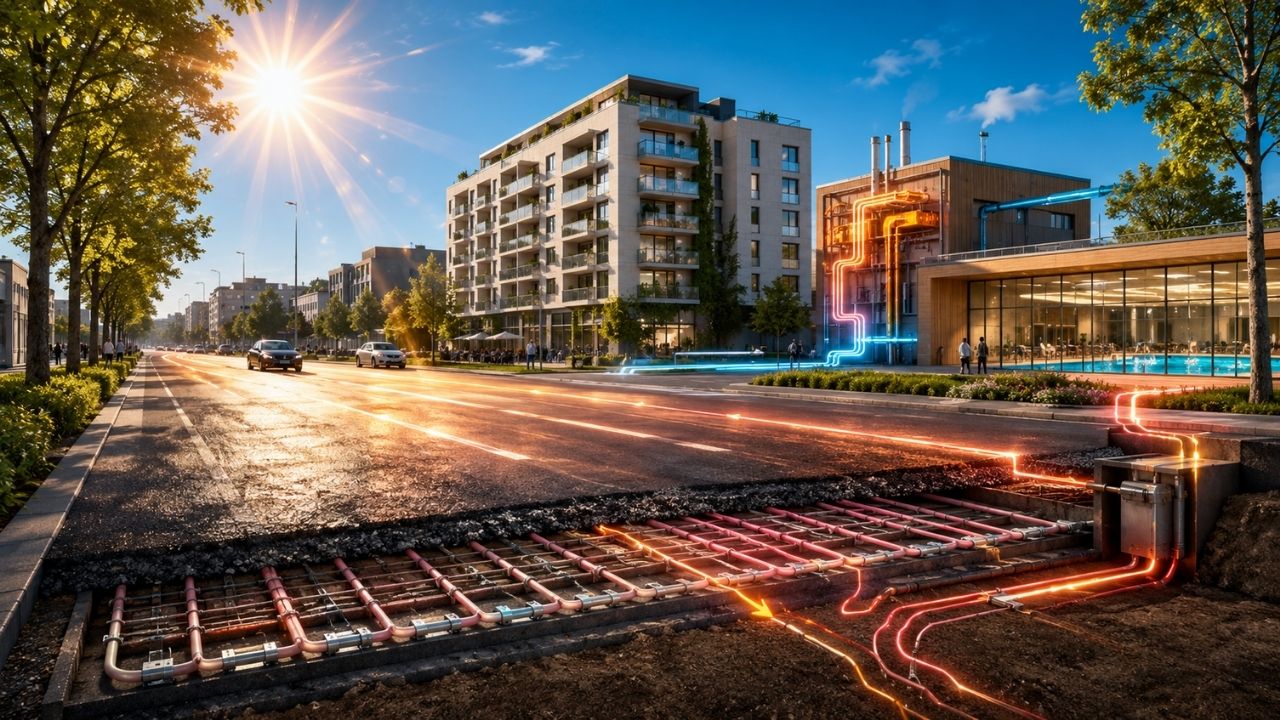

With pipes installed under the pavement, the road equipped with Power Road® captures solar heat, can store energy for months, and supply heating systems in nearby buildings. Eurovia’s solution already appears in French projects related to swimming pools, homes, service areas, and anti-ice infrastructure in winter.
The road is no longer seen just as a circulation surface in some Eurovia projects in France. With Power Road®, the company uses pipes integrated into the asphalt to capture solar heat, transfer thermal energy to nearby buildings, and support uses such as heating swimming pools, apartments, industrial processes, and service areas.
According to Power Road®, from Eurovia/VINCI Construction, the technology works from solar radiation that heats the pavement during the day. In applications already mentioned by Eurovia between 2018 and 2023, the system appears in locations such as Saint-Arnoult, Fleury-sur-Orne, Feurs, Saint-Pol-de-Léon, Agneaux, and Olonzac, always with the proposal to take advantage of a thermal source that would normally be dissipated into the environment.
How the road manages to transform asphalt heat into useful energy

The logic of Power Road® is relatively simple: the road receives heat from the sun, this heat is absorbed by the pavement, and a network of pipes installed in the surface layers captures part of this energy. These pipes are between 5 and 8 centimeters deep and conduct a thermal transfer fluid.
-
AI Video Generator Automatically Creates Subtitles and Animated Captions

-
São Paulo Unveils Latin America’s Largest Underground Reservoir, Holding 900 Million Liters, in the Greater São Paulo Area

-
Chinese Teen Wins Gold in Germany for Invention Turning Air Moisture into Underground Irrigation in Drought-Stricken Areas

-
Desertification Threatens Brazil’s Caatinga: 85% of Semi-Arid Region Affected, 30 Million at Risk, and Efforts Underway to Restore 10 Million Hectares by 2045




According to the technical description of the solution, this fluid can reach up to 35 °C under solar radiation. After that, the captured energy can be used immediately or stored for later use. In practice, the asphalt starts to function as a kind of urban thermal collector, without ceasing to fulfill its original function as pavement.
Energy can be used in winter, in pools, and in industrial processes

Power Road® was presented by Eurovia as an alternative to heat buildings in winter and also support hot water production. The road equipped with the system can transfer heat to residential properties, commercial facilities, pools, sports units, and industrial processes, depending on the project and nearby infrastructure.
In cases of direct use, the company states that the solution can decarbonize up to 95% of domestic hot water production, pool heating, or industrial processes. It also claims that the system can provide up to 80% renewable energy in certain applications. These numbers depend on the technical context of each installation, such as available area, thermal demand, and integration with heat pumps.
The same technology also targets heat islands and winter safety

In addition to heating buildings, Power Road® is also presented as a resource to reduce accumulated heat in urban areas. Eurovia states that the technology can lower the surface temperature of roads by an average of 10 °C, helping to tackle heat islands in cities and paved areas.
Another application point is in road safety. The road with a thermal system can be used to combat ice and snow in critical sections, as the heat captured and transferred to the pavement can assist in maintaining the surface during cold periods. This function appears in projects like the 5th generation road in Égletons and the parking lot of Xavier Marmier secondary school in Pontarlier.
Projects in France show use in apartments, service areas, and public infrastructure

Among the examples cited by Eurovia are the Forez Aquatic Pool, in Feurs, in 2019, the Haut Léon Communauté Pool, in Saint-Pol-de-Léon, in 2023, and a set of 61 apartments in Fleury-sur-Orne, in Normandy, in 2019. These cases indicate that the road can be integrated into different types of thermal demand.
Applications also appear in the VINCI Autoroutes service area in Saint-Arnoult, near Paris, since 2018, at the Manche energy authority in Agneaux, in 2023, and at the Hérault technical services center in Olonzac, in southern France, also in 2023. The central point is to take advantage of already existing surfaces, such as roads and parking lots, to generate an additional energy function.
Solution does not turn any street into a power plant, but expands the role of urban pavement


Despite the potential, Power Road® does not mean that any road can automatically become a significant energy source. The technology depends on design, proper installation, nearby thermal demand, and integration with equipment like heat pumps. It also requires cost analysis, maintenance, and energy return in each case.
Even so, the concept draws attention because it changes the way asphalt is perceived. Instead of being just a surface that absorbs heat and contributes to higher temperatures in cities, it can be part of a low-carbon system. The road is treated as energy, climate, and urban infrastructure at the same time.
What remains in debate
Power Road® places the road within a larger discussion about the future of cities. If today asphalt is usually associated with accumulated heat and energy consumption, Eurovia’s proposal tries to reverse this logic by transforming part of this heat into a resource for buildings, pools, industries, and service areas.
The challenge is knowing to what extent this type of technology can move beyond specific projects and scale up in other regions, including in hot climate countries like Brazil. Do you believe that roads capable of capturing heat and supplying nearby structures would be a viable solution for Brazilian cities? Leave your opinion in the comments.