Portuguese
 Spanish


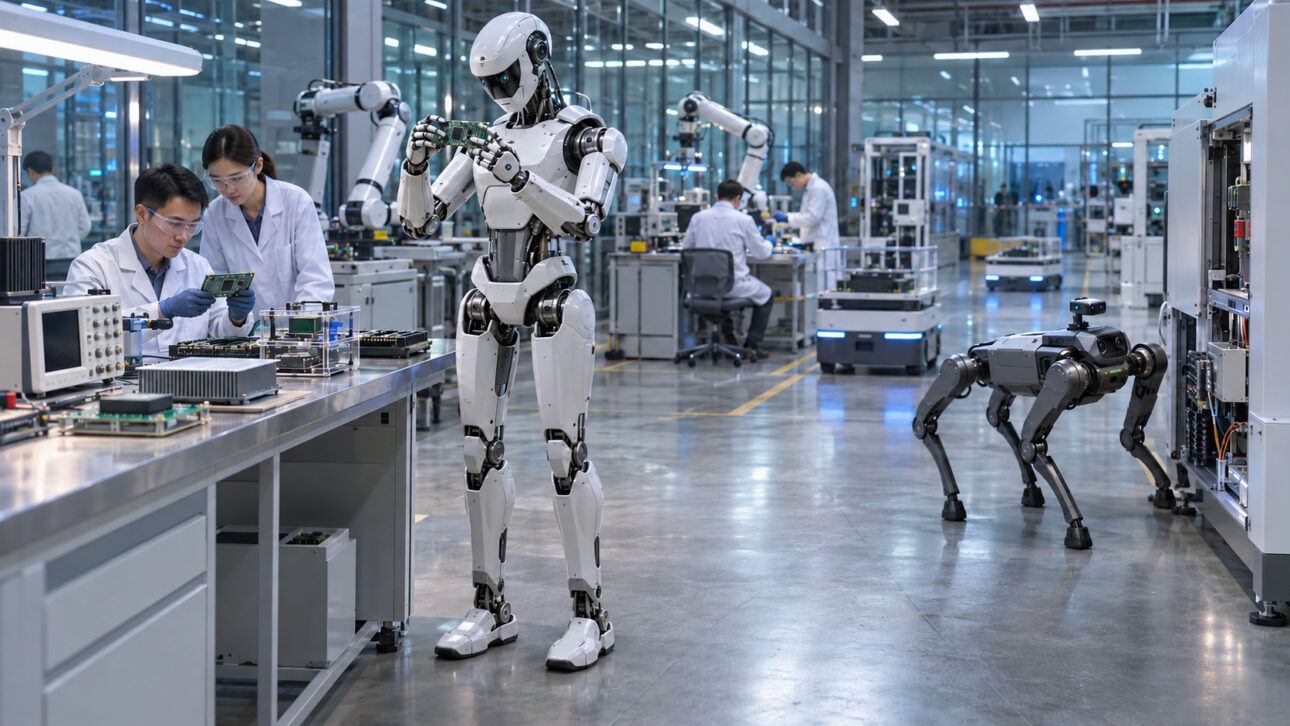

China’s Black Sesame Technologies opens physical AI center in Shenzhen and expands commercialization of its SesameX platform. The technology combines three processing lines for service robots, industrial quadrupeds and advanced humanoids
China has taken another step in the race to apply artificial intelligence to robotics with the expansion of the SesameX chip platform, developed by Black Sesame Technologies. On November 19, 2026, the company announced a new headquarters in Shenzhen dedicated to embodied AI and showcased applications of its processors across different robot categories. The initiative aims to strengthen the production of intelligent machines for industrial, logistics and service activities.
Despite the announcement, the SesameX platform is not new. The Chinese manufacturer first launched the technology in 2025 and presented its three modules at robotics events in 2026.
The latest announcement involves the expansion of its corporate structure and the formation of partnerships to turn the chips into commercial applications.
-
Samsung, SK hynix and Micron unite to standardize robot charging and enhance chip factory automation

-
University of Leicester professor Emma Bunce has worked 20 years for this weekend, when the €1.6 billion BepiColombo probe fires its thrusters after more than eight years and 6 billion miles to become only the second mission ever to orbit Mercury.

-
Archaeologists from Switzerland’s canton of Bern found a 13 cm bronze neck ring nearly 4,000 years old among rocks more than 2,600 metres up the Lötschen Pass, the first Early Bronze Age jewellery ever recovered there.
-
Study reveals how 2024 geomagnetic storm created unprecedented four electron bands in Earth’s Van Allen belts


Three chip lines offer 16 to 700 TOPS for different robot categories
The SesameX platform includes three families of computing modules, called Kalos, Aura and Liora. Each serves a category of equipment, with different processing and control requirements.
The first module, Kalos NX-3, comes in 16- and 48-TOPS versions and was developed primarily for commercial service robots.
Planned applications include cleaning machines, delivery equipment, reception robots and mobile inspection systems.
The module also includes image-processing and motion-control capabilities. These functions help equipment recognize obstacles and navigate.
The Aura NX-5 delivers up to 70 TOPS and is designed for applications that require greater computing capacity.
The manufacturer targets this module at quadruped robots, collaborative robotic arms and industrial equipment that must perform a range of tasks.
In September 2026, Black Sesame delivered Aura development kits to AUBO Robotics, a Chinese collaborative robot manufacturer.
The companies plan to develop applications that integrate perception, decision-making and motion control.
The Liora NX-7, in turn, uses an A2000U processor with a stated capacity of 700 TOPS, targeting humanoid robots and more complex robotic systems.
The manufacturer’s technical documentation says the module also has 96 GB of LPDDR5 memory and supports multiple cameras.
This configuration allows AI models to run directly on the equipment, without relying entirely on external servers.
However, TOPS figures indicate the theoretical number of computing operations per second under the conditions specified by the manufacturer.
They therefore do not, by themselves, show that a robot will be faster, smarter or more efficient in operation.
Company opens Shenzhen headquarters and announces orders for industrial and humanoid robots
The development announced on November 19 involves the creation of a headquarters specializing in embodied AI, also known by the English term embodied AI.
Black Sesame established the facility in Qianhai, in Shenzhen, China, using an operating model integrated with Hong Kong.
The goal is to bring semiconductor research, robot development and industrial suppliers closer together.
The location also allows the company to tap into the region’s concentration of electronic component manufacturers and automation companies.
The company also opened a demonstration space featuring equipment from more than 10 technology partners.
The machines on display included humanoid robots, quadruped robots, mobile platforms and collaborative industrial arms.
The Chinese newspaper China Securities Journal reported that the exhibition included demonstrations of robots carrying luggage, handling objects and performing complex movements.
However, these demonstrations do not prove that all the applications are commercially available at scale.
The manufacturer said it has relationships with dozens of companies in the sector and strategic agreements with groups including Midea, AUBO Robotics, COSCO Shipping and Joyson Electronics.
It also announced that it had secured orders related to the mass production of equipment in several categories.
These include humanoid robots, quadruped robots, industrial arms, mobile platforms and gardening machines.
However, the company has not publicly detailed the volumes contracted, the financial amounts or the individual timelines for the orders.
It has also not confirmed that all SesameX modules are already used in robots sold at scale.
Chips developed for smart vehicles could intensify competition in the global robotics market
Founded in 2016, Black Sesame Technologies initially built its business around developing semiconductors for smart vehicles.
The Huashan and Wudang chip families are part of that history, with applications related to environmental perception and automotive data processing.
Now, the company aims to leverage that experience to serve robot manufacturers.
The strategy reflects the fact that autonomous vehicles and robotic machines share technological challenges, including image recognition and decision-making.
Both also need to process information from sensors and execute commands in short time frames.
In humanoid robots, however, these functions must also keep pace with the movements of arms, legs, hands and other joints.
In this context, physical AI combines data processing with the ability to interact directly with the environment.
Black Sesame’s proposal involves using an architecture that handles both perception and reasoning functions and motion control.
The company describes this division as an integration of the robots’ brain and cerebellum.
While one part processes information and organizes decisions, another monitors sensors and controls movements in real time.
As a result, the integration could make it easier to develop industrial equipment capable of performing more complex tasks.
Black Sesame still needs to establish commercial use of its products across different manufacturers and applications.
For now, the company provides technical documentation and development tools for the SesameX platform.
The Shenzhen center is expected to support component integration and the expansion of industrial partnerships as robot manufacturers move through testing, production and commercialization.