





 Portuguese
  English
  Spanish
  4 min of reading
  0 comments


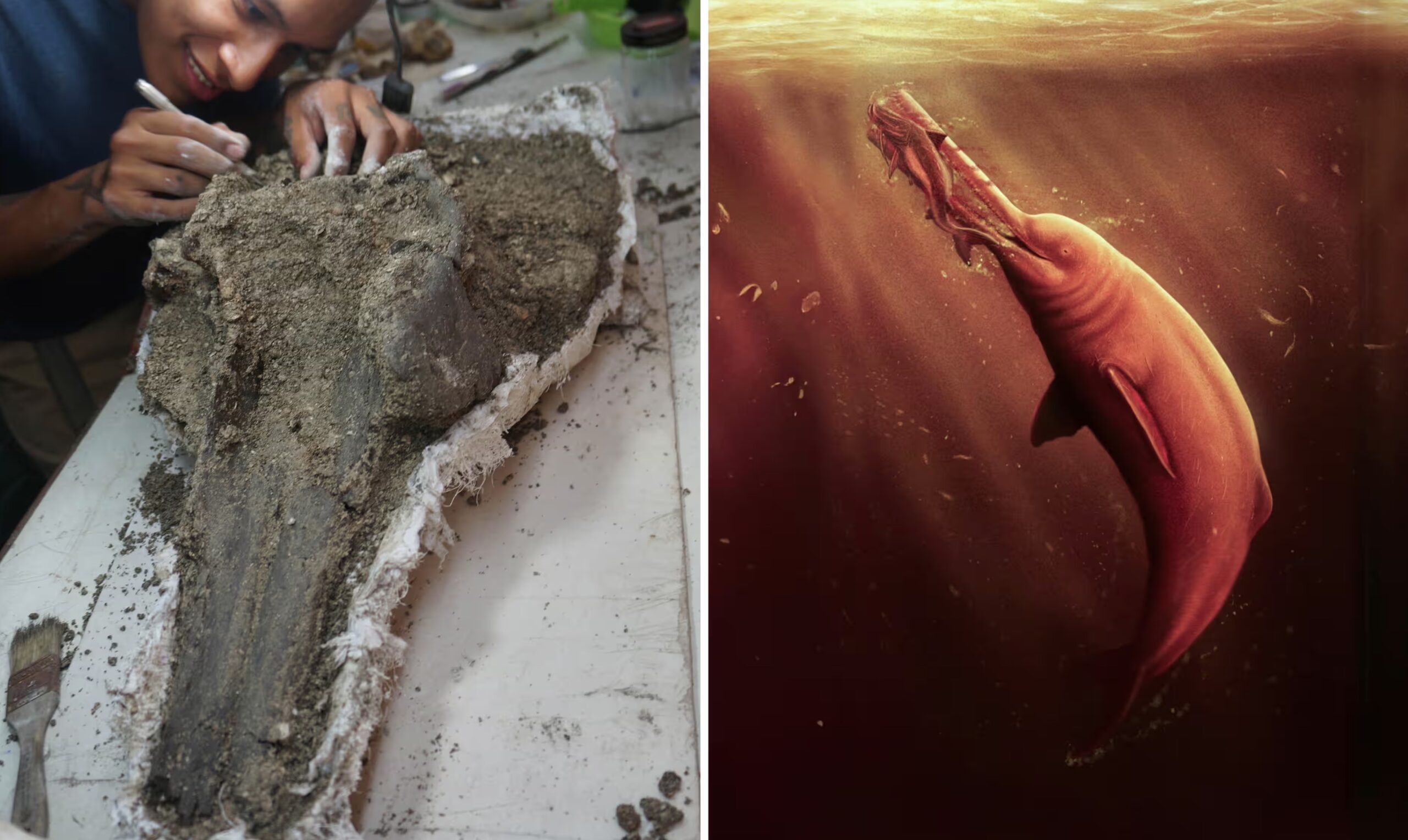
With 3.5 Meters in Length, the Pebanista yacuruna Is the Largest River Dolphin Ever Discovered, Found in the Peruvian Amazon and Dated to 16 Million Years Ago.
A scientific finding on the banks of the Napo River in the Peruvian Amazon is redefining the understanding of the evolution of aquatic mammals in South America. Peruvian and European researchers announced in March 2024 the discovery of the largest river dolphin ever identified on the planet, a fossil approximately 3.5 meters in length, belonging to an extinct species of the genus Pebanista. The skull of the animal, preserved in astonishing condition, was found by paleontologists from the Universidad Mayor de San Marcos and immediately stood out for its unusual proportions and for belonging to a geological period when the Amazon was still a large inland marine system.
Discovery That Changes the Evolutionary Lineage of Dolphins
According to the study published in the scientific journal Science Advances and reported by outlets such as The Guardian and BBC Science, the fossil was excavated from sediments dated to about 16 million years, in the Miocene.
At that time, the Amazon was not a tropical rainforest as it is today, but rather a vast system of interconnected lakes and channels, known as the “Pebas System,” that covered areas of present-day Peru, Colombia, and Brazil. It was in this setting that the giant Pebanista yacuruna lived, named after the Amazonian mythological creature “Yacuruna,” described in indigenous legends as an aquatic being that inhabits deep rivers.
-
“Whatever Russia is testing, it is sophisticated”: The quote is from the American COMSPOC, which observed two Russian military satellites maneuvering to within less than 3 meters of each other in low orbit last week.

-
Scientists discovered purely by chance that a microscopic organism taken from a pond in Oxford does not follow one of the “universal” rules of DNA, a finding made during a sequencing test with a very different objective.
-
After 30 years of development, engineer presents flying car that turns into a ‘plane’ in less than 2 minutes, uses a 280 hp engine, has already logged over 170 flight hours, and is coming to market

-
Scientists create a ‘Google Earth’ of the human body, scanning entire organs in 3D with synchrotron X-rays and allowing zooming in to cellular structures without cutting the tissue.






The analysis of the fossil revealed unprecedented anatomical features among known river dolphins: long and robust teeth, a wide skull adapted for hunting large prey, and a bone structure indicating a vigorous swimming capacity, far superior to that of modern river dolphins.
The size and morphology indicate that the animal could have occupied the top of the food chain in prehistoric Amazonian aquatic systems, acting as a true dominant predator in an ecosystem filled with giant fish and extinct crocodilians.
A Distant Relative of Today’s Dolphins
Although the Pebanista yacuruna was found in South America, its evolutionary lineage has Asian origins. Comparative research shows that the group is ancestral to the current Ganges River and Indus River dolphins, found in India and Pakistan.
This connection suggests an ancient migration of ancestral species between continents, likely through oceanic routes during periods of elevated sea levels.


Paleontologist Rodolfo Salas-Gismondi, one of the leaders of the research, emphasized that the discovery “represents a bridge between the aquatic faunas of Asia and South America” and demonstrates how ancient marine connections shaped the river biodiversity that exists to this day.
“This prehistoric Amazon dolphin shows that the Pebas System was a cradle of evolution and an essential biogeographic corridor for tropical aquatic fauna,” the scientist explained to Reuters.
The Largest River Dolphin Ever Recorded
Before this discovery, the title of the largest known river dolphin belonged to the Brachydelphis mazeasi, also found in Peruvian sediments, measuring about 2.8 meters. The new specimen comfortably surpasses this mark, reaching 3.5 meters and an estimated weight of over 250 kilograms.
This size makes it larger than many modern marine species, which surprised researchers, as size is generally limited by the depth and extent of rivers — conditions that, in the case of the ancient Pebas system, were quite different from today’s.
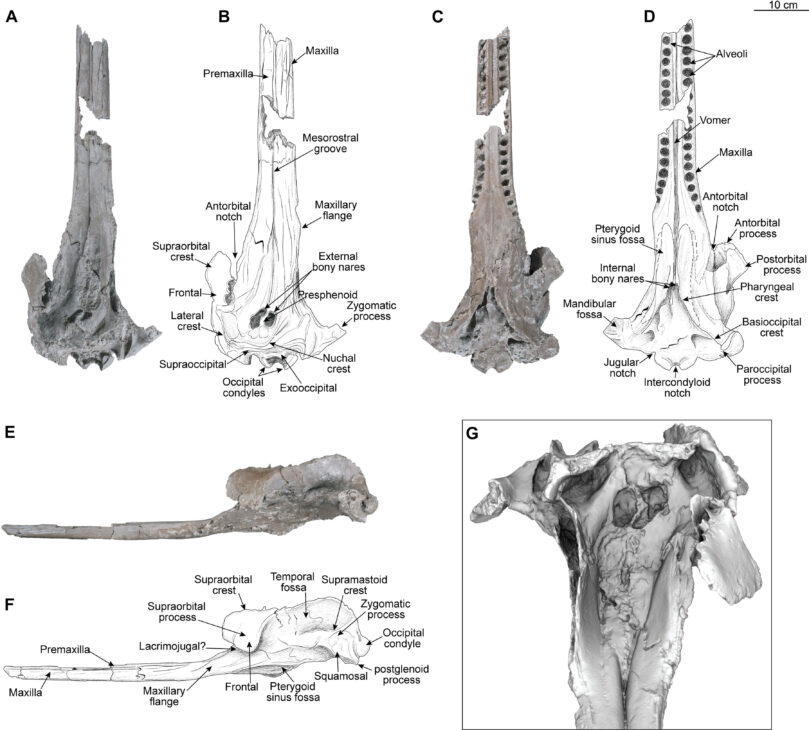
The discovery reinforces the role of the Amazon as one of the largest repositories of river fossils on the planet, revealing that millions of years ago, it housed a colossal and little-known biodiversity. Furthermore, it provides new clues about how modern river dolphins — such as the pink river dolphin (Inia geoffrensis) — evolved from marine ancestors that adapted to the isolated river environment.
The Amazon as a Living Archive of Natural History
The fossil is currently on display at the Natural History Museum of the Universidad Mayor de San Marcos in Lima, and has become a symbol of a new phase of South American paleontology.
Scientists claim that findings of this type help to understand how climate and geographical changes have shaped tropical ecosystems, and warn that habitat loss and deforestation could compromise the discovery of new species still hidden beneath the Amazonian soil.
With colossal dimensions and unprecedented scientific importance, the Pebanista yacuruna is not just the largest river dolphin ever discovered: it is an open window to a past when the Amazon was a vast inland ocean, and its rivers hosted predators of almost mythical proportions.


Be the first to react!