






 Portuguese
  Spanish


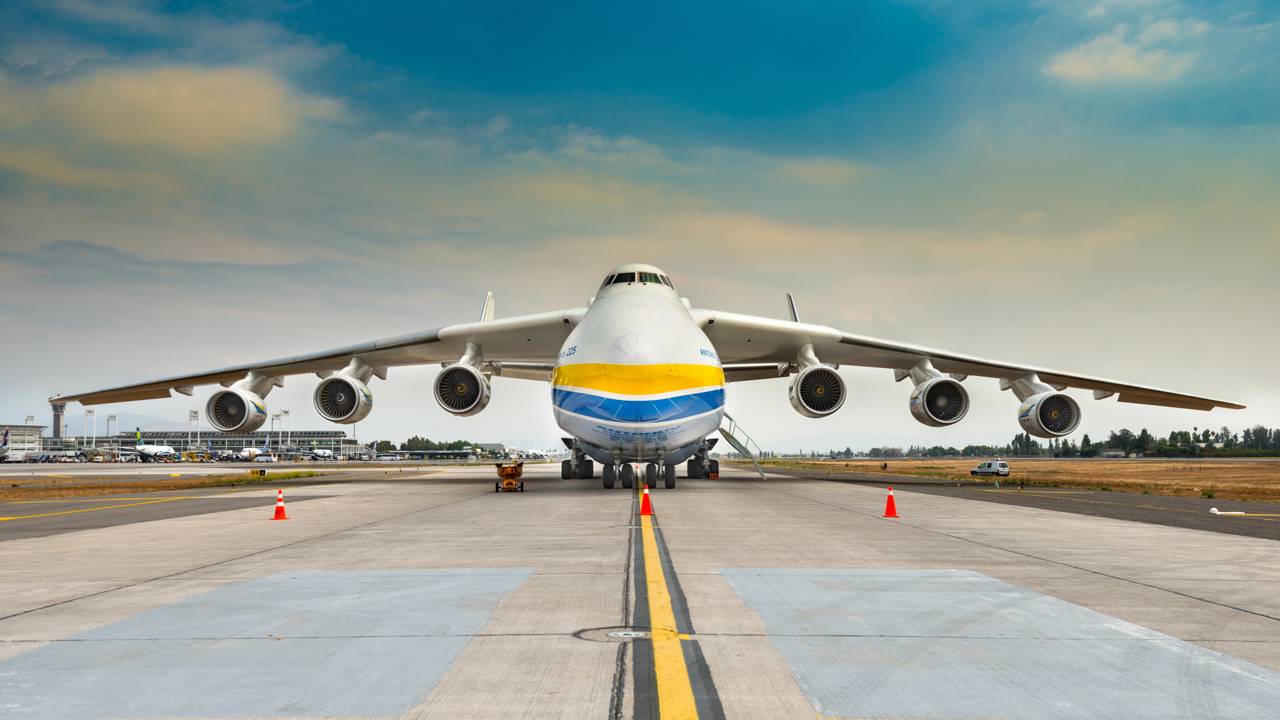


Created for space missions and later adapted for transporting extreme loads, the Antonov An-225 Mriya gathered rare engineering solutions and became a global reference in cargo aviation.
The Antonov An-225 Mriya entered aviation history as one of the largest aircraft ever built for cargo transportation.
Designed in the then Soviet Union and operated by Ukraine after the end of the Soviet bloc, the freighter was developed to carry non-standard volumes, including the Buran space shuttle, and became a reference in super-heavy cargo operations.
The aircraft was 84 meters long, with a wingspan of 88.4 meters, and a capacity to transport up to 250 tons of cargo.
-
Brazilian Town Known for Its Steady Winds Impresses with Cutting-Edge Hospitals, Clean Air, and Peaceful Living Just Three Hours from São Paulo

-
Animal Thought Extinct for 130 Years Reappears in Brazil, Exciting Scientists with Rare Comeback
-
German Sailor Found Mummified on His Boat in the Philippines, Leaving Scientists Puzzled by an Unbelievable Detail
-
Brazilian Couple Trades Motorhome for “Houseboat” Adventure on Historic Welsh Canal with Unique Challenges


The name Mriya means “dream” in Ukrainian.
These data explain the attention the plane received at airports and aviation-related events, especially for its application in missions requiring dimensions and capacity beyond those offered by conventional freighters.
The origin of the project was linked to the Soviet space program.
In the 1980s, the Soviet Union needed to transport components of the Buran, including the space shuttle itself, over the fuselage of an aircraft.
Antonov used the experience accumulated with the An-124 Ruslan and developed a larger model, with structural changes aimed at external cargo.
Why the Antonov An-225 needed six engines
The configuration with six turbofan engines met a technical need.
The Mriya needed to generate enough thrust to take off with heavy loads and maintain adequate performance on long-distance flights.
Data from specialized air charter operators recorded that the aircraft could transport unique pieces of up to 200 tons on certain routes, in addition to reaching a maximum payload of 250 tons.
The landing gear was also designed for this type of operation.
The set had 32 wheels, distributed to reduce pressure on the runway and allow the movement of an aircraft with hundreds of tons.
In flights of this magnitude, the operation depends not only on the plane but also on the capacity of runways, aprons, taxiways, and ground support equipment.
Another important element was the front opening.
The articulated nose allowed direct loading of large industrial parts, such as turbines, generators, and equipment that would not fit in common freighters.
The absence of a rear ramp, used in some military and cargo planes, was part of the structural configuration adopted for the model.
The Mriya’s twin tail and flight control
The twin tail of the An-225 had an aerodynamic function.
As the plane was designed to carry the Buran over the fuselage, a single vertical tail could be in a region affected by turbulence generated by the external load.
This effect would reduce the efficiency of the control surfaces responsible for directional stability.
With two vertical stabilizers at the ends of the horizontal stabilizer, the designers positioned the control surfaces in areas with more favorable airflow.
The solution helped preserve stability in flight conditions with large volumes over the fuselage.
This set of choices shows how the project was guided by specific requirements.
The engines responded to the need for thrust, the wings had dimensions compatible with the required lift, the landing gear distributed the weight on the ground, and the twin tail reduced aerodynamic limitations imposed by the external load.

Records of the Antonov An-225 and special cargo operations
After the end of the Soviet space program, the An-225 was adapted for commercial use.
The aircraft returned to operation in the early 2000s and was employed by Antonov Airlines in special cargo missions.
Records from the International Aeronautical Federation and the Guinness Book associate the model with hundreds of air transport records.
Among the operations attributed to the Mriya are flights with heavy industrial loads and the transport of very long or bulky items.
At various stops, aviation photographers and visitors followed landings and takeoffs, turning part of the operations into events of public interest.
The comparison with the Boeing 747-8F helps to size the difference between the models, although each was designed for different purposes.
Boeing’s technical documents indicate that the 747-8 Freighter has a maximum structural load between 139.6 and 144.15 tons, depending on the configuration considered, and a revenue payload between 133.2 and 137.75 tons.
The An-225 reached 250 tons, but it was a unique aircraft, with more specialized and limited operation.
The role of the world’s largest freighter in the pandemic
During the Covid-19 pandemic, the An-225 was used in the international transport of medical supplies.
In April 2020, Antonov reported that the aircraft carried a load of 103,880 kilos from China to Ukraine, with an approximate volume of 1,000 cubic meters, intended to combat the coronavirus.
In the same period, NATO reported that the freighter arrived in Germany with 10 million protective masks on a flight supported by the Strategic Airlift International Solution program.
The mechanism allowed participating countries to access heavy transport aircraft operated by Antonov.
In these missions, volumetric capacity played a central role.
In health emergencies, the available internal space directly influences the quantity of masks, protective clothing, tests, and hospital equipment transported in a single trip.
For this reason, the An-225 was activated on routes with high logistical demand during the global health crisis.
The destruction of the An-225 in Hostomel and the reconstruction project

The only completed An-225 was destroyed in 2022 during fighting at Antonov Airport in Hostomel, in the early days of the Russian invasion of Ukraine.
The loss affected both the operation of super-heavy cargo and the preservation of an aircraft considered unique in the history of the Ukrainian aerospace industry.
After the destruction, Ukrainian authorities and Antonov representatives mentioned reconstruction plans, with possible use of components from the second fuselage started during the Soviet period and never completed.
So far, however, the reconstruction of the plane depends on financial resources, availability of parts, technical certification, and operational viability.
Part of the An-225’s systems belongs to an old industrial chain, which increases the complexity of the process.
The eventual reconstruction would require component compatibility, supplier review, and adaptation to current operational and safety standards.
There is no secure public confirmation that a new unit has been completed or put into service.
Even out of operation, the An-225 continues to be cited in technical analyses of extreme cargo air transport.
Modern commercial aircraft tend to prioritize efficiency, fleet availability, and operational cost, while the Mriya was developed for specific weight and volume missions.
This difference explains why the model remains associated with operations requiring capacity beyond the usual standards of cargo aviation.
The history of the An-225 also illustrates how engineering decisions depend on the problem to be solved.
In the case of the Mriya, each technical solution responded to a concrete need: transporting an external space load, operating with high weight, and allowing the movement of large industrial equipment.





actuallly built by soviet union(russian) when ukraian was part of Russia.
Seen the behemoth quite a few times when they used to bring in wind power turbines and fan blades to Chennai. Been inside them too. Bult like steel tanks. Not sophisticated yet very, very powerful. Speciality Cargo carriers. An epitome of human ingenuity
Great engineering work.
I wish new ones could be made since technology has advanced.
Not true because it’s is only the located of there the engineer’s ther in Russia federation even today they continued to the productivity and the Ukraine can’t even producs 20% of this giant