






 Portuguese
  Spanish


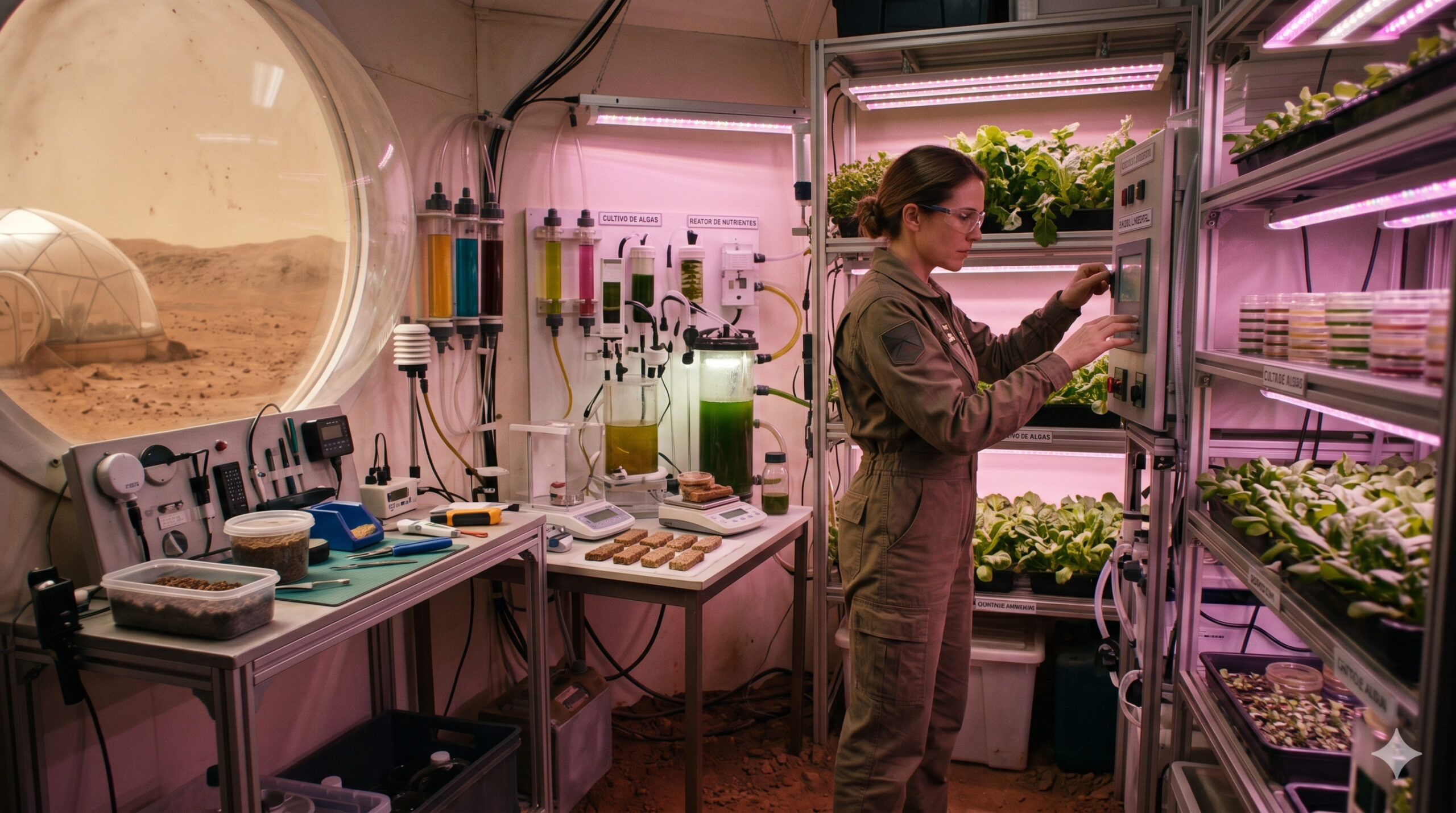


NASA launches $750,000 challenge to create food production systems on the Moon and Mars without relying on Earth.
In 2026, NASA opened a global competition targeting one of the most sensitive bottlenecks in long-duration space exploration: feeding humans off-Earth without making food a permanent resupply burden. Announced by the agency on January 13, the Deep Space Food Challenge: Mars to Table offers a total prize of US$ 750,000 for teams capable of designing complete food systems for surface environments like Mars and the Moon, with registration open until July 31, 2026.
The challenge is not just about the menu. According to NASA itself, participants need to create a complete food plan for a crew on Mars and design an integrated system that considers production, preparation, storage, safety, variety, palatability, operation, and integration with life support systems. The central point is to reduce dependence on Earth for missions that can last months or years, where transporting all necessary food would increase mass, cost, and logistical risk.
NASA’s proposal is direct: transform space food into self-sufficient infrastructure, not just packaged supplies. The Mars to Table Challenge, administered with support from the Methuselah Foundation within the Deep Space Food Challenge series, seeks concepts capable of meeting 100% of the crew’s variable nutritional needs within the constraints of a Martian habitat, paving the way for systems that can also have applications in remote locations, disaster zones, polar bases, and regions on Earth with fragile supply chains.
-
Parker Solar Probe Discovers High-Speed Dust Grains Near the Sun, Offering New Insights into Solar Corona’s Mysteries

-
Google Revives Historic Hangar for Cutting-Edge Tech in Silicon Valley: Once Built for a “Flying Aircraft Carrier,” Now a Hub for Drones and Robotics
-
Son of Brazilian Farmers Develops AI Robots in Arizona, Wins $175,000, and Tests Machines for Farming Tasks Amid U.S. Labor Shortage
-
Canadian Student Wins $50,000 at World’s Largest Youth Science Fair with AI-Powered Sea Turtle Robot Hunting Microplastics and 3D Holographic Camera Exposing Ocean Threats



NASA’s Mars to Table Challenge offers $750,000 for space food systems
The Mars to Table Challenge was launched as part of NASA’s strategy to enable sustainable missions in the Artemis program and future journeys to Mars.
The total prize reaches US$ 750,000, distributed among teams that present innovative solutions for food production in extreme conditions. The focus is on complete systems, not just a specific type of food.


This includes cultivation, processing, storage, and preparation. The idea is to create a closed food cycle, capable of functioning with few resources and minimal external intervention.
Producing food on Mars is one of the biggest challenges for long-duration missions
Feeding astronauts in Earth orbit is already complex. On Mars, the challenge multiplies due to several factors.
The average distance between Earth and Mars can exceed 200 million kilometers. This means frequent resupplies are unfeasible, both in terms of time and cost.
Furthermore, Martian missions can last more than two years. Carrying all the necessary food would require enormous cargo volumes, reducing space for essential equipment and increasing the total mission weight.
Food system needs to function with little water, limited energy, and hostile environment
The Martian environment imposes severe restrictions. Water is scarce, radiation is high, and temperatures are extremely low.
Food systems need to operate with maximum efficiency. This means consuming little water, using energy in a controlled manner, and resisting adverse conditions.
Additionally, Mars’ atmosphere is composed mainly of carbon dioxide, with low pressure, which hinders traditional biological processes.
NASA seeks complete solutions, not just isolated plant cultivation
Unlike initiatives focused solely on space agriculture, the Mars to Table Challenge requires integrated solutions.
This includes everything from cultivation to food preparation. Systems need to transform raw materials into consumable meals, considering taste, nutritional value, and food safety.
The agency also evaluates the adaptability of the solutions. The system must work on both the Moon and Mars, with minimal adjustments.
One of the central concepts of the challenge is the closed loop. This means maximizing the reuse of available resources, reducing waste and external dependence.

Organic waste can be transformed into nutrients for new crops. Water can be continuously recycled within the system.
This model is essential for long-duration missions. Without it, any space base would depend on constant resupply, which would limit its viability.
Food production can use biotechnology, 3D printing, and hybrid systems
The proposed solutions can involve different technologies. Among them, biotechnology, hydroponic cultivation, aeroponics, and even 3D food printing.
NASA does not restrict the approach, as long as the system is functional and adaptable to the space environment.
This opens space for innovation. Teams can combine traditional techniques with new technologies to create more efficient systems. Another point considered by NASA is the psychological impact of food.
In long missions, food monotony can affect astronauts’ well-being. Having adequate variety, flavor, and texture can directly influence the crew’s mental health.
Therefore, the challenge does not only involve calories and nutrients. The quality of the food experience also enters the equation.
Artemis Missions and Future Mars Trips Depend on Food Autonomy
The Artemis program, which aims to establish a human presence on the Moon, already considers the need for local food production.
For Mars, this need is even greater. The distance makes any dependence on Earth a significant risk.
Developing self-sufficient food systems is an essential step to transform exploratory missions into a permanent presence. The Mars to Table Challenge follows NASA’s open innovation model.
Teams from different countries, including startups, universities, and independent researchers, can participate.
This format increases the diversity of solutions. Ideas that would not emerge within a single laboratory can appear in different parts of the world.
Developed Technologies Can Impact Food Production on Earth
Like other space projects, the solutions created for the challenge can have applications on Earth. Efficient food production systems in extreme environments can be adapted for arid regions, dense urban areas, or places with resource scarcity.
Vertical farming, for example, already benefits from technologies developed for space. The ability to produce food in extraterrestrial environments can be the decisive factor for long-duration missions.
Without food autonomy, bases on the Moon and Mars would depend on constant logistics, increasing costs and risks. With self-sufficient systems, exploration can advance to a new phase, with continuous presence and gradual expansion.
US$750,000 Challenge Shows That the Biggest Problem Isn’t Arriving, But Staying
The modern space race is not just about reaching new destinations, but about staying in them. Creating food outside Earth represents one of the biggest obstacles to this permanence.
The Mars to Table Challenge places this problem at the center of the discussion, offering financial incentives for solutions that can change the course of space exploration.
If someone manages to create an efficient food system for Mars, they will not only be winning a prize but also helping to define how and if humans can live off Earth for long periods.
Do you believe the solution to feeding humans on Mars will come from large corporations or from smaller teams that can solve a problem that could define the future of life off-planet?




grab sand, and ur own piss, and make it into dow, then eat that, and drink ur piss for water.
Making flour with death skin
Algae and water