






 Portuguese
  Spanish


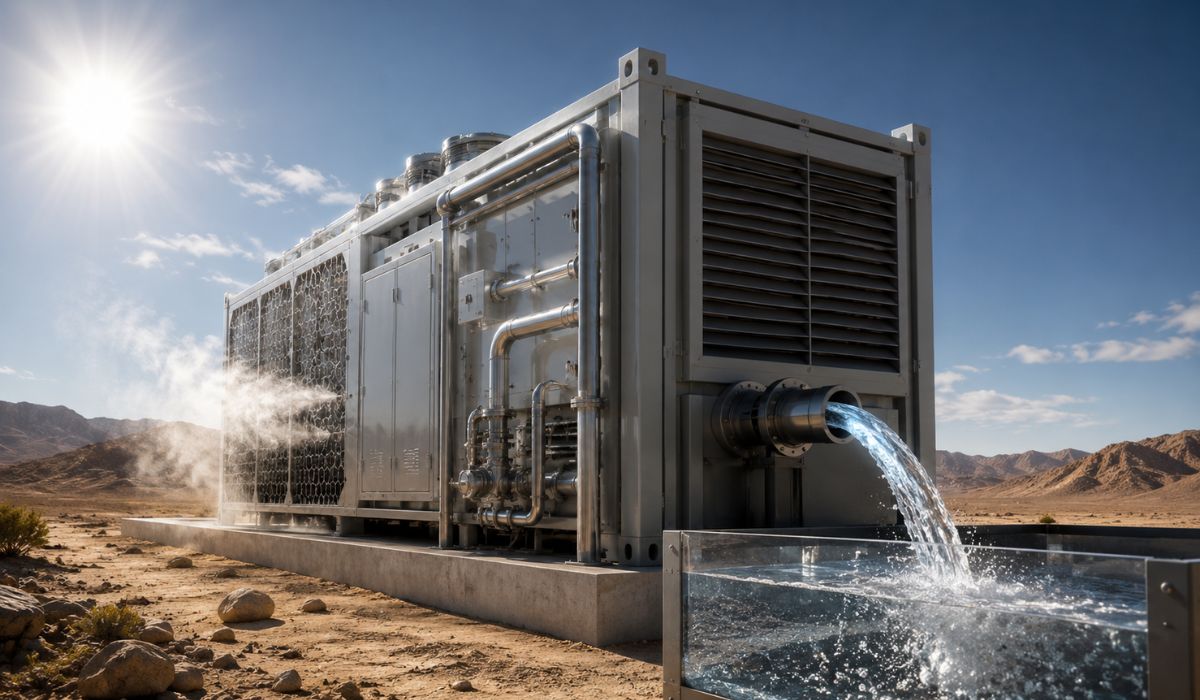


New technologies aim to extract potable water from air humidity, even in dry environments, accelerating a scientific race for decentralized solutions for regions affected by droughts, hurricanes, and supply failures.
Machines capable of extracting potable water from dry air and systems that use ultrasound to accelerate the collection of this liquid have become part of a new research front against water scarcity.
For now, these technologies do not replace public supply networks or large-scale desalination projects, but they are being studied as complementary alternatives for arid regions, islands, and isolated communities after extreme weather events.
One of the most recent initiatives was presented by Atoco, a company founded by chemist Omar Yaghi, a professor at the University of California, Berkeley, and one of the winners of the 2025 Nobel Prize in Chemistry.
-
Brazilian Innovator Transforms 1962 Mercury Comet with Nissan Leaf Electric Motor, Achieving 125 km Range for Under $6,000

-
China Tests Giant 582-Ton Magnets to Contain Plasma Hotter Than the Sun’s Core, Aiming to Cut Superconductor Costs and Generate First Electricity from “Artificial Sun” by 2030
-
Seventh Grader Builds Nuclear Fusion Machine at Home, Aiming for Guinness World Record

-
Ancient Ritual Circle, Hidden for 5,000 Years, Discovered in Scotland’s Machrie Moor Using Sensors, Revealing a “Phantom Stonehenge”



According to the company, units similar in size to a 20-foot container can produce up to 1,000 liters of clean water per day by capturing humidity from the air, even in dry environments.
The system’s operation is based on what is known as reticular chemistry, an area that allows for the construction of molecular materials with designed pores.
These materials, known as metal-organic frameworks or MOFs, form crystals with internal cavities capable of retaining specific molecules, such as water, carbon dioxide, and other gases.
In practice, the technology functions like a molecular sponge.
The material attracts water vapor present in the air, traps these molecules in its structure, and then allows them to be released in liquid form.
According to Atoco, the equipment was designed to operate with low-intensity thermal energy and can be installed near the communities served.
The proposal gained traction because it addresses a frequent limitation in supply crises.
In places where pipelines, reservoirs, or electrical grids are damaged by storms, water delivery relies on trucks, vessels, bottles, or emergency systems.
Decentralized equipment, according to researchers in the field, can reduce some of this dependence when technical conditions and proper maintenance are in place.

How reticular chemistry captures water from dry air
The 2025 Nobel Prize in Chemistry was awarded to Susumu Kitagawa, Richard Robson, and Omar Yaghi for the development of metal-organic frameworks.
The Royal Swedish Academy of Sciences highlighted that these materials opened a new form of molecular architecture, with cavities large enough to allow molecules to enter and exit.
This characteristic made MOFs useful in various scientific applications.
These include gas storage, carbon dioxide capture, removal of unwanted substances, and water collection in low-humidity environments.
Adaptation for supply use, however, depends on factors such as cost, durability, production scale, and the safety of the water obtained.
Yaghi associates part of his scientific trajectory with personal experience of water scarcity.
In a speech at the Nobel banquet, the chemist stated that he grew up in a refugee community in Jordan without running water or electricity.
He recalled that the arrival of water mobilized the neighborhood and said he would run to fill containers before the flow was interrupted.
In the same speech, the researcher described reticular chemistry as “a science capable of reimagining matter.”
He used the phrase to advocate for scientific cooperation, academic freedom, and the international circulation of researchers in areas related to climate and water security.

Ultrasound accelerates the release of captured water
While Atoco works with systems based on reticular materials, another line of research seeks to solve a specific stage of atmospheric capture: the removal of water after it has already been absorbed.
In many models, this release depends on heat, usually solar, to evaporate and condense the liquid.
MIT researchers presented, in November 2025, an ultrasonic device capable of accelerating this process.
According to the institution, the equipment uses high-frequency sound waves to make the absorbent material vibrate and release water droplets in minutes, instead of relying solely on thermal evaporation.
The study, published in the journal Nature Communications, describes the technique as a form of vibrational mechanical action.
In tests reported by the authors, the method increased the energy efficiency of the extraction step by about 45 times compared to solar heat-induced evaporation models.
MIT’s technology does not produce water on its own nor does it eliminate the need for energy.
The role of ultrasound is to more quickly release water that has already been captured by a suitable material.
According to the researchers, small solar panels could power the device and allow for repeated cycles throughout the day.
This point is relevant for differentiating research fronts.
Atoco’s machine and MIT’s ultrasonic device are not the same equipment.
Both relate to atmospheric water collection but operate in distinct stages and projects: one focused on daily production in larger units, the other concentrated on accelerating the release of water retained in absorbent materials.
Water crisis increases the search for alternative sources
The advancement of these technologies occurs in a scenario of increasing pressure on traditional freshwater sources.
A United Nations University report released in January 2026 stated that the world has entered an era of “global water bankruptcy.”
The document points out that nearly three-quarters of the population live in countries classified as water-insecure or critically water-insecure.
The same survey reports that about 2.2 billion people still lack access to safely managed drinking water, while 3.5 billion live without safe sanitation.
Approximately 4 billion face severe water scarcity for at least one month a year, according to the United Nations University.
In this context, desalination remains an important technology for coastal countries with low availability of freshwater.
According to the Associated Press, more than 20,000 desalination plants operate worldwide, and the sector has been growing since 2010, according to the International Desalination and Reuse Association.
The process, however, requires investment, energy, and environmental control.
The United Nations Environment Programme states that brine discarded by plants can increase salinity, reduce dissolved oxygen, and affect marine organisms when disposal is not adequately managed.
For this reason, water sector experts treat atmospheric solutions, reuse, conservation, desalination, and protection of water sources as different tools for different problems.
The choice depends on climate, cost, demand, available infrastructure, and local capacity to operate the systems.


Islands and isolated communities enter the technology radar
Caribbean islands appear among the locations cited by researchers and local authorities because they combine exposure to hurricanes, periods of drought, and reliance on concentrated infrastructure.
In July 2024, Hurricane Beryl hit Grenada and caused severe damage in Carriacou and Petite Martinique, impacting homes, essential services, and water systems.
After such events, the presence of water in the streets or flooded areas does not mean access to potable water.
Pumping systems, reservoirs, distribution networks, and treatment plants can be interrupted at the same time as the need for safe water for consumption, hygiene, and emergency care increases.
In 2025, Hurricane Melissa also generated demand for water, sanitation, and hygiene actions in the Caribbean.
A Unicef regional report estimated that thousands of people needed assistance to restore essential services after the phenomenon passed.
Water harvesting from the air is presented, in this scenario, as an option to reduce specific vulnerabilities.
Its large-scale adoption, however, still depends on proof of field performance, availability of parts, local training, operational costs, and water quality monitoring.
Even with these limitations, the research changes how part of science observes the water available on the planet.
In addition to rivers, oceans, aquifers, and reservoirs, vapor dispersed in the atmosphere has come to be treated as a possible source for localized uses, provided that collection is safe and economically viable.





It can’t be a black person
What is the cost of producing a liter of water in Sahara desert?
We shall need this machine on Mars
Phillip Kyobe did you not READ the article, EARTH NEEDS WATER NOW, not sometime in never when you believe the BS about going to mars… you sound Stupid saying what you said🤣🤣🤣🤣🤣