






 Portuguese
  Spanish


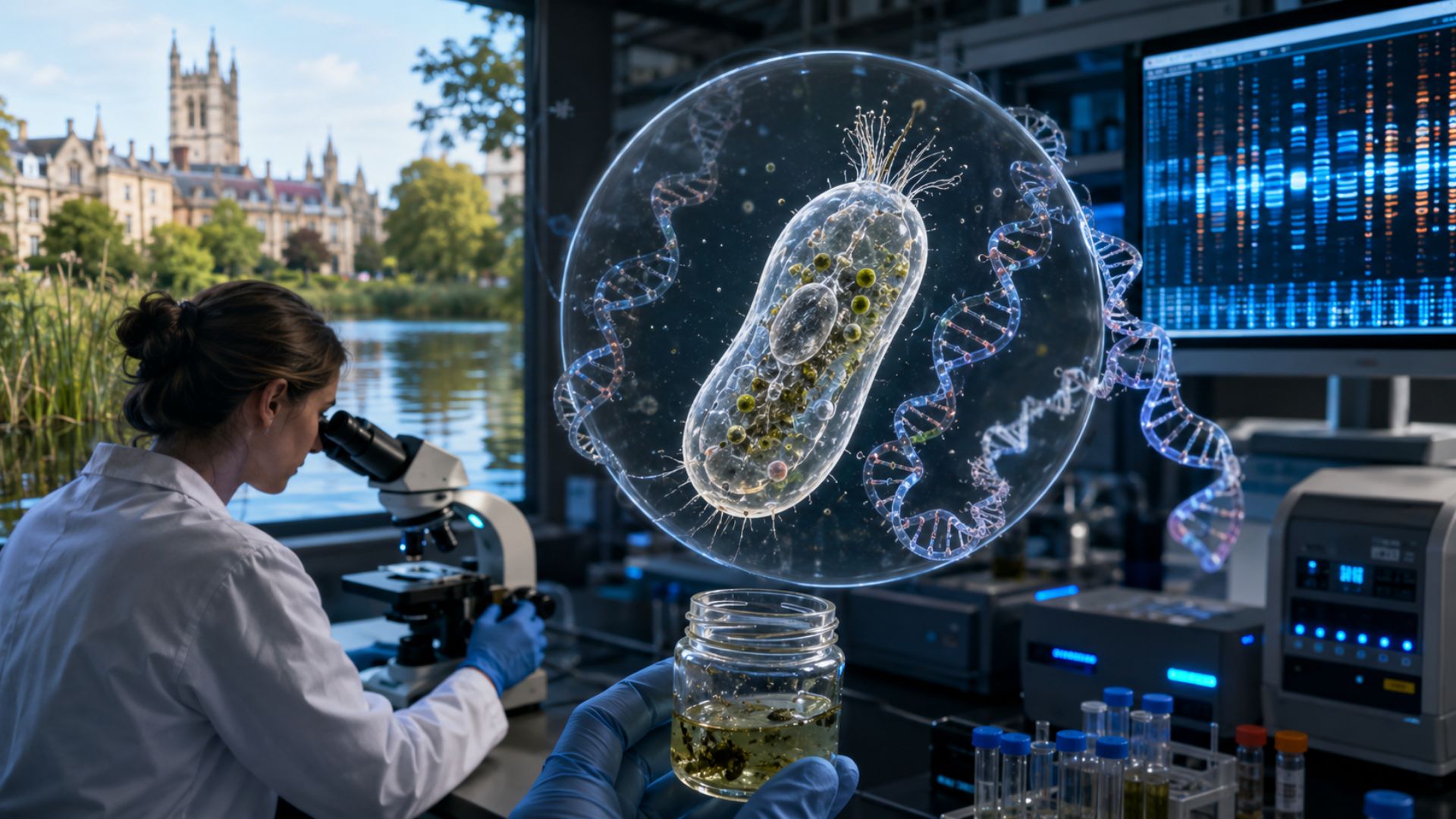


Scientists at the Earlham Institute, UK, accidentally discovered that the microscopic organism Oligohymenophorea sp. PL0344, collected from a pond in Oxford University Parks, rewrites universal rules of the genetic code by using two stop codons as different amino acids in an unprecedented finding published in the journal PLOS Genetics.
Scientists at the Earlham Institute, UK, made an unexpected discovery during a DNA sequencing test. The microscopic organism they were analyzing, collected from a pond in Oxford University Parks, rewrites one of the rules considered universal in the genetic code.
The research was led by Dr. Jamie McGowan, a postdoctoral scientist at the Earlham Institute. The initial objective was practical: to test a new sequencing method capable of working with minimal amounts of DNA, including genetic material from a single cell.
The target of the test was a freshwater protist. The result was an unprecedented genetic anomaly. The organism, identified as Oligohymenophorea sp. PL0344, turned out to be a previously unknown species with a rare way of reading DNA.
-
This Mars rover may finally reveal if life ever existed on Mars.

-
A nearly 70-year-old Chinese inventor has registered 90 patents and created a device that stores water in the roots, helping seedlings survive drought while trying to transform the arid slopes of the Loess Plateau into green areas without relying on heavy irrigation.

-
Researchers want to change the way of producing rare earth magnets, reducing purification steps and making better use of the elements found in Swedish deposits.
-
5.5 tons pulled from the seabed: a ‘living carpet’ of invasive coral was suffocating the Baía de Todos-os-Santos until the Brazilian Navy descended with divers, steel brushes, and acid salt to carry out the largest eradication operation of the species ever conducted in the country.



The discovery was published in the scientific journal PLOS Genetics. Two codons that normally function as stop signals in protein synthesis were reassigned to different amino acids, a combination that the researchers classify as never before seen.
“It was pure luck that we chose this protist to test our sequencing method, and it just goes to show how much we still have to learn about protist genetics,” said Dr. McGowan.
What this Oxford organism did so differently from DNA rules

To understand the finding, it’s necessary to recall how the genetic code works. In almost all living beings, three codons signal the end of a gene: TAA, TAG, and TGA. They function as punctuation marks in genetic instructions, indicating that protein synthesis should stop.
This system is described as almost universal. Variations known so far are rare, and when they occur, TAA and TAG usually change together, assuming the same amino acid. This pattern suggested that the two codons were linked in evolution.
The Oxford organism did something different. Only TGA continues to function as a stop codon. The other two signals were repurposed for distinct meanings: TAA came to specify lysine, while TAG came to code for glutamic acid.
The combination is what makes the case unique. “We are not aware of any other case where these stop codons are linked to two different amino acids,” said Dr. McGowan. “This breaks some of the rules we thought we knew about gene translation.”
The team also found more TGA codons than expected, specifically distributed right after the coding regions. The researchers believe that this concentration helps compensate for the loss of the other two stop signals and prevents continuous readings harmful to the cell.
What are ciliates and why is this group so genetically strange
Oligohymenophorea sp. PL0344 belongs to a group called ciliates. They are swimming protists, visible under a microscope, found in various aquatic environments. They have become especially interesting to geneticists for a specific reason.
Ciliates are known as hotspots for genetic code alterations. Repeated studies have shown that this group harbors more anomalous genetic variations than any other known type of organism.
The category “protist” is broad by definition. “Essentially, it’s any eukaryotic organism that is not an animal, plant, or fungus,” explained Dr. McGowan. This includes amoebas, algae, diatoms, slime molds, and red algae.
The diversity within the group is so vast that generalizations are almost impossible. Some protists are more closely related to animals, others to plants. There are predators and prey, parasites and hosts, organisms that swim and others that are sessile.
A study published in PLOS Genetics in 2024 reinforced that ciliates are exceptionally rich sources of surprises in the genetic code. Researchers identified multiple independent reassignments of the UAG stop codon in phyllopharyngeal ciliates, with different species using the same codon to encode distinct amino acids.
Why the discovery of this organism challenges what was known about the genetic code
DNA can be understood as a set of instructions, but these instructions need to be interpreted. First, a gene is transcribed into RNA. Then, RNA is translated into amino acids, which bind to form proteins and other functional molecules.
Translation begins at an initiation codon (ATG) and ends at a stop codon. In the organism found in Oxford, this traditional termination system was reorganized in a way that had not yet been documented in any other living being.
Genome and transcriptome analysis identified suppressor tRNA genes corresponding to the reassigned codons. This confirmed the conclusion that the organism truly reads the old stop signals as amino acids, not just in isolated cases.
The discovery has implications that go beyond biological curiosity. It shows that even one of the most conserved systems in biology can be more flexible than imagined. The genetic code, considered almost immutable for decades, harbors exceptions that evolution has been producing independently in different lineages.
Scientists attempting to create synthetic genetic codes in the lab find, in nature, examples of mechanisms that no one had designed. “There are fascinating things we can find, if we look for them,” said Dr. McGowan. “Or, in this case, when we’re not looking for them.”
What the Earlham Institute’s research means for molecular biology
The original research that identified Oligohymenophorea sp. PL0344 was published in PLOS Genetics in 2023. The work was funded by the Wellcome Trust as part of the Darwin Tree of Life Project and supported by the Biotechnology and Biological Sciences Research Council (BBSRC), part of UKRI.
Sequencing data and genome assembly resources have been deposited in public repositories. This decision allows other research groups to replicate and deepen the finding, a practice that has become standard in molecular biology in recent decades.
For the non-specialized reader, the central message is simple. Nature does not operate with rules as rigid as once imagined, and little-studied organisms (especially microbial ones) can hold surprises that rewrite entire chapters of biology textbooks.
The combination of new sequencing methods and scientific curiosity is the engine of these discoveries. Without testing a technique for tiny DNA samples, this organism from a British pond would remain invisible to science, even though it harbors one of the most notable exceptions to the standard genetic code.
And you, did you find this discovery impressive? Do you think there are still many rules of biology waiting to be rewritten? Leave your opinion in the comments.


عبدالله غيلان