






 Portuguese
  Spanish


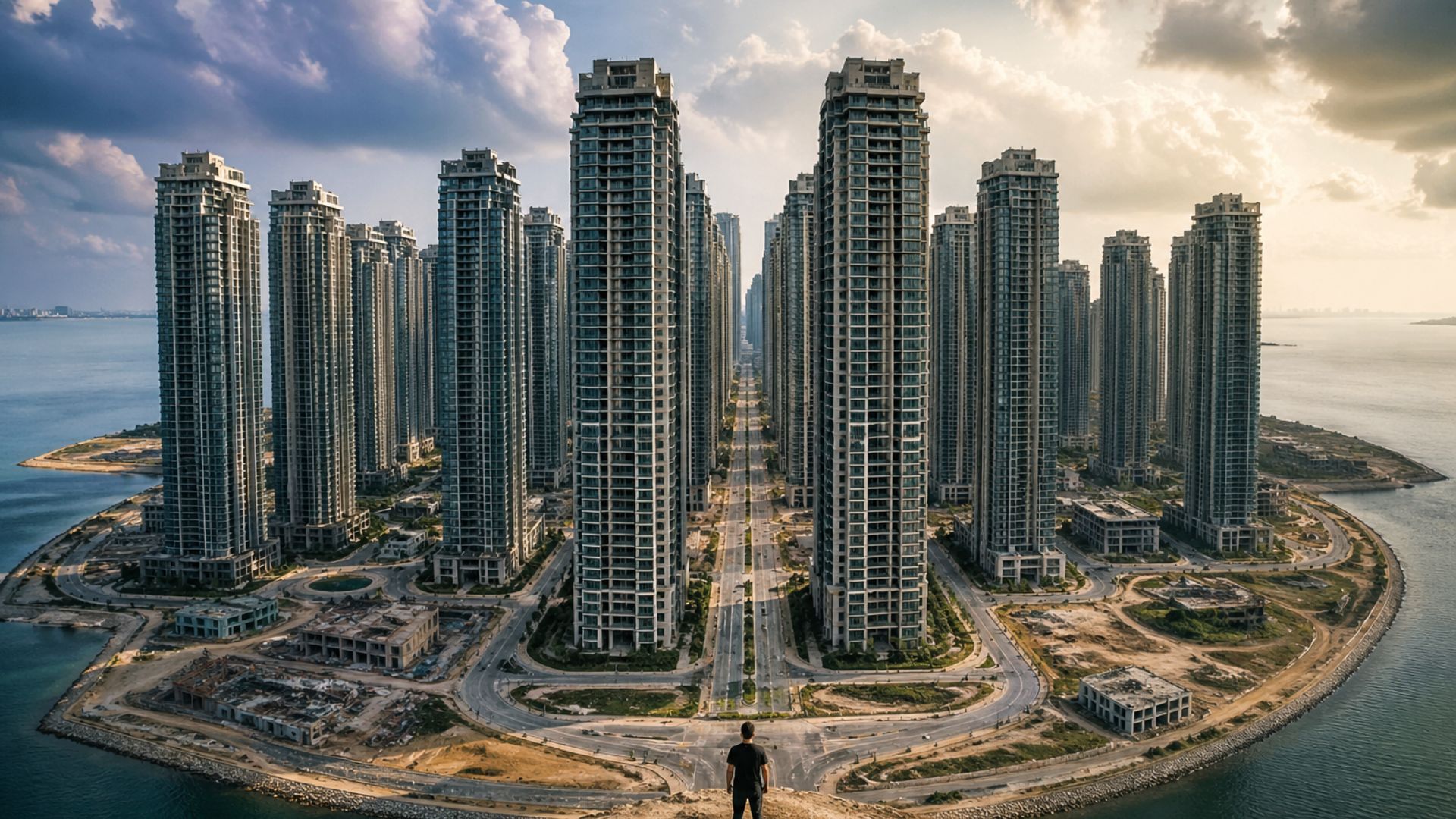

Urban megaprojects advance without residents, accumulate empty towers, structural delays, and highlight the mismatch between capital, planning, and real life in different countries, from artificial islands in Asia to entire neighborhoods in Europe and Africa, marking a global phenomenon.
Forest City, a real estate megaproject launched in 2014 in Johor, Malaysia, has become one of the most visible symbols of the gap between urban ambition, international capital, and actual occupancy.
Planned to house about 700,000 residents on artificial islands near Singapore, the development progressed faster than the arrival of residents.
The project envisaged almost 14 km² of reclaimed land, but only one of the four islands had been recovered by 2025, with about 20,000 people living there.
-
Failed Family Bakery Sparks Engineer’s Innovation, Leading to a $100 Million Energy-Efficient Oven Company in Brazil

-
Elon Musk Loses Trillionaire Status as SpaceX Shares Plummet, Wiping Out $61 Billion in a Day

-
New Railway in Mexico Diverted to Preserve 4,000-Year-Old Rock Art Resembling Aztec Rain God
-
Chinese Researchers Discover Largest Whale Graveyard in Indian Ocean: Nearly 500 Skeletons, Some 5.3 Million Years Old, Reveal Ecosystem Insights and Potentially Unknown Species



The landscape of residential towers, wide streets, and partially occupied commercial areas exposes the limit of cities built before the demand they were supposed to meet.
Anticipated Urbanism and Empty Cities

The logic is not isolated. Over the past two decades, different countries have invested in neighborhoods, districts, and entire cities built as financial assets, technological showcases, or state projects.
In many cases, concrete arrived before jobs, services, and social networks that transform buildings into a city.
In Spain, the Francisco Hernando Residential, in Seseña, near Madrid, became a European example of the 2000s real estate bubble.
The plan envisaged 13,000 apartments, but the 2008 financial crisis halted expansion and left thousands of units in an urban complex larger than the existing demand.
Over time, part of the occupancy advanced, driven by housing pressure in the Madrid metropolitan area.
Still, the case showed that filling buildings alone does not solve an urban sequence error.
Transport, services, commerce, schools, and jobs need to accompany the arrival of residents.
Real Estate Projects Without Urban Dynamics
In Turkey, Burj Al Babas took visual speculation to the extreme.
The development envisaged 732 castle-inspired constructions, but the developer’s bankruptcy halted the project and left hundreds of unfinished structures in a repetitive setting, without its own urban dynamics.
Songdo, in South Korea, reveals another face of this phenomenon.
Conceived as a smart city on reclaimed land in Incheon, the area combines sensors, fiber optics, efficient buildings, and automated systems.
The advanced infrastructure, however, did not eliminate criticisms about low urban vitality in its early years.

The city now has a significant population and continues to develop, but its initial trajectory showed that technology does not create urban life by itself.
Songdo occupies about 53 km² and had more than 167,000 residents in the 2020 population snapshot.
Artificial Islands and High-Cost Enclaves
In Lagos, Nigeria, Eko Atlantic was born with another promise: to protect the coast from erosion and create a new financial center on land reclaimed from the Atlantic.
The work involves a large sea barrier and millions of cubic meters of sand, but also generated debate about access, cost, and urban segregation.
China is home to some of the most well-known examples of anticipated urbanization.
Tianducheng, in Hangzhou, copied Parisian references, including a replica of the Eiffel Tower of 108 meters.
In its early years, it was described as a “ghost city,” although it later gained residents and ceased to be completely empty.
Ordos Kangbashi, in Inner Mongolia, also became a global symbol of this imbalance.
Funded by the wealth cycle linked to coal, the district built wide avenues, cultural facilities, and public buildings before consolidating the expected human density.
Data from the 2020 Chinese census showed 118,796 inhabitants in Kangbashi.
State planning and unequal growth
In Kunming, the Chenggong district followed a similar strategy: transferring administrative and university functions to activate a new centrality.
The 2020 census recorded 649,501 residents in the district, a significant number, but urban planning criticism remains linked to the unequal pace between housing, employment, and services.


Caofeidian, in Hebei, was planned as an industrial and urban hub associated with port logistics and heavy industry.
Studies and documents on Chinese ecocities indicate targets of hundreds of thousands to about 1 million inhabitants, but occupation depended on the actual speed of economic activity.
Outside China, Palm Jebel Ali, in Dubai, shows how artificial megaprojects are also vulnerable to financial cycles.
Launched in 2002 and stalled for years after the global crisis, the archipelago was relaunched in 2024 and is described as larger than Palm Jumeirah, with an extensive new coastline.
Population aging and empty properties
Japan presents the inverse problem.
Instead of cities built without residents, the country faces homes left behind by demographic contraction and migration to large centers.
The 2023 housing survey recorded 9 million vacant residences, equivalent to 13.8% of Japan’s housing stock.
These cases show that a city is not born solely from engineering, credit, or architectural appearance.
When housing, work, transport, commerce, and belonging do not advance together, the result can be a landscape ready ahead of its time, functional on paper, and incomplete in daily life.


