






 Portuguese
  Spanish
  3 min of reading
  0 comments


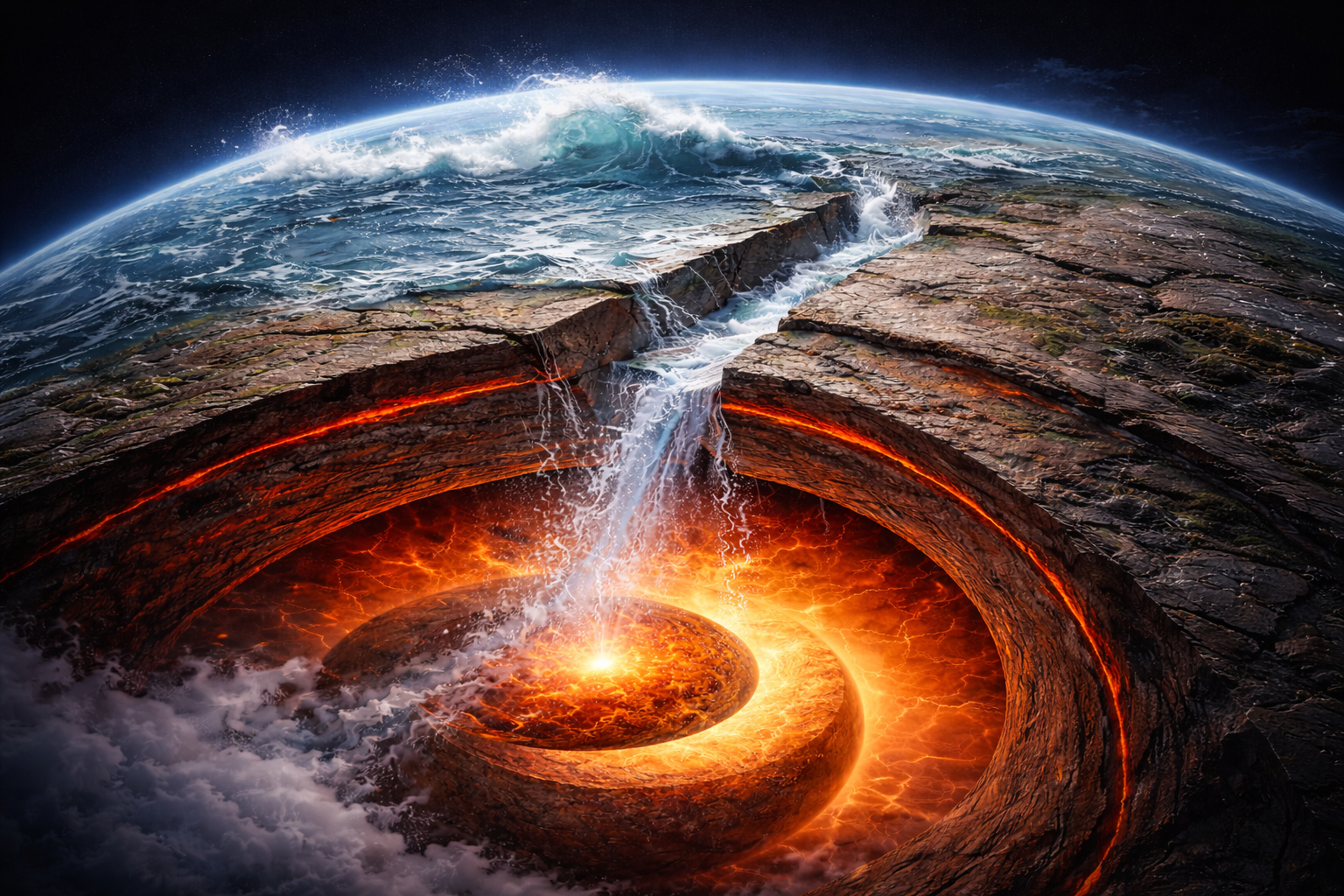
Recent studies show how tectonic plates bring water to almost 3,000 km deep and influence the Earth’s core
A significant scientific discovery was recently confirmed, changing the way we understand the planet’s internal dynamics.
The Earth is absorbing water from the oceans to extremely deep regions, in a process that occurs nearly 3,000 kilometers below the surface, according to a study published in 2023 in the journal Nature Geoscience.
This phenomenon, previously considered theoretical, has been validated by researchers, revealing a continuous geological cycle that connects oceans, mantle, and Earth’s core.
-
Fossils millions of years old reveal that giant capybaras once dominated Chile, a country where the largest rodent on the planet simply no longer exists today.

-
Former coal mining area in the central United States receives nearly 17,000 solar panels generating 9.8 megawatts, serving over 650 subscribers and including about 200 low-income families without installing anything on rooftops.

-
Hidden beneath a small entrance in Namibia’s underground, the largest underground lake in the world is the size of 2 football fields, 264 meters deep, and even has rare animals that survive without sunlight.

-
The industry relies on oil to manufacture plastic, but a 16-year-old girl used banana peels and managed to create a bioplastic after two years of attempts.




According to scientific analyses, this transport occurs through subduction zones, which act as true natural conveyor belts, carrying oceanic material into the Earth’s interior.
Water transport by tectonic plates reveals a deep cycle
Subduction zones play a central role in this process, as they push oceanic plates loaded with hydrated minerals into the mantle.
These minerals store water in their structure, which is gradually released as pressure increases during deep diving.
Recent research indicates that this transport goes beyond the surface layers, reaching regions much deeper than previously estimated.
According to explanations released by the scientific channel Drishti IAS: English, the mechanism occurs continuously, with water being transported over millions and billions of years.
Thus, this deep flow is not a one-time event but rather a constant process that directly influences the planet’s internal structure.


Interaction of water with the core transforms internal structure
When water is released at great depths, it begins to interact with elements present in the Earth’s outer core.
At this stage, a reaction occurs with the silicon present in this liquid region, causing significant chemical changes.
This process does not happen quickly, but rather over billions of years, at a slow and continuous pace, described by scientists as “geological dripping.”
As a result, the internal structure of the planet is gradually modified, creating new layers and altering the behavior of the core.
The functioning of this cycle can be summarized in clear steps:
- The tectonic plate dives carrying hydrated minerals
- Intense pressure releases the stored water
- The water reacts with the silicon of the outer core
- A new crystalline layer forms over the core
Discovery of the E-prime layer expands understanding of the planet
As a result of these reactions, researchers identified the formation of the so-called E-prime layer.
This structure was described by scientists from the University of Arizona and Yonsei University, who analyzed its distinct chemical composition.
The layer has a high concentration of hydrogen and low presence of silicon, indicating that it was not part of the Earth’s original formation.
Moreover, this region acts as a filter between the internal layers, influencing heat flow and the movement of materials in the core.
As this movement is responsible for generating the Earth’s magnetic field, the process also impacts this important mechanism of protection against solar radiation.
Impacts of the deep cycle on the functioning of the planet
The Earth’s magnetic field directly depends on the internal dynamics of the core, which is affected by these chemical reactions.
Thus, the transport of water from the oceans to the deep interior not only alters the planet’s composition but also influences its physical behavior.
This cycle reveals a direct connection between the surface and the deeper regions of the Earth, showing that the oceans play an essential role in the planet’s evolution.
In this way, recent discoveries reinforce the complexity of geological processes and expand understanding of the formation and transformation of the Earth over time.
In light of this scenario, to what extent can this invisible cycle continue to shape the future of the planet without us perceiving its direct effects?







Be the first to react!