Portuguese
  Spanish


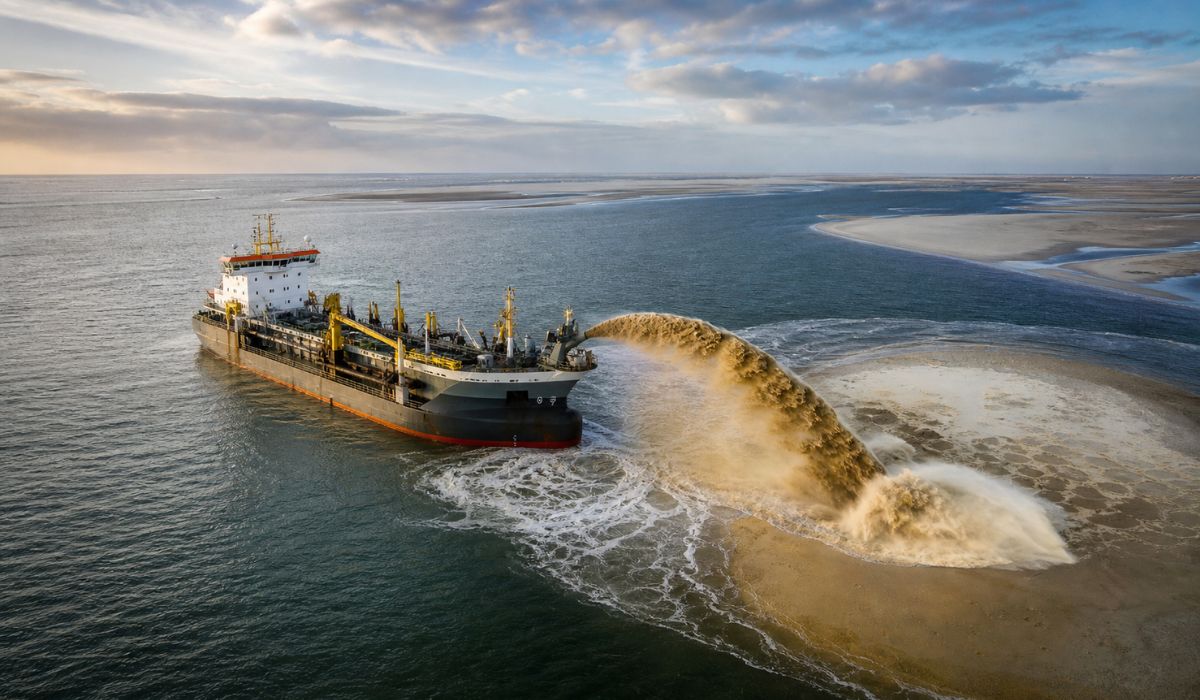


Project in the Netherlands foresees large-scale sand replenishment in the Oosterschelde estuary, an area where sandbanks, mudflats, and tidal zones play a relevant environmental and coastal role.
The Netherlands will reinforce two natural areas of the Oosterschelde estuary with millions of cubic meters of sand to reduce the loss of sandbanks, mudflats, and areas exposed during low tide.
The project will be executed by Boskalis Nederland and will focus on the Galgeplaat and the Slikken van den Dortsman, formations used by birds and seals as feeding and resting areas, according to the company and Rijkswaterstaat, the Dutch agency responsible for water and infrastructure management.
The intervention uses a technique known as sand supplementation, applied to restore sediments in coastal regions affected by erosion and current changes.
-
Pennsylvania Mine Creates Ice in Summer Heat and Melts in Winter, Turning a Mountain Crevice into a Reverse Natural Refrigerator

-
China Accelerates Global Expansion of Robotics: From Smart Vacuums to Industrial and Humanoid Machines, Millions Exported to Over 150 Markets
-
Polar Air Mass to Hit Brazil: Temperatures to Plummet in Nine States, Near Freezing in the South with Frost Risk Until Monday
-
Chinese “dark factories” produce electric cars 24/7 with minimal human intervention, as Zeekr assembles 800 units daily, raising concerns in Brazil.





In the Oosterschelde, the measure seeks to keep these environments above the waterline during part of the tidal cycle, a necessary condition for them to continue performing their ecological function and contributing to the dissipation of wave energy.
According to a technical study published by researchers from Wageningen University & Research, the plan foresees the application of approximately 3 million m³ of sand at different points of the Galgeplaat and the Slikken van den Dortsman.
After the natural settlement of the material, the volume is expected to stabilize at approximately 2.6 million m³, a figure also cited by Boskalis when announcing the contract.
Rijkswaterstaat’s official schedule indicates project completion in 2027.
The Programme for Large Waters, an initiative linked to ecological restoration in Dutch aquatic systems, reported that the work is expected to be carried out in the winter of 2026/2027.
Why the Netherlands will replenish sand in the Oosterschelde estuary
The need to restore sediments is linked to changes caused by the construction of the Oosterscheldekering, a system of dams and storm barriers built to protect part of the Netherlands from floods coming from the North Sea.
After the construction, the tidal currents in the Oosterschelde lost intensity, according to Boskalis.
With less strong currents, sand stopped returning to the banks, mudflats, and salt marshes at the same rate observed before the system change.
During storms, part of the material continues to be carried to deeper channels, which contributes to the gradual reduction of areas exposed at low tide.
This process is described in the Netherlands as “sand hunger”.
The term refers to the estuary’s loss of capacity to naturally replenish the sediments that support intertidal areas.
Over time, sandbanks become lower, remain out of water for less time, and offer less surface availability for species that depend on this type of environment.
In a statement, Boskalis stated that rising sea levels are expected to accelerate this process in the coming years.
The company also stated that, “without intervention, these valuable intertidal areas will eventually disappear below the waterline.”
Galgeplaat and Slikken van den Dortsman host birds and seals
The Galgeplaat and the Slikken van den Dortsman are part of a set of environments that emerge during part of the low tide.
On these surfaces, coastal birds find food in the sediment, while seals use the exposed banks as resting areas, according to Rijkswaterstaat.
The reduction of these formations alters the availability of locations used by fauna.
Therefore, sand replenishment is treated by Dutch authorities as a measure for the conservation of intertidal habitats and also as part of maintaining the natural functioning of the Oosterschelde.
According to Boskalis, the supplementation should help preserve the Galgeplaat and the Slikken van den Dortsman as feeding and resting areas for at least 25 years.
The estimate is linked to the expected behavior of the sediment after application and the role of tides in the gradual redistribution of sand.
In addition to their environmental function, these shallow plains also participate in coastal protection.
Rijkswaterstaat states that by receiving sand, the Galgeplaat and the slikken remain important sites for birds and seals and continue to contribute to wave protection.
How sand replenishment will be done at sea
The sand will be distributed at different points, in a total area estimated at 261 hectares, according to the technical study by Wageningen University & Research.
The document states that Galgeplaat will receive five replenishment sections, while Slikken van den Dortsman will have two.
The material should come from regular waterway maintenance activities and a sand extraction area in Wemeldinge.
This origin was indicated in the project’s technical plan and allows the use of sediments obtained within the coastal region’s own management.
To transport and discharge the sand, a trailing suction hopper dredger will be used, a vessel employed in dredging and coastal replenishment works.
This type of ship collects sediments from the bottom, stores the material in its own compartments, and then transports it to the application site.
Information about the use of the dredger was released by Boskalis.
After being deposited, the sand undergoes natural accommodation.
Tides, waves, and sediment compaction alter the final shape and volume of the replenishment.
For this reason, the technical plan foresees an initial application of about 3 million m³ and a subsequent stabilization around 2.6 million m³.
Coastal engineering attempts to contain sediment loss
Sand replenishment is a coastal engineering solution used to add sediments to environments subject to erosion.
In the case of the Oosterschelde, the measure seeks to compensate for a loss associated with the alteration of currents after the construction of the storm surge barrier.
The choice of this type of intervention is related to the objective of maintaining the physical characteristics of intertidal areas without transforming the site into a rigid structure.
Instead of erecting a fixed barrier over the environment, the project adds sediment so that tidal dynamics redistribute part of the sand over time.
In the Oosterschelde, the intervention also shows an indirect effect of large flood protection works.
The Oosterscheldekering reduced the region’s exposure to storms from the North Sea but changed the flow of sediments in the estuary.
Sand replenishment functions, in this context, as an attempt to correct part of this physical imbalance.
Project monitoring should consider factors such as sediment stability, fauna response, tidal behavior, and erosion rate after application.
These data are relevant to assess whether the measure will maintain the exposed areas for the foreseen period and whether new interventions will be necessary in the future.
The operation in Galgeplaat and Slikken van den Dortsman occurs in a context where low-lying coastal regions monitor the combined effects of protection works, erosion, and sea-level rise.
In the Dutch case, the intervention shows how coastal management depends both on physical barriers and on maintaining natural environments that help reduce wave force.